Weekly Security Bulletin #4: Chrome and Barracuda under active exploitation, critical flaw in Apache httpd
· Security
This issue covers November 8 to 14. We checked the Red Hat CVE database and CVE.org. Exploitation status comes from the CISA KEV catalog, scores from NVD and each vendor’s own record, and exploitation likelihood from FIRST’s EPSS data. We could not reach the GitHub Advisory Database this week and did not use OpenCVE. Vendor pages we could not read are flagged in the text. Issue #3 promised the Microsoft monthly update for the next issue; that section is below.
In short
- Chrome 157.0.8103.50 fixes CVE-2026-125350 (use-after-free in the XML component, CVSS 8.8), which Google says has an exploit in the wild. CISA added it to KEV on November 10 with a November 24 deadline. Chromium browsers such as Edge and Opera are also affected.
- In Barracuda’s Email Security Gateway and other appliances, CVE-2026-116606 and CVE-2026-111560 can be chained to get root. Both entered KEV on November 10, and Barracuda says it has seen exploitation at a small number of organizations.
- OpenSSH 10.6p2 fixes CVE-2026-123158, a password authentication bypass in sshd on Linux systems that use musl libc with PAM disabled (for example Alpine). It entered KEV on November 9, and its EPSS value of 0.19 is the highest this week.
- Apache httpd 2.4.55 through 2.4.70 has a remote code execution flaw in mod_http2 (CVE-2026-119618). Version 2.4.71 fixes it. It is not in KEV, but Red Hat says public research shows a reliable exploit against a default configuration.
- Outlook’s CVE-2026-124194 (spoofing, CVSS 6.5) is exploited according to Microsoft and was fixed in the November 10 update. CISA added 12 flaws to KEV this week in total.
- 12 · New flaws added to KEV · November 9, 10 and 13, versus 3 last week
- 9 · Security fixes in Chrome 157.0.8103.50 · 6 of the 8 listed are high severity
- 426 · New Red Hat CVE records · Nov 8 to 13, 5 of them critical
- 4 · KEV entries scored CVSS 9.8 · GPUStack, FreeSWITCH, IBM Aspera, Barracuda ESG
- 0.19 · EPSS value of the OpenSSH flaw · 97th percentile
The urgent ones
Google Chrome: CVE-2026-125350
Chrome 157.0.8103.50 (.50/.51 on Windows and Mac, .50 on Linux) reached the stable channel on November 9. CVE-2026-125350 is a use-after-free in the XML component: a crafted web page can run code inside the browser’s sandbox. Google says an exploit for it exists in the wild. Chromium rates it “High” and the NVD record carries a CVSS 3.1 score of 8.8. CISA added it to KEV on November 10, with a November 24 deadline for federal agencies. CISA says other Chromium-based browsers such as Edge and Opera may be affected; we did not verify their fixed versions in this run, so check their own update pages. Home users and organizations are both affected. In Chrome, open the About Chrome page from the menu to download the update, then restart the browser.
Barracuda: CVE-2026-116606 and CVE-2026-111560
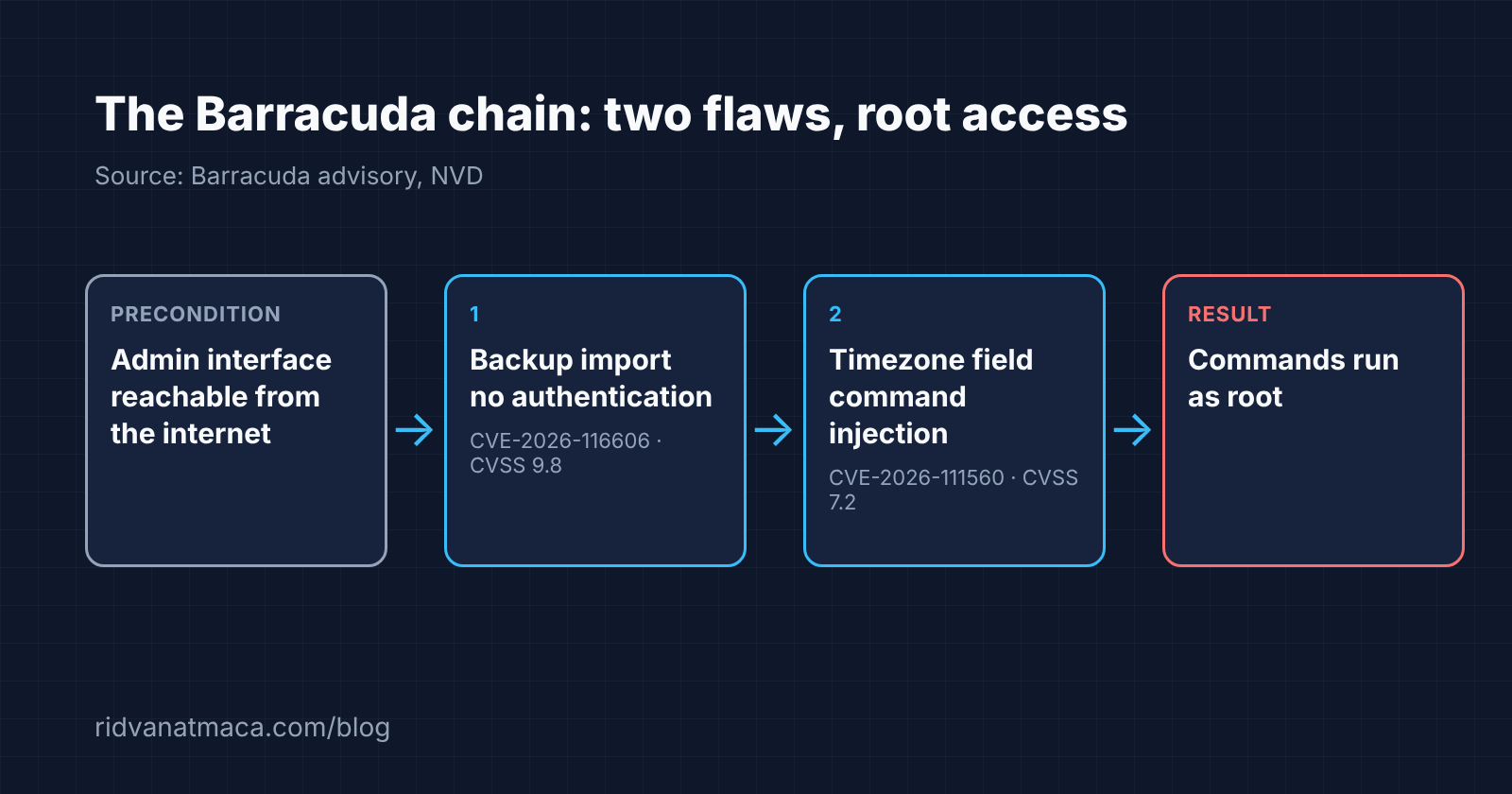
Barracuda disclosed two flaws affecting the Email Security Gateway (ESG), Load Balancer ADC, Message Archiver, WAF Control Center, Web Application Firewall and Web Security Gateway. CVE-2026-116606 affects only the ESG (CVSS 3.1: 9.8): someone who can reach the admin interface, without authenticating, can upload a crafted backup to the configuration import function and change the appliance’s global configuration. In CVE-2026-111560 (CVSS 3.1: 7.2, Mandiant’s 4.0 score 8.6), commands written into the timezone field run as root; that needs administrator access. Chained, the two give an attacker root on the device. On November 9 Barracuda added that it has seen exploitation at a small number of organizations. CISA put both in KEV on November 10, with a November 13 deadline. Patches: BNSF-40425 (9.4.017 and later) and BNSF-40430 (earlier than 9.4.017) for the ESG, BNADC-16586 for ADC and WAF, BNMA-32468 for Message Archiver, BNWF-60060 for WAF Control Center and BNYF-24789 for Web Security Gateway. The NVD record lists ESG versions before 9.4.0.030 as affected. If you cannot patch right away, Barracuda recommends restricting the admin interface to a trusted internal network instead of the internet. Organizations are affected.
OpenSSH sshd: CVE-2026-123158
OpenSSH 10.6p2 was released on November 5. When sshd runs on musl libc with PAM disabled (for example Alpine Linux), any password between 256 and 1024 characters is accepted for some account configurations. The CVE record gives a CVSS 3.1 score of 8.1 (MITRE). CISA added it to KEV on November 9. At 0.19, its EPSS value is the highest of the flaws we checked. The OpenSSH release notes say they consider the root cause to be outside sshd but avoidable on the sshd side. The NVD record lists Alpine versions before 3.21.10, 3.22.8 and 3.23.8 as affected; Alpine’s own advisory page could not be found in this run, so confirm the package version with Alpine. The sources name no workaround. If you do not need password login on an internet-facing sshd, turning it off is a sensible general measure, but that is our suggestion, not the vendor’s. Anyone running Alpine-based servers or containers is affected, including home lab users.
Apache httpd mod_http2: CVE-2026-119618
Apache httpd 2.4.71 came out on November 11 and fixes three flaws, one of them critical. CVE-2026-119618 lets concurrent threads corrupt memory in assign_headers() inside mod_http2, which can lead to remote code execution. Affected: httpd 2.4.55 through 2.4.70 and the GitHub mod_h2 releases 2.0.8 through 2.0.42. NVD gives a CVSS 3.1 score of 8.1 (high attack complexity) and Red Hat gives 9.8. Red Hat also says public research demonstrates a reliable exploit against a server in its default configuration. It is not in KEV and the Apache advisory does not mention exploitation; EPSS is 0.013. According to Red Hat, servers that only serve HTTP/1.1 are not affected, so if h2 and h2c are absent from the Protocols directive there is no exposure. RHEL 8 and earlier are not affected; on RHEL 9 and 10 the severity is “Important”, with fixes in RHSA-2026:98981 (RHEL 9) and RHSA-2026:98978 (RHEL 10). Home users and organizations that run web servers are both affected.
This week’s comparison table
| Flaw | Product | Issue | Score | Exploited | Fix |
|---|---|---|---|---|---|
| CVE-2026-125350 | Google Chrome and Chromium browsers | Use-after-free in XML, code execution | 8.8 (3.1) | yes (KEV, Nov 10) | 157.0.8103.50 |
| CVE-2026-116606 | Barracuda ESG | Change configuration through backup import, no authentication | 9.8 (3.1) | yes (KEV, Nov 10) | 9.4.0.030 (NVD), BNSF-40425 / BNSF-40430 |
| CVE-2026-111560 | Barracuda ESG, ADC, WAF, BMA, WCC, WSG | Command injection in the timezone field, root | 7.2 (3.1) | yes (KEV, Nov 10) | BNSF-40425 / 40430, BNADC-16586, BNMA-32468, BNWF-60060, BNYF-24789 |
| CVE-2026-123158 | OpenSSH sshd (Linux, musl, PAM disabled) | Password authentication bypass | 8.1 (3.1, MITRE) | yes (KEV, Nov 9) | OpenSSH 10.6p2 |
| CVE-2026-102895 | GPUStack | Unauthenticated administrative access | 9.8 (3.1) | yes (KEV, Nov 9) | 2.2.0 |
| CVE-2026-116779 | FreeSWITCH | Run API commands through SIP MESSAGE | 9.8 (3.1) | yes (KEV, Nov 9) | 1.11.3 |
| CVE-2026-123218 | IBM Aspera Faspex 5.0.0 - 5.0.19 | Authorization bypass, full admin access | 9.8 (3.1, IBM) | yes (KEV, Nov 9) | 5.0.19 PL1 |
| CVE-2026-124194 | Microsoft Outlook (Microsoft 365 Apps, Office 2021, 2024) | Spoofing, no warning for an unsafe action | 6.5 (3.1) | yes (KEV, Nov 10) | November 10 update |
| CVE-2026-20320 | Cisco BroadWorks | Read configuration files through XXE | 7.5 (3.1, Cisco) | yes (KEV, Nov 10) | RI.2026.07, no workaround |
| CVE-2026-114713 | UnrealIRCd 6.0.0 - 6.2.7 | Server-to-server command injection via labeled-response | 8.6 (3.1, MITRE) | yes (KEV, Nov 13) | 6.2.7.1 |
| CVE-2026-123039 | Check Point Gaia (Firewall, Security Gateway, Management) | Local root through DynamicCLI | 7.8 (3.1, Check Point) | yes (KEV, Nov 13) | sk1000362 (page unreadable) |
| CVE-2026-111793 | Openwave Webtop Media Transcoder | File type restriction bypass | 4.3 (3.1) | yes (KEV, Nov 10) | 1.1.22.0 (per NVD range) |
| CVE-2026-119618 | Apache httpd 2.4.55 - 2.4.70 | Remote code execution in mod_http2 | 8.1 (NVD), 9.8 (Red Hat) | no (not in KEV) | 2.4.71 |
Score and priority do not always line up. The Openwave flaw scores 4.3 yet is in KEV, while the Apache flaw scores between 8.1 and 9.8 and is not. Being in KEV means exploitation is confirmed; not being there only means CISA has not confirmed it yet. Check Point’s sk1000362 page did not load, so see the vendor page for patch details. The UnrealIRCd flaw applies to networks with at least two linked servers.
Microsoft’s November update
Microsoft published its monthly update on November 10. MSRC’s November document has 1,644 records (including third-party components in Azure Linux), 75 of them marked “Critical”. The only flaw with confirmed exploitation is Outlook’s CVE-2026-124194: Outlook shows no warning for an unsafe action, which allows spoofing over the network. CVSS is 6.5; Microsoft marked exploitation as “Exploitation Detected” and CISA added it to KEV the same day. We found no publicly disclosed flaw that is not yet exploited. Three remote code execution flaws that Microsoft scores 9.8 are rated “exploitation less likely”: Windows Search (CVE-2026-116928), Windows LDAP (CVE-2026-119958) and the Windows Xbox Live Networking Service (CVE-2026-112967). Install the Windows and Office updates through Windows Update and Microsoft 365 Apps.
What happened to flaws from earlier issues?
- Brotli, CVE-2026-111497 (added to KEV in #3): Apple’s November 9 security notes list a Brotli memory corruption fix under this CVE for iOS and iPadOS 27.2.1 and 26.7.3, macOS Golden Gate 27.2.1 and macOS Tahoe 26.7.3. Apple’s notes do not mention exploitation.
- SonicWall SonicOS, CVE-2026-19868 (#3): the CISA deadline is November 20. The NVD record was updated on November 9 and now gives the affected range as earlier than 7.3.4-7015 on Gen7 and earlier than 8.2.2-8015 on Gen8. That does not match the 7.3.4-7013 and 8.2.3-8015 we took from news sources in #3. SonicWall’s SNWLID-2026-0014 advisory did not load in this run either, so confirm the fixed version in the advisory itself.
- WordPress core, CVE-2026-119977 (#3): the WordPress news page shows no security release after 7.1.4, only 7.2 Beta 5 (November 10). We found no fix announcement for older branches. CISA’s federal deadline passed on November 6.
- Ivanti Connect Secure, CVE-2026-111357 (#3, the first flaw in the chain was in #1): the NVD record covers versions before 25.1.1.3. Ivanti’s advisory page failed to load again and we saw no new development.
- Chrome 157 (#3): the build that shipped on November 3 was refreshed this week as 157.0.8103.50. For CVE-2026-125350 in the new build, Google says an exploit exists in the wild.
- Android: the December bulletin (2026-12-01) has not been published yet. The 2026-11-05 patch level from the November bulletin still applies.
The week in numbers
| Records | |
|---|---|
| Critical | 5 |
| Important | 269 |
| Moderate | 119 |
| Low | 33 |
| CVSS | |
|---|---|
| Barracuda ESG (116606) | 9.8 |
| FreeSWITCH (116779) | 9.8 |
| IBM Aspera (123218) | 9.8 |
| GPUStack (102895) | 9.8 |
| Chrome (125350) | 8.8 |
| UnrealIRCd (114713) | 8.6 |
| OpenSSH (123158) | 8.1 |
| Check Point (123039) | 7.8 |
| Cisco BroadWorks (20320) | 7.5 |
| Barracuda (111560) | 7.2 |
| Outlook (124194) | 6.5 |
| Openwave (111793) | 4.3 |
| New entries | |
|---|---|
| W38 | 7 |
| W39 | 12 |
| W40 | 6 |
| W41 | 5 |
| W42 | 9 |
| W43 | 8 |
| W44 | 10 |
| W45 | 3 |
| W46 | 12 |
Patch and deadline calendar
- Nov 5 · OpenSSH 10.6p2 released · Fix for CVE-2026-123158
- Nov 7 · IBM Aspera Faspex 5.0.19 PL1 bulletin · CVE-2026-123218
- Nov 9 · Chrome 157.0.8103.50 and Apple 27.2.1 / 26.7.3 updates released · GPUStack, OpenSSH, FreeSWITCH and IBM Aspera added to KEV, Barracuda added exploitation details
- Nov 10 · Microsoft November update · Chrome, Outlook, Barracuda (2), Cisco BroadWorks and Openwave added to KEV
- Nov 11 · Apache httpd 2.4.71 released · Fix for CVE-2026-119618
- Nov 13 · UnrealIRCd and Check Point added to KEV · Cisco BroadWorks advisory updated
- Nov 16 · KEV deadline: UnrealIRCd and Check Point
- Nov 20 · KEV deadline: SonicWall CVE-2026-19868
- Nov 24 · KEV deadline: Chrome, Outlook, Cisco BroadWorks, Openwave
What to do this week
Priority order
- Update your browsers · Chrome 157.0.8103.50 or later. For Edge and Opera, check their own update pages. Restart the browser after updating.
- Patch Barracuda appliances · The patch IDs above for ESG, ADC, WAF, Message Archiver, WAF Control Center and Web Security Gateway. Take the admin interface off the internet.
- Alpine and musl-based servers · OpenSSH 10.6p2 or Alpine’s fixed package. Confirm the version in Alpine’s advisory.
- Move Apache httpd to 2.4.71 · If you use a distribution package, install the distribution’s security update. If you do not use HTTP/2, removing h2 and h2c from the Protocols directive puts the server in the unaffected group, according to Red Hat.
- Windows and Office · Install the November updates and update Microsoft 365 Apps. The Outlook flaw is exploited.
- Phones and Apple devices · iOS and iPadOS 27.2.1 (26.7.3 on older devices), macOS Golden Gate 27.2.1, Tahoe 26.7.3. On Android, the patch level should be 2026-11-05 or later.
- Server and enterprise products · GPUStack 2.2.0, FreeSWITCH 1.11.3, IBM Aspera Faspex 5.0.19 PL1, Cisco BroadWorks RI.2026.07, UnrealIRCd 6.2.7.1, Openwave Webtop Media Transcoder 1.1.22.0, and sk1000362 for Check Point. Check SonicWall in the advisory, with the note from #3.
- I use a Chromium-based browser. Does the Chrome flaw affect me? · CISA says the flaw may affect Chromium-based browsers such as Edge and Opera. Check your browser’s own release page to see whether it is up to date.
- My Barracuda admin interface is not exposed to the internet. Do I still need the patch? · Barracuda says organizations whose admin interface is not reachable from the internet are less exposed to this attack path. It still recommends running the latest firmware with all patches applied.
- The Apache flaw is not in KEV. Should I hurry? · If HTTP/2 is on, yes. Not being in KEV does not mean it is not exploited, only that CISA has not confirmed it. Red Hat says an exploit against the default configuration has been demonstrated.
- What does EPSS mean? · FIRST’s estimate of the probability that a flaw will be exploited in the next 30 days. 0.19 means roughly 19 percent. The score updates daily.
- When is the next bulletin? · Every week. The status of the flaws in this issue will appear in the next one.
Full list of flaws
The 12 flaws added to KEV this week
- November 9: GPUStack CVE-2026-102895, OpenSSH CVE-2026-123158, FreeSWITCH CVE-2026-116779, IBM Aspera Faspex CVE-2026-123218.
- November 10: Microsoft Outlook CVE-2026-124194, Openwave Webtop Media Transcoder CVE-2026-111793, Cisco BroadWorks CVE-2026-20320, Barracuda CVE-2026-111560 and CVE-2026-116606, Google Chromium CVE-2026-125350.
- November 13: UnrealIRCd CVE-2026-114713, Check Point CVE-2026-123039.
Chrome 157.0.8103.50: the 8 listed fixes
- High: CVE-2026-125345 (WebGL), CVE-2026-125347 (FileSystem), CVE-2026-125343 (Compositing), CVE-2026-125348 (GPU), CVE-2026-125344 (V8), CVE-2026-125350 (XML).
- Medium: CVE-2026-125349 (GPU), CVE-2026-125342 (GPU).
- Google says the update has 9 fixes in total; the list shows 8.
The 5 records Red Hat marked critical (Nov 8 to 13)
- CVE-2026-119618: Apache httpd mod_http2, remote code execution.
- CVE-2026-107360: rubygem-safemode, allow-list bypass through op-assign expressions.
- CVE-2026-110697: Red Hat Quay, SQL LIKE wildcard injection in the robot listing leaks cross-tenant robot tokens.
- CVE-2026-123710: Red Hat Quay, unauthenticated registry signing key takeover through service key rotation.
- CVE-2026-119990: Azure OpenAI Go client, elevation of privilege (CVSS 9.8).
Critical Microsoft November records scoring 9.0 or higher
- CVE-2026-109469: Entra Device Registration, elevation of privilege (10.0).
- CVE-2026-112967: Windows Xbox Live Networking Service, remote code execution (9.8).
- CVE-2026-116928: Windows Search, remote code execution (9.8).
- CVE-2026-119958: Windows LDAP, remote code execution (9.8).
- CVE-2026-119990: Azure OpenAI, elevation of privilege (9.8).
- CVE-2026-119078: Apache Commons Codec, Blake3 key derivation (9.1).
- Four Chromium records (9.6): CVE-2026-121035, CVE-2026-121126, CVE-2026-121156, CVE-2026-126885.
- Microsoft reported no exploitation for any of them; the only record with confirmed exploitation is Outlook CVE-2026-124194.
Apple’s November 9 updates
The iOS and iPadOS 27.2.1 security note lists 9 CVEs across AirPlay, App Intents, Bluetooth, Brotli, CoreUtils and other components. The note does not mention exploitation.
Sources
- Red Hat CVE database
- CVE.org
- NIST National Vulnerability Database (NVD)
- CISA Known Exploited Vulnerabilities Catalog
- FIRST EPSS
- Chrome Releases: Stable Channel Update for Desktop, November 9
- Barracuda: Pre-Authentication Authorization Bypass and Command Injection Vulnerabilities
- OpenSSH release notes, 10.6p2
- Apache HTTP Server 2.4 vulnerabilities
- Red Hat: CVE-2026-119618
- IBM Aspera Faspex security bulletin
- Cisco BroadWorks XXE advisory
- Check Point sk1000362
- Microsoft MSRC: CVE-2026-124194
- Apple: iOS 27.2.1 and iPadOS 27.2.1 security content
- WordPress release announcements
- Android Security Bulletin, November 2026
- NVD record: CVE-2026-19868