Why do we hiccup? Where the “hic” sound actually comes from
· Health
You are in a quiet room, or in the middle of a meeting, and a “hic” escapes without warning. Before you can wonder what happened, a second one follows. Everyone knows hiccups, yet few people can say why the body does this or where the sound actually comes from.
What happens in the body during a hiccup
First the diaphragm, the broad muscle separating the chest from the abdomen, contracts suddenly and without your say. In a normal breath air flows in gently. In a hiccup, roughly 35 milliseconds after the spasm begins, the glottis (the gap between the vocal cords) closes. Incoming air is cut off abruptly, and that is the sound. Wikipedia's overview gives the same order: contraction first, closure after.
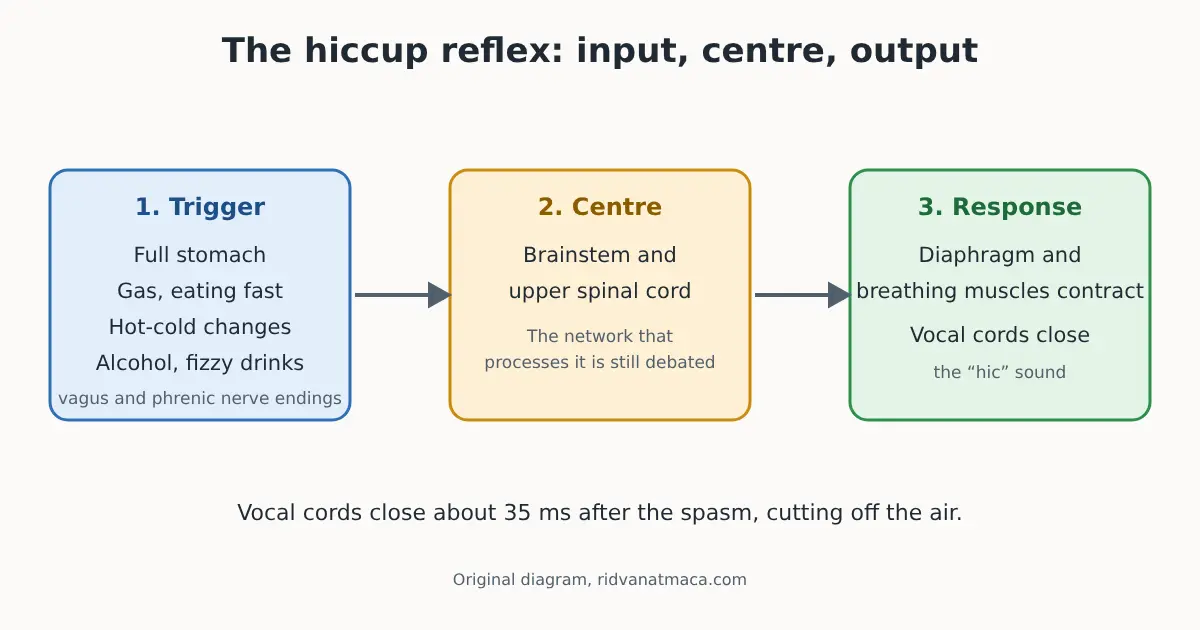
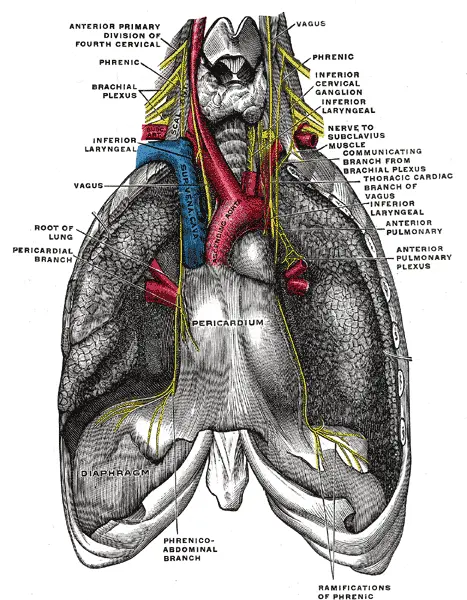
This is a reflex arc, a three-stage circuit that needs no conscious decision. On the input side, the vagus nerve, the phrenic nerve and the sympathetic chain carry news from receptors in the stomach, the oesophagus and the underside of the diaphragm. The brainstem and upper spinal cord process it. On the output side the phrenic nerve contracts the diaphragm, and the recurrent laryngeal nerve, a branch of the vagus, closes the vocal cords. Where exactly the “hiccup centre” sits is still debated.
What sets it off
Commonly listed triggers are a very full stomach, eating fast, fizzy drinks, alcohol, sudden temperature changes and excitement. What they share is that they stimulate the input nerves. They do not work the same way for everyone, and two people eating the same meal may see only one of them start.
Why do we have them? Evolution has no firm answer
Hiccups look useless, and yet they have not disappeared. There are two main explanations, and neither has been properly tested.
- A leftover breathing pattern: In 2003 Straus and colleagues proposed that hiccups are a motor pattern inherited from ancestors that breathed both air and water. Their reasoning: hiccups are suppressed when the carbon dioxide in inhaled air rises, the muscle relaxant baclofen can stop them, and they appear in the womb before the lungs are used for breathing. All three features resemble the gill ventilation of amphibians. The same team adds that the circuit may have been kept because closing the glottis helps an infant swallow milk without it entering the lungs.
- Venting swallowed air: In 2012 Daniel Howes disagreed. He noted that most of the muscles recruited by the hiccup reflex play no part in suckling, and argued that the reflex evolved to clear air from the stomachs of nursing young, making room for more milk.
Both are hypotheses. It is too early to say that one has more evidence than the other.
Cures people swear by
Holding your breath, drinking water, eating sugar, getting scared: every household has a list. As Wikipedia's summary of the literature notes, no particular medical treatment is known to work especially well, because high-quality evidence is missing. Most of these methods work by stimulating the input nerves (through swallowing and drinking) or by changing carbon dioxide levels (through breath-holding), and none has been tested in controlled trials.
The most notable attempt so far was a 2021 research letter in JAMA Network Open. Of 249 people who used a special straw with a forced-suction-and-swallow design, most (about 92%) reported that their hiccups stopped. But this came from an online survey and was self-reported. The authors themselves call for a randomised, blinded trial.
The record
The longest recorded bout, noted by Guinness, belongs to American Charles Osborne: from 1922 to 1990, about 68 years, an estimated 430 million hiccups.
Sources
- Hiccup (Wikipedia): definitions, durations, Charles Osborne record
- Straus et al., “A phylogenetic hypothesis for the origin of hiccough”, BioEssays, 2003
- Howes, “Hiccups: A new explanation for the mysterious reflex”, BioEssays, 2012
- Alvarez et al., JAMA Network Open, 2021: a forced-inspiration suction and swallow tool for hiccups