Weekly Security Bulletin #3: SonicWall MFA bypass, WordPress and Ivanti under active exploitation
· Security
There was no bulletin last week, so this issue covers October 25 to November 7. The sources are the same: the Red Hat CVE database, CVE.org, OpenCVE and the GitHub Advisory Database. Exploitation status comes from CISA KEV, and scores and versions come from the vendor’s own record. Where we could not read a vendor page, the text says so.
In short
- CVE-2026-19868 in SonicWall SonicOS’s SSLVPN service lets someone get around MFA on SAML-protected logins. It was added to KEV on November 6. News reports give the fixed versions as 7.3.4-7013 and 8.2.3-8015, and there is no workaround.
- A flaw in WordPress core (4.7 through 7.1.3) allows unauthenticated code execution during a core upgrade. It joined KEV on November 3. The fix is in 7.1.4.
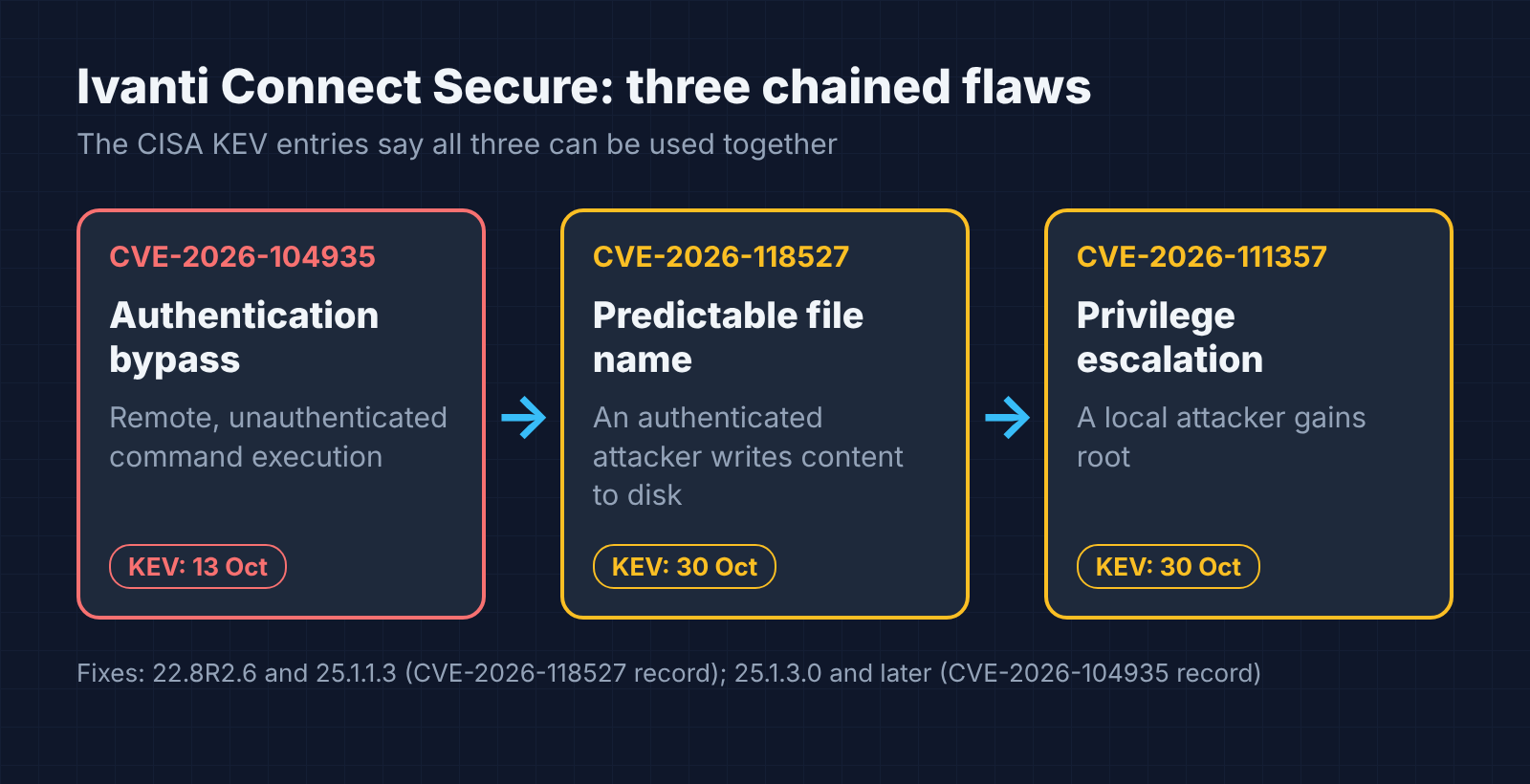
- Two more Ivanti Connect Secure flaws (CVE-2026-118527 and CVE-2026-111357) join the CVE-2026-104935 chain we covered in #1. Both were added to KEV on October 30.
- GitLab’s CVE-2026-97229 (CVSS 10.0) was added to KEV on October 29, and the PHP2Shell flaws on October 26.
- Chrome 157 shipped with 213 security fixes, 7 of them critical. Android’s November bulletin covers fixes up to patch level 2026-11-05.
- 13 · New KEV additions · Oct 26 - Nov 6, 3 in the last 7 days
- 213 · Security fixes in Chrome 157 · 7 critical, 77 high
- 1,471 · New Red Hat CVE records · Oct 25 - Nov 6, 5 rated “critical”
- 2 · New Ivanti KEV entries · Oct 30, two flaws in the chain
- 10.0 · GitLab CVE-2026-97229 score · Added to KEV on Oct 29
The urgent ones
SonicWall SonicOS SSLVPN: CVE-2026-19868
When SSLVPN logins use SAML, someone with valid credentials for a different authentication method can get around the SAML checks, including MFA enforced through SAML. The CVE record lists SonicOS 7.3.3-7015 and earlier on Gen7 and 8.2.2-8015 and earlier on Gen8 as affected. SonicWall published SNWLID-2026-0014 on November 6, CISA added the flaw to KEV the same day, and federal agencies have until November 20. The vendor’s CVE record has no score; CISA-ADP gives 7.5 (CVSS 3.1). We took the fixed versions (7.3.4-7013 and 8.2.3-8015) and the lack of a workaround from news coverage, because SonicWall’s advisory page could not be read for this issue. Confirm them in the advisory before you roll out. Mostly organizations are affected: SonicWall firewalls that use SAML-based SSLVPN for remote access.
WordPress core: CVE-2026-119977
The temporary paths used during a core upgrade are predictable and reachable from the web. An unauthenticated attacker can run code on the server in the short window while the upgrade is in progress (CVSS 3.1: 8.1, per Wordfence). The CVE record lists versions 4.7 through 7.1.3 as affected. WordPress released 7.1.4 on October 28, and sites with background updates enabled get it automatically. The release post gives no CVE number for this flaw and says fixes for older branches are still being backported. CISA added it to KEV on November 3. Home users who host their own site and organizations are both affected; sites that turned off automatic updates should upgrade by hand.
Ivanti Connect Secure: CVE-2026-118527 and CVE-2026-111357
CVE-2026-104935 (authentication bypass), which we covered in #1, did not stay alone. According to CISA’s KEV entries, CVE-2026-118527 (a predictable file name that lets an authenticated attacker write content to disk, CVSS 4.3) and CVE-2026-111357 (privilege escalation to root, CVSS 7.0) can be chained with it, and their KEV listing shows all three are used in real attacks. Both were added to KEV on October 30. The CVE-2026-118527 record gives the fixes as 22.8R2.6 and 25.1.1.3, and 25.1.3.0 and later for CVE-2026-104935. Ivanti’s advisory page did not load for this issue, so the fixed version for CVE-2026-111357 comes only from news reports (the same two builds). CISA warns that Ivanti’s Integrity Checker may not show CVE-2026-104935 exploitation because the commands run in memory. Organizations are affected.
Other flaws added to KEV
| Flaw | Product | Issue | Score | Exploited | Fix |
|---|---|---|---|---|---|
| CVE-2026-19868 | SonicWall SonicOS SSLVPN | Bypass of SAML and MFA checks | 7.5 (3.1, CISA-ADP) | yes (KEV, Nov 6) | 7.3.4-7013 / 8.2.3-8015 (news reports) |
| CVE-2026-119977 | WordPress core 4.7-7.1.3 | Unauthenticated code execution during upgrade | 8.1 (3.1) | yes (KEV, Nov 3) | 7.1.4 |
| CVE-2024-27834 | Apple systems using Safari and WebKit | Pointer Authentication bypass | 5.5 (3.1, CISA-ADP) | yes (KEV, Nov 4) | Safari 17.5 and matching releases (May 2024) |
| CVE-2026-118527 | Ivanti Connect Secure | File write through a predictable file name | 4.3 (3.1) | yes (KEV, Oct 30) | 22.8R2.6 / 25.1.1.3 |
| CVE-2026-111357 | Ivanti Connect Secure | Privilege escalation to root | 7.0 (3.1) | yes (KEV, Oct 30) | 22.8R2.6 / 25.1.1.3 (news reports) |
| CVE-2026-97229 | GitLab CE/EE 19.2-19.4 | Unauthenticated code execution through a CI/CD regex | 10.0 (3.1) | yes (KEV, Oct 29) | 19.4.2 / 19.3.5 / 19.2.8 |
| CVE-2026-76418 | Cisco ASA and FTD | Denial of service that reloads the device through SSL VPN | 8.6 (3.1) | yes (KEV, Oct 29) | Versions in Cisco’s advisory |
| CVE-2026-109618 / -109619 | PHP | Code execution through memory corruption and stale request state | 9.2 (4.0) | yes (KEV, Oct 26) | 8.2.35 / 8.3.36 / 8.4.27 / 8.5.12 |
| CVE-2026-111497 | Google Brotli 1.0.3-1.2.0 | Buffer overflow in the decoder | 9.2 (4.0) | yes (KEV, Oct 27) | 1.0.10 / 1.1.1 / 1.2.1 |
| CVE-2026-48356 | Adobe Commerce and Magento | Upload of a dangerous file type | 9.3 (3.1) | yes (KEV, Oct 27) | July 2026 patches |
| CVE-2026-41709 | VMware ESX | Admin actions are not logged | 2.7 (3.1) | yes (KEV, Oct 28) | Broadcom advisory |
| CVE-2026-46300 | Linux kernel | Shared-fragment marker lost when coalescing | 7.8 (3.1) | yes (KEV, Oct 28) | kernel patch |
Two entries in the table do not match their scores. The VMware ESX flaw scores 2.7 and only lets someone with admin rights skip the audit trail, yet it is in KEV, so it is used in real attacks. Apple’s CVE-2024-27834 is also from 2024: Apple’s Safari 17.5 page lists it as fixed in May 2024 and does not mention exploitation. The KEV entry comes from CISA. If you run current releases such as iOS 27.2, iOS 26.7.2 or macOS Tahoe 26.7.2, you need to do nothing more.
- Oct 12 · GitLab 19.4.2, 19.3.5 and 19.2.8 released · Fix for CVE-2026-97229
- Oct 26 · Apple iOS 27.2, iOS 26.7.2, iOS 18.7.11 and macOS updates · Date from Apple’s release list
- Oct 28 · WordPress 7.1.4 released · Fix for the upgrade flaw
- Oct 29 · GitLab and Cisco ASA/FTD flaws added to KEV
- Oct 30 · Two Ivanti flaws added to KEV
- Nov 2 · Android November bulletin published · Updated to version 1.1 on Nov 6
- Nov 3 · Chrome 157 reaches the stable channel · WordPress flaw added to KEV
- Nov 6 · SonicWall SNWLID-2026-0014 and KEV entry · Due date Nov 20
What happened to flaws from earlier issues?
| Flaw | First covered in | Status this week | |
|---|---|---|---|
| Ivanti Connect Secure CVE-2026-104935 | Weekly Security Bulletin #1 | Two new flaws (CVE-2026-118527, CVE-2026-111357) were added to KEV on Oct 30 and are used in the same chain. If you suspect a compromise, CISA recommends a factory reset, an upgrade to the latest version, and new passwords, certificates and API keys | |
| PHP2Shell CVE-2026-109618 / -109619 | Weekly Security Bulletin #2 | Added to KEV on Oct 26 (federal due date Oct 29). Fixes are 8.2.35, 8.3.36, 8.4.27 and 8.5.12 | 8.1 and older are unsupported |
Chrome, Android and Apple
Chrome 157 reached the stable channel on November 3: 157.0.8103.38 on Linux and 157.0.8103.38/.39 on Windows and Mac. Google lists 213 security fixes, seven of them critical (in Dawn, ANGLE, WebGL, Prerender, Geometry and Core). The release post does not mention exploitation. The update takes effect once you restart the browser. Android’s November bulletin came out on November 2 and covers patch levels 2026-11-01 and 2026-11-05; its highest severity is critical and it supports Android 14 to 17. The bulletin does not report any exploited flaw. Check your phone’s patch level in Settings: 2026-11-05 or later closes every listed issue. Microsoft’s monthly update is expected on Tuesday, November 10, and we will cover it next issue.
The week in numbers
| Records | |
|---|---|
| Critical | 5 |
| Important | 570 |
| Moderate | 732 |
| Low | 164 |
| Entries | |
|---|---|
| PHP Group | 2 |
| Ivanti | 2 |
| Adobe | 1 |
| 1 | |
| Broadcom | 1 |
| Linux | 1 |
| GitLab | 1 |
| Cisco | 1 |
| WordPress | 1 |
| Apple | 1 |
| SonicWall | 1 |
| Added | |
|---|---|
| W36 | 10 |
| W37 | 14 |
| W38 | 7 |
| W39 | 12 |
| W40 | 6 |
| W41 | 5 |
| W42 | 9 |
| W43 | 8 |
| W44 | 10 |
| W45 | 3 |
What to do this week
Order of priority
- Check SonicWall · If you use SAML for SSLVPN, move SonicOS to 7.3.4-7013 (Gen7) or 8.2.3-8015 (Gen8). Confirm the versions in SonicWall’s SNWLID-2026-0014 advisory.
- Bring WordPress to 7.1.4 · Upgrade by hand if you turned off automatic updates. If you are on an older branch, check for the security release for your branch.
- Update Ivanti Connect Secure · 22.8R2.6, 25.1.1.3 or newer. If you suspect a compromise, follow the recovery steps CISA recommends. The 22.8 branch reaches end of life on January 31, 2027.
- Check GitLab · You need 19.4.2, 19.3.5 or 19.2.8 and later. Ruby applications that compile a regex from user input need Ruby 4.0.9, 3.4.12 or 3.3.13.
- PHP, Brotli and Adobe Commerce · PHP 8.2.35, 8.3.36, 8.4.27 or 8.5.12; Brotli 1.0.10, 1.1.1 or 1.2.1; the July 2026 patches for Adobe Commerce.
- Update browsers and phones · Chrome 157.0.8103.38 or later, Android patch level 2026-11-05, and on Apple devices iOS 27.2 / 26.7.2 / 18.7.11 and macOS 26.7.2. Then restart the browser.
- Cisco ASA/FTD and VMware ESX · Confirm the fixed versions in the Cisco and Broadcom advisories.
- What does being in KEV mean? · CISA has confirmed the flaw is used in real attacks. Federal agencies usually get between three days and two weeks to patch.
- Why is a flaw scored 2.7 in KEV? · A CVSS score rates technical severity. KEV asks whether attackers use the flaw. A low-scoring flaw is still useful to an attacker if it, say, hides their tracks.
- I do not use SAML. Does the SonicWall flaw affect me? · The CVE record and news reports say it affects setups where SSLVPN logins use SAML. If you are on a version older than 7.3.4-7013 / 8.2.3-8015, updating is still the right call.
- Did my WordPress site update itself? · If background updates are on, it should already be on 7.1.4. Check the version on the Updates screen or in the About window.
- When is the next bulletin? · Every week. The status of this issue’s flaws will appear in the next issue.
Full list of flaws
The 13 flaws added to KEV in these two weeks
- Oct 26: PHP CVE-2026-109618 and CVE-2026-109619.
- Oct 27: Adobe Commerce and Magento CVE-2026-48356; Google Brotli CVE-2026-111497.
- Oct 28: VMware ESX CVE-2026-41709; Linux kernel CVE-2026-46300.
- Oct 29: GitLab CVE-2026-97229; Cisco Secure Firewall ASA and FTD CVE-2026-76418.
- Oct 30: Ivanti Connect Secure CVE-2026-118527 and CVE-2026-111357.
- Nov 3: WordPress core CVE-2026-119977.
- Nov 4: Apple CVE-2024-27834.
- Nov 6: SonicWall SonicOS SSLVPN CVE-2026-19868.
Notable records Red Hat rates “critical”
- CVE-2026-115731 / -115732 (Puppet Server and OpenVox): A client with a CA-signed certificate can run code on Puppet Server (9.4), and a name-matching flaw lets it impersonate another node (9.0). Puppet Enterprise 2023.8.13, 2025.12.1 and 2026.0.1 are fixed. Red Hat scores it 9.9 and calls it “critical”. Not in KEV.
- CVE-2026-116692 (MLflow 3.12.0rc0 up to 3.17.0): Code execution on an unauthenticated MLflow server through third-party scorer deserialization (9.8). Fixed in 3.17.0.
- CVE-2026-123061 (LiteLLM Enterprise proxy): An unauthenticated file read can leak the master key (9.8, Red Hat). Only proxies with an Enterprise license are affected. We could not confirm the fixed version for this issue.
Critical flaws in Chrome 157
- CVE-2026-121156 (Dawn, buffer overflow)
- CVE-2026-121229 (ANGLE, memory corruption)
- CVE-2026-121246 (WebGL, use after free)
- CVE-2026-121035 (Prerender, use after free)
- CVE-2026-121247 (Dawn, buffer overflow)
- CVE-2026-121203 (Geometry, use after free)
- CVE-2026-121126 (Core, use after free)
Remote code execution flaws marked critical in the Android November bulletin
- CVE-2026-58868 (Framework)
- CVE-2026-58876 (System)
- CVE-2026-58936 (System)
Critical advisories published on the GitHub Advisory Database on Nov 5-6
- LXD (github.com/canonical/lxd): project restriction bypass and file write or command execution through malicious images, six advisories (GHSA-47w9-6r3f-938g, GHSA-pjff-c2wc-f6jm, GHSA-fmc8-p6q7-75cc, GHSA-vghh-5rfx-xhq8, GHSA-jpf8-86f3-wp38, GHSA-9j25-mm2h-2f76).
- kaniko (CVE-2026-105769, GHSA-5q7h-w9jf-cx97): can send an Azure access token to lookalike ACR registry hosts.
Sources
- Red Hat CVE database
- CVE.org
- OpenCVE
- GitHub Advisory Database
- CISA Known Exploited Vulnerabilities Catalog
- SonicWall SNWLID-2026-0014
- WordPress 7.1.4 release announcement
- Ivanti Connect Secure security advisory
- CISA: Ivanti Connect Secure alert
- GitLab 19.4.2 patch release
- Ruby: regexp fixes for GitLab CVEs
- CISA: PHP vulnerabilities
- Cisco ASA and FTD advisory
- Chrome Releases: Stable Channel Update, Nov 3
- Android Security Bulletin, November 2026
- Apple: Safari 17.5 security content