Why isn't Nepal's flag rectangular? A shape described step by step in the constitution
· Countries
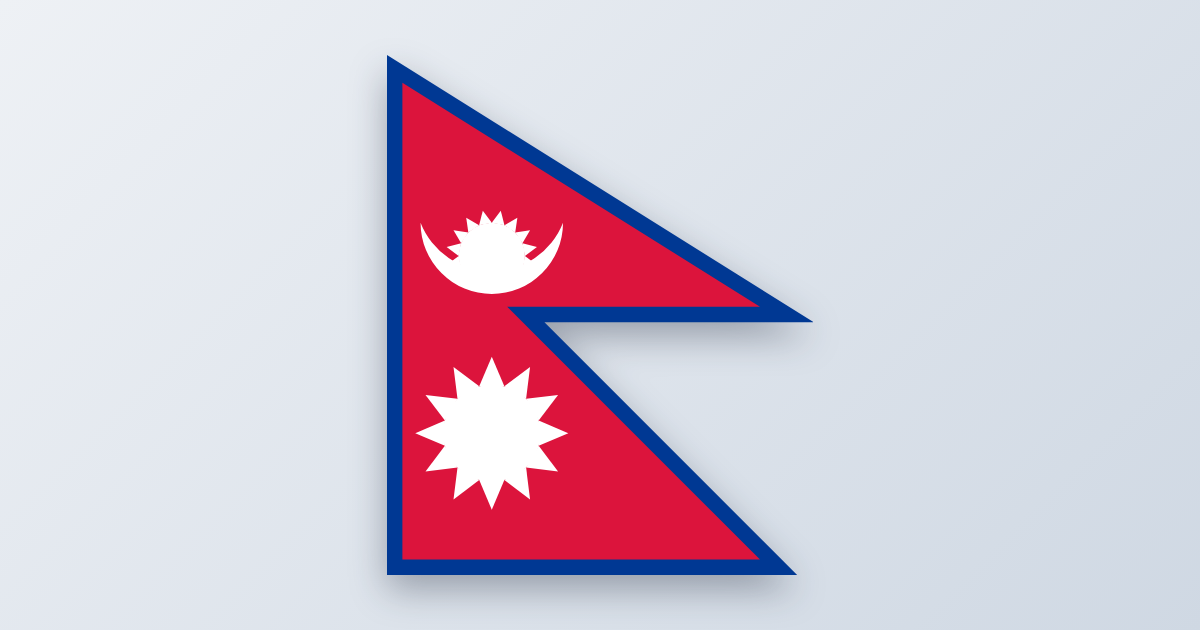
Line up the national flags of the world and one of them stands out at once. Every other flag is a rectangle or something close to a square. Nepal's flag is two triangles stacked on top of each other. How that shape came about, and how it was fixed in law, is less a story about cloth than about history and geometry.
Two pennants joined
Flags of the World, the reference site flag enthusiasts rely on, reports that the flag descends from two separate pennants. According to that account they belonged to rival branches of the Rana family, who once ran the country. The moon above was linked to the royal house, the sun below to the Rana branch whose members were prime ministers until 1961. The account is relayed from a reference book, so I read it as a widely repeated explanation, not as settled fact. [2]
An older depiction appears in a 1928 book: a crimson flag with a green border, where the moon and sun were drawn with human faces. The plainer design used today was adopted in December 1962 with the new constitutional government, and the faces were dropped at that point. [2]
The moon, the sun and the colours
The explanation repeated most often is that Nepal should last as long as the sun and the moon stay in the sky. Eight of the moon's sixteen rays are visible, and the sun has twelve. The two triangles are also said to stand for the Himalayas, or for Hinduism and Buddhism. That reading is attributed to a 1963 publication of the Department of Publicity and appears as a quotation on the flag site. The constitution itself gives no meaning. It only describes shape and colours. [2][3]
The colour has its own status too. The 1990 constitution names crimson as the national colour and the rhododendron (Rhododendron arboreum) as the national flower. [3]

A geometry problem written into the constitution
The oddest thing about this flag is that its shape is explained step by step in a legal text. The flag schedule of Nepal's constitution (Article 5 in the 1990 text, Article 8 and Schedule 1 in the 2015 text) has twenty-four steps. It reads like instructions for a ruler and compass: first draw line AB along the bottom of a crimson cloth, then extend the perpendicular AC by a third of AB, and after that fix the centres, radii and ray counts of the moon and sun. [1][3]
- AC = AB + AB/3, so without the border the height is 4/3 of the width.
- BE = AB is marked off along BD, which keeps the lower triangle's edge up to the notch at a 45 degree slope.
- The border is as wide as the length TN found while constructing the moon. It is deep blue and the same thickness on every side.
- If the flag is to be flown on a rope the border stays as is; for a pole, the border on the pole side can be widened as needed.
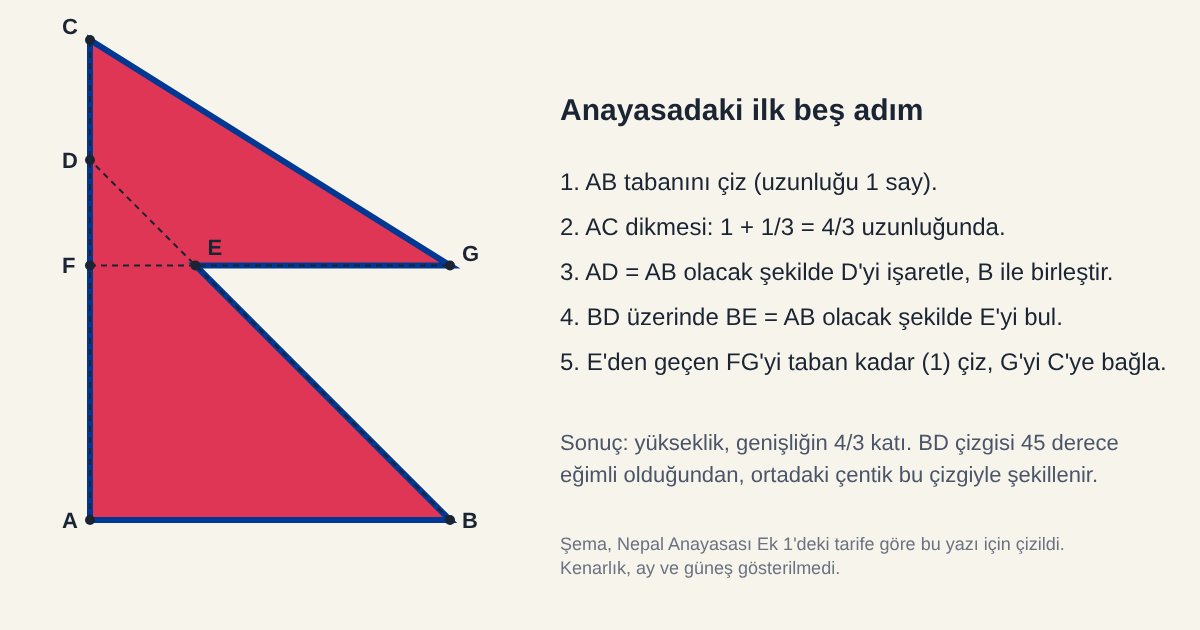
When I worked through the first five steps myself, the notch (points E and F) came out at about 0.71 of the base length. This also explains why the two points are not equal: Flags of the World notes that once the border is added, the upper point looks longer because its angle is narrower. A flag hung vertically is simply the horizontal version turned 90 degrees clockwise. [2]
Why are the others rectangles?
One answer on Flags of the World suggests asking the question the other way round. The national flag as we know it grew largely out of ship flags in Europe and the Mediterranean, and for practical reasons those settled on rectangles between 1.5:1 and 2:1. Countries outside Europe defined their national flags later, and most adopted that mould. Nepal kept its two-pennant structure. Another contributor points out that triangular flags (dhvaja) still fly from temple masts in India. [2]
These are forum comments from knowledgeable contributors, not proven history. Still, I find it a satisfying explanation: Nepal's flag looks less like an exception to a rule and more like a tradition that survived from before the rule existed.
In short: why isn't the flag of Nepal rectangular?
It was formed by stacking two separate pennants, and in its current plain form it was adopted in December 1962. Its shape and proportions are set by a 24-step geometric description in the constitution. Unlike other countries, which moved to rectangles through ship flags, Nepal kept the older pennant tradition. [1][2][3]
Sources
- Constitution of the Kingdom of Nepal (1990), Schedule 1: National Flag. Comparing Constitutions / ICL, University of Bern (accessed: 2026-11-03)
- Flags of the World: Nepal (accessed: 2026-11-03)
- Flags of the World: Nepali Flag Law and Construction Details (including the 2015 constitution, Article 8 and Schedule 1) (accessed: 2026-11-03)
Cover image: Flag of Nepal.svg, Wikimedia Commons · Public domain.