Why does soil smell after rain? The bacteria behind petrichor
· Science
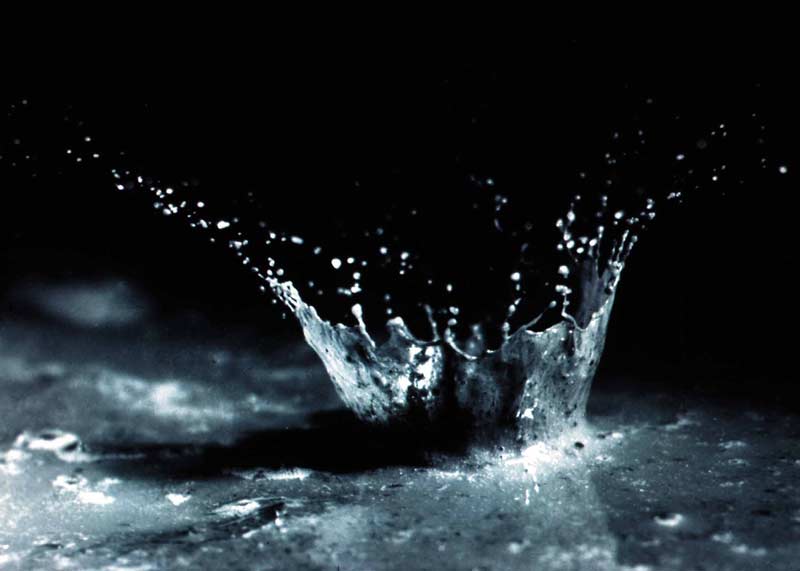
When the first drops hit dry, cracked ground, most of us do the same thing: stop and take a deep breath. The smell is so familiar that it even has its own name, petrichor. So where does it come from, and why are our noses so sensitive to it?
The oil called “blood of the stone”
In March 1964, Isabel Joy Bear and Richard Thomas of Australia's CSIRO published a paper in Nature. They steam-distilled rocks and clay-rich soil that had been exposed to warm, dry weather, and got a yellowish oil. They named the oil that carries the smell “petrichor”, from the Greek petra (stone) and ichor, the fluid that ran in the veins of the gods in Greek mythology. Roughly, “blood of the stone”. Moisture pushes the oil out of pores in rock and soil, and rain spreads the smell around. [1][2]
Before that, the scientific name for the smell was “argillaceous odour”, meaning clay odour. I think the new name stuck far better than the old one. [6]
The bacteria make the real smell
Today the main component of the smell is considered to be geosmin. The name roughly means “earth smell” in Greek, and the molecule is made by Streptomyces bacteria living in soil. Streptomyces is a very common genus of soil bacteria, also known for producing antibiotics. [6]
A 2020 study in Nature Microbiology showed what the smell does for the bacteria. Geosmin genes are present in nearly all Streptomyces species, and genes for a similar odorant, 2-methylisoborneol (2-MIB), in about half of them. The smell is released when a colony starts forming spores. Springtails, tiny soil animals, move toward it, feed on the colony and carry the spores away, both in their droppings and stuck to their bodies. [5]
So what we call the “nice smell of earth” is a signal a bacterium sends out to spread itself. Knowing that doesn't spoil the smell for me. If anything, it makes it more interesting.
How does the smell reach the air?
As long as the smelly molecules stay in the soil, we notice nothing. They have to get into the air. Young Soo Joung and Cullen Buie at MIT watched this with high-speed cameras. In about 600 experiments they dropped water on 28 different surfaces, 12 engineered materials and 16 soils. When a drop hits a porous surface, small air bubbles get trapped at the contact point, rise through the drop and burst, throwing microscopic droplets (aerosols) into the air. [3][4]
Interestingly, light and moderate rain produced more aerosols than a downpour. In a heavy shower the drop hits so fast that the bubbles have no time to form. Buie suggests this could explain why the smell is stronger after light rain. That is a hypothesis, though. The experiments did not measure whether the aerosols actually carried odorant compounds; they only showed that they carried a dye. [3]
- Streptomyces colonies make geosmin while forming spores.
- Moisture and rain release smelly compounds from soil and rock.
- When a drop hits the ground, trapped bubbles burst and aerosols enter the air.
- The wind brings those aerosols to our noses.

Why is our nose so sensitive?
The human nose can detect geosmin at concentrations below one part per billion. A 1992 study, as reported by Wikipedia, puts the threshold at 0.4 parts per billion. For scale: about one gram in an Olympic swimming pool (roughly 2.5 million litres) would be a dilution at that threshold. [6]
I haven't seen a clear source explaining why we are this sensitive. A commonly voiced guess is that it helped us because it signals water and fertile soil, but that is not an established fact. I read it as a comment rather than a finding: we probably like the smell of rain because, for a very long time, rain has been good news.
In short: why does rain smell?
The main component is geosmin, made by Streptomyces bacteria in soil. Moisture and rain release it, and aerosols formed where drops hit the ground carry it into the air. Our noses are so sensitive to geosmin that a very small amount is enough. [1][3][5]
Sources
- Bear, I. J. & Thomas, R. G. (1964). Nature of argillaceous odour. Nature 201, 993–995 (accessed: 2026-10-30)
- CSIRO. The smell of rain: how our scientists invented a new word (accessed: 2026-10-30)
- MIT News. How raindrops can release aerosols (2015) (accessed: 2026-10-30)
- Joung, Y. S. & Buie, C. R. (2015). Aerosol generation by raindrop impact on soil. Nature Communications 6, 6083 (accessed: 2026-10-30)
- Becher, P. G. et al. (2020). Developmentally regulated volatiles geosmin and 2-methylisoborneol attract a soil arthropod to Streptomyces bacteria promoting spore dispersal. Nature Microbiology 5, 821–829 (accessed: 2026-10-30)
- Wikipedia. Petrichor (accessed: 2026-10-30)
Cover image: United States Department of Agriculture · Public domain.
