Weekly Security Bulletin #1: 37 Chromium flaws and Ivanti under active exploitation
· Security
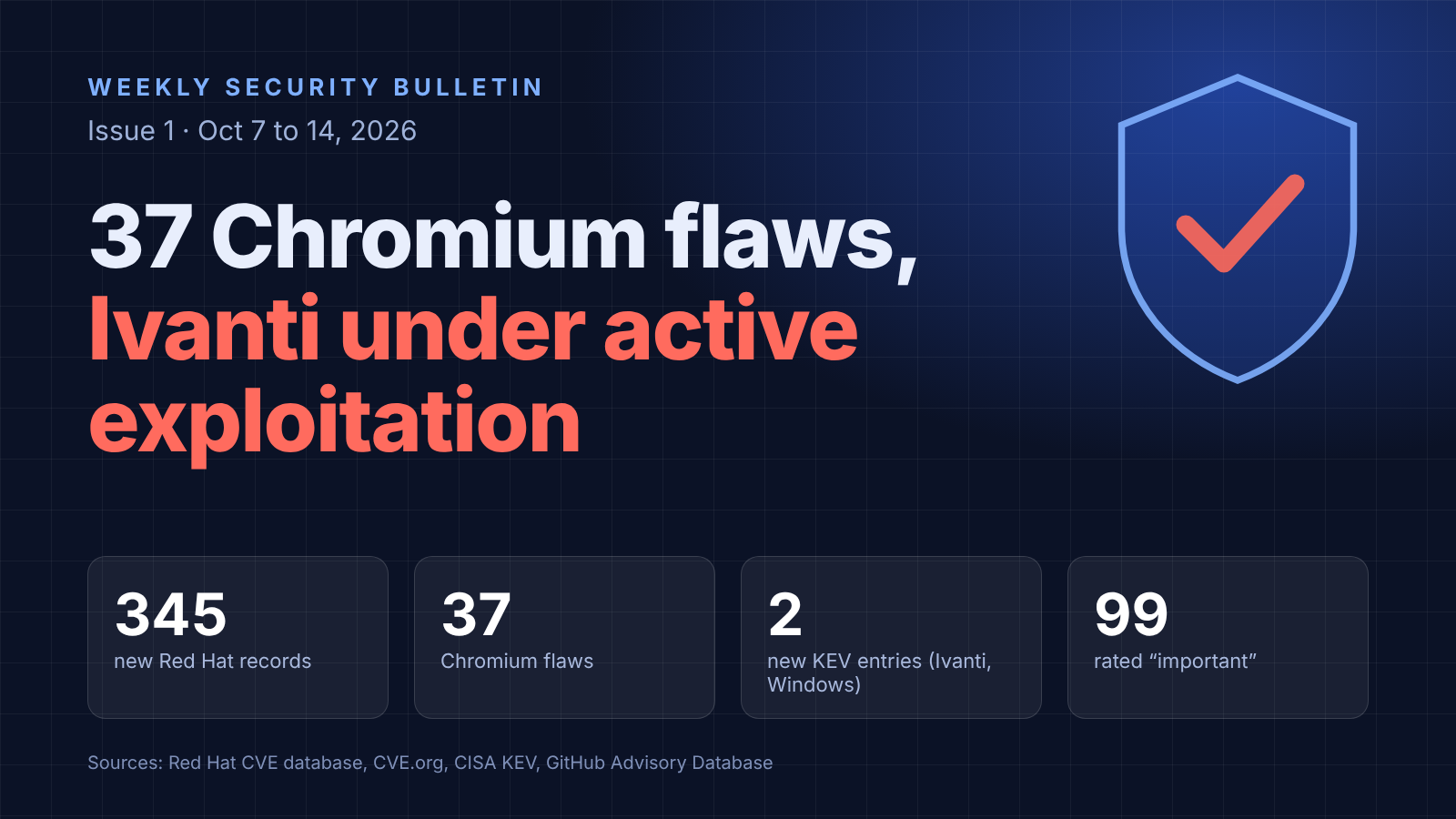
The Weekly Security Bulletin scans four sources each week: the Red Hat CVE database, CVE.org, OpenCVE and the GitHub Advisory Database. Whether a flaw is really being exploited comes from the CISA KEV list.
In short
stats
Urgent items first
Ivanti Connect Secure: CVE-2026-104935
Windows Shell: CVE-2026-96951
compare
“No data” means the sources hold no exploitation record. It is not proof that nothing is happening. The CVSS scores come from the issuing CNA (Ivanti, Microsoft, Inductive Automation) or from Red Hat, and the two can differ.
The week in numbers
| Records | |
|---|---|
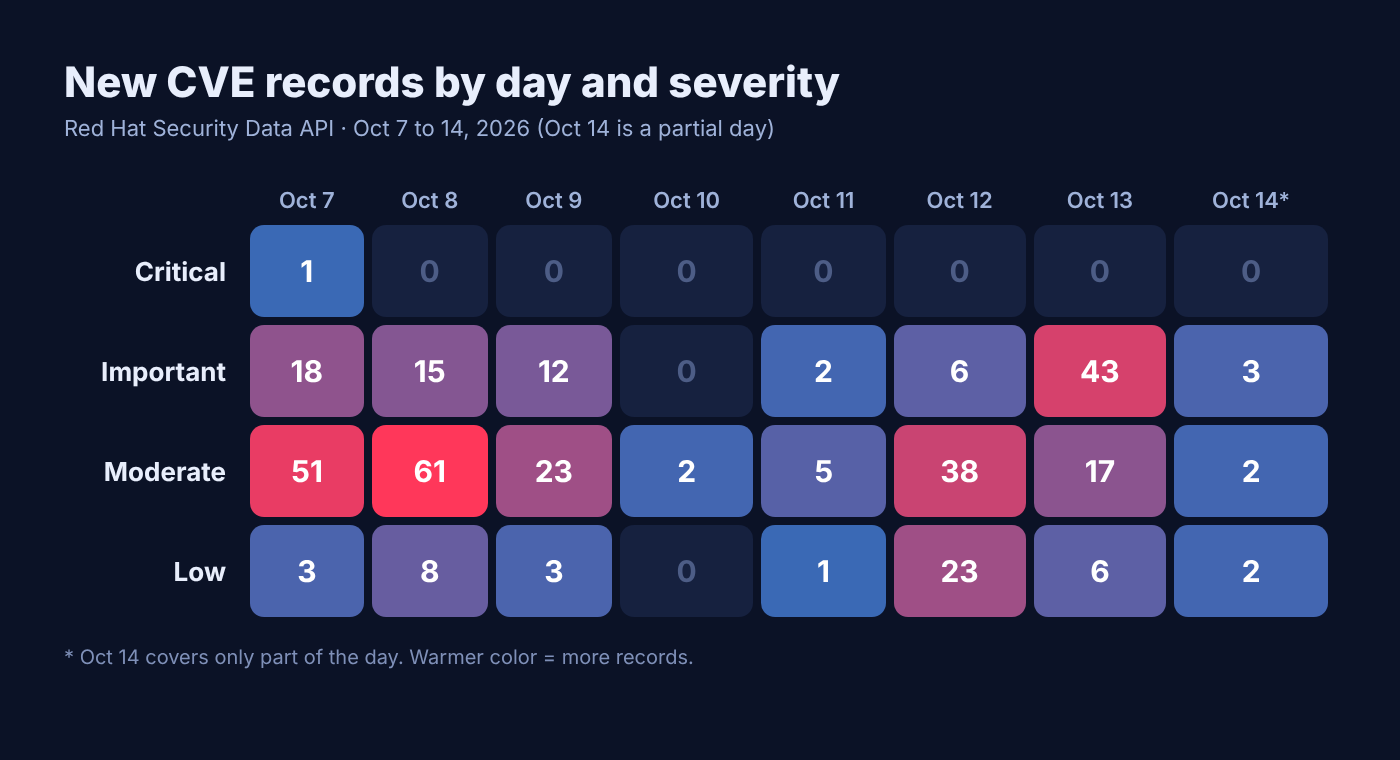
| Critical | 1 |
| Important | 99 |
| Moderate | 199 |
| Low | 46 |
| Records | |
|---|---|
| Oct 7 | 73 |
| Oct 8 | 84 |
| Oct 9 | 38 |
| Oct 10 | 2 |
| Oct 11 | 8 |
| Oct 12 | 67 |
| Oct 13 | 66 |
| Oct 14 | 7 |
| Records | |
|---|---|
| ImageMagick | 60 |
| Chromium | 37 |
| FreeRDP | 18 |
| kernel | 13 |
| xorg-x11-server | 11 |
| pydantic-ai | 10 |
| ffmpeg | 9 |
| MariaDB | 8 |
| busybox | 7 |
Which areas do the records fall into?
How do the records split by severity?
Most common weakness types (CWE)
Chrome and Chromium
On Oct 13 Red Hat published 37 Chromium records in a single day. Seven are scored 9.6, and most are use-after-free (CWE-416). The first CVE.org record (CVE-2026-110148) says the SVG flaw affects Chrome before 155.0.8059.79 and that Chromium rates it “Critical”. An attacker can run code inside the sandbox through a crafted HTML page. No exploitation record exists.
Update Chrome
GitHub Advisory Database: a .NET week
All 25 records on the first page of GitHub’s reviewed advisories are NuGet packages dated Oct 13. Most are .NET and ASP.NET Core entries that Microsoft released on its monthly update day. Two are rated critical:
- CVE-2026-88092 (GHSA-rv87-ccxw-8ggf): HTTP request/response smuggling in ASP.NET Core, with tampering impact. CVSS 9.4. The 10.0 line is affected before 10.0.13 and the 11.0 line before 11.0.0-rc.2.
- CVE-2026-70188 (GHSA-fpq8-4vhr-rcxx): Same class of bug, leading to a security-feature bypass. CVSS 9.1; same affected versions.
In Microsoft’s own scoring, neither has proven exploit code yet. If you run ASP.NET Core behind a reverse proxy, this class of bug matters most, because the exploit relies on the proxy and the app reading the same request differently.
Other notable items
Libraries and application servers
- async-http-client (CVE-2026-107282): Red Hat’s only “critical” record this week. On a cross-host replay, the original request’s Host header and Authorization credentials can go to the new target. CVSS 4.0: 9.4 (Red Hat’s CVSS 3 score is 6.5). Fixed in 3.0.13 and 2.16.1.
- Quarkus REST Data Panache (CVE-2026-87744): If an operation is customized with
@MethodPropertieswithout re-declaring roles, the generated code silently drops the class-level security requirement and the endpoint is left open without authentication. Red Hat: Important, 9.1. - Ignition (CVE-2026-92817): Industrial control software. A user with a Vision session can use the session ID to gain Designer privileges and run code in the Gateway process. CVSS 8.8. Fixed in 8.1.55 and 8.3.9. CISA published it as ICSA-26-286-01.
- pydantic-ai (10 records): One example is unauthorized tool execution because Content-Type validation is missing, 7.6.
- Trilium Notes (CVE-2026-77438): 7.5 on OpenCVE. The public share search can leak titles, paths and content of password-protected notes without authentication. Versions up to and including 0.103.0 are affected; the record names no fixed version.
Linux distributions and desktop components
- kernel (13 records): Most are scored 7.0. Use-after-free and out-of-bounds read fixes in bpf, netfilter, tcp, vlan, sched and mm.
- xorg-x11-server (11 records): The highest is 7.8, a use-after-free in passive grab handling that allows code execution.
- ImageMagick (60 records): The busiest package of the week. The highest score is 7.0, code execution through a crafted PICT file. Most are moderate or low.
- FreeRDP (18 records): One is “important”, the rest moderate and low. Example: a double-free in NSCodec causing denial of service, 5.9.
Old flaws added to CISA KEV (Oct 8)
- ISC BIND: CVE-2015-5477
- Apache Struts: CVE-2016-3081
- Strapi: CVE-2023-22894
- ONLYOFFICE Docs Server: CVE-2021-3199
- ProFTPD: CVE-2015-3306
All five were published years ago and entered the list on Oct 8. That means an old flaw still works against unpatched, internet-facing systems. The due date was Oct 11.
| Added flaws | |
|---|---|
| May | 21 |
| June | 23 |
| July | 26 |
| Aug | 31 |
| Sept | 43 |
| Oct* | 11 |
What to do this week
Priority order
How to read the sources
Method and limits
- Period: Oct 7, 2026 to Oct 14, 2026. Oct 14 is a partial day.
- Red Hat counts come from the Red Hat Security Data API
after=2026-10-07query, using each record’spublic_date. - The treemap grouping and shortened package names are specific to this post.
- Fixed versions come from the vendor’s CVE.org record. Where there is none, the table says “follow the record”.
- This post is not a security audit and does not replace checking your own environment.
faq
CISA Known Exploited Vulnerabilities Catalog
button
features