Why does China have only one time zone? Solar noon in Kashgar is nearly 3 pm
· Countries
Cross China from end to end and you never have to touch your watch. The country is roughly five time zones wide, yet its official time is one: UTC+8, or “Beijing time”. Why was it set up that way, and how do people in the far west fit their days around it?
From five zones to one
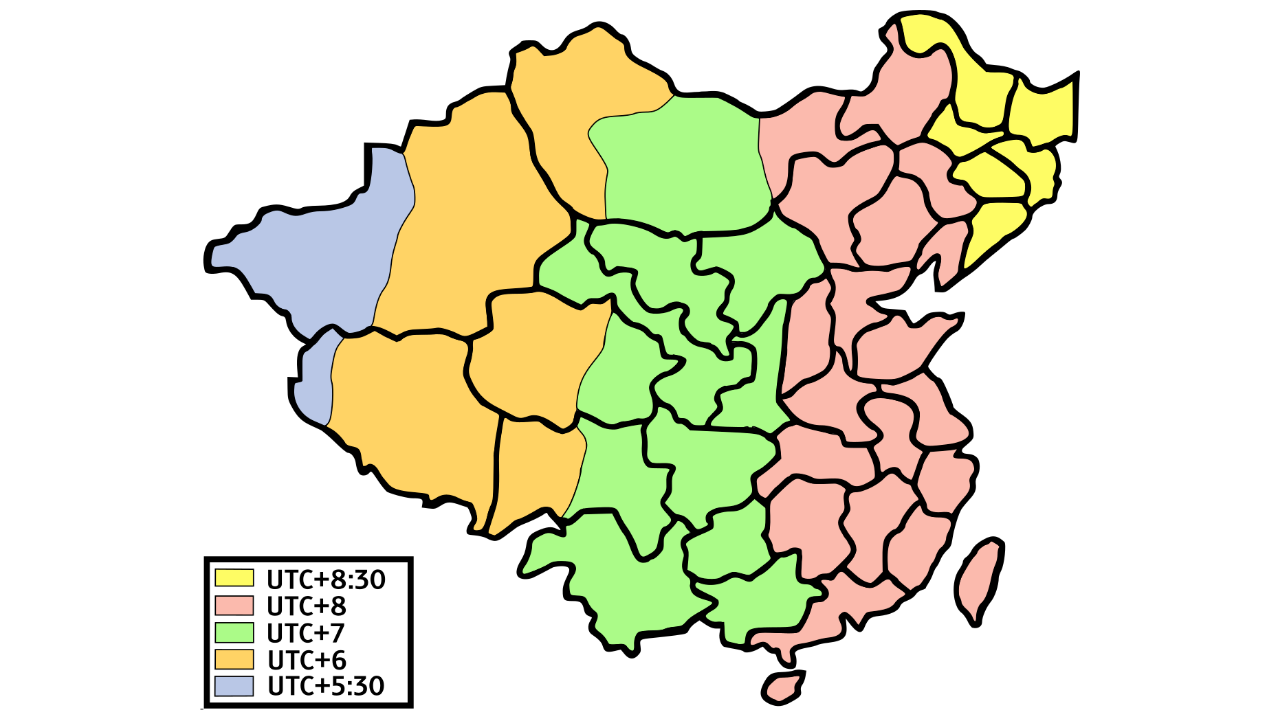
It was not always like this. In 1918 the Central Observatory in Beijing proposed five zones for the country: Kunlun (UTC+5:30), Sinkiang-Tibet (UTC+6), Kansu-Szechwan (UTC+7), Chungyuan (UTC+8) and Changpai (UTC+8:30). Sources say that system lasted until 1949. [2][1]

The war years scrambled things: in 1939, during the war against Japan, the whole country ran on Kansu-Szechwan time (UTC+7). When the civil war ended in 1949-1950, regional governments other than Xinjiang and Tibet switched to Beijing time (UTC+8), and one clock became the standard. I can’t point to a document that explains the decision in detail; the sources only describe the new government putting the country on a single time. [2][1]
What time is solar noon in the west?
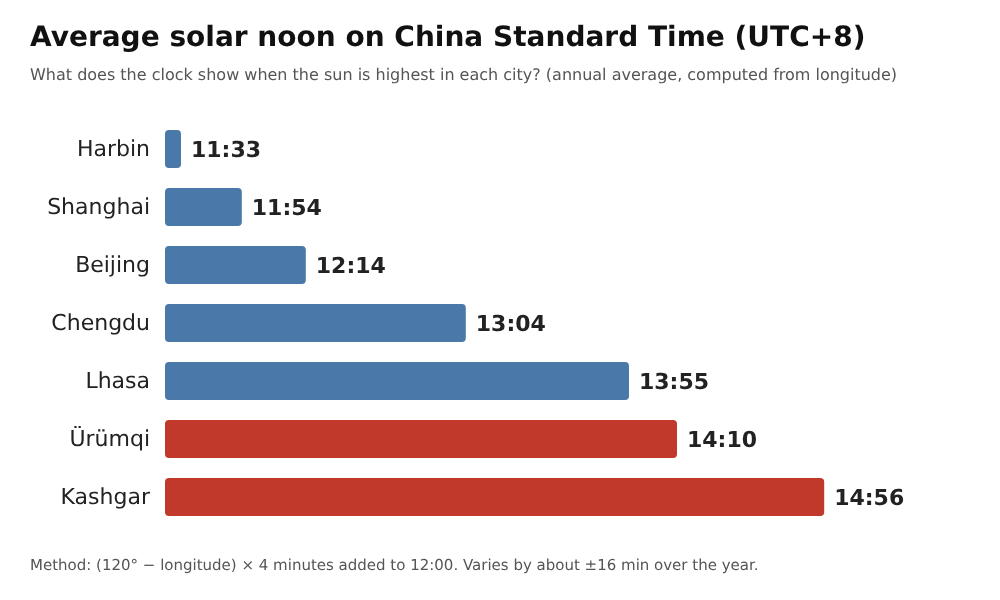
Solar noon is the moment the sun is highest in the sky. The further west a city sits from 120°E, the meridian UTC+8 is built around, the later solar noon arrives on the clock: each degree of longitude is about 4 minutes. The chart below runs that calculation for seven cities. In Beijing solar noon is around 12:14. In Kashgar it is almost 15:00, and on some days of the year as late as 15:10. [1]
Two clocks in Xinjiang
The local workaround in the west is an unofficial second clock: Xinjiang time, or Ürümqi time, at UTC+6. It runs two hours behind Beijing and matches neighbouring Kyrgyzstan. Reports say Uyghurs commonly use it while Han Chinese tend to stick with Beijing time, so ask someone in Ürümqi what time it is and the answer depends on who you ask. Some local authorities run both standards side by side. [1][2]
In practice, the day is shifted. Shops and offices in Xinjiang commonly keep 10:00 to 19:00 on Beijing time, which is 08:00 to 17:00 on Ürümqi time. Some institutions stretch the lunch break by 60 to 90 minutes to avoid the summer heat. [2]
The clock policy didn’t move in one direction
Reportedly, between 1969 and 1986 Xinjiang switched back and forth several times between Xinjiang time and Beijing time. China also observed daylight saving time from 1986 to 1991 and then dropped it. [2] The topic has a political side as well; Al Jazeera’s piece on how clocks and politics get tangled is a good read on that. [3]
Questions and answers
Sources
- timeanddate.com: China’s one time zone (accessed 2026-11-13)
- Time in China, Wikipedia (accessed 2026-11-13)
- Conflict over the clock: China among countries where time is political, Al Jazeera (accessed 2026-11-13)
Cover image: ROC-Timezones.svg, Wikimedia Commons · Alan Mak, Skrzeczu · CC BY-SA 3.0.