Why can we read scrambled letters? There is no “Cambridge study”
· Education
You have probably seen a text like this one: “Aoccdrnig to a rscheearch at Cmabrigde Uinervtisy, it deosn’t mttaer in waht oredr the ltteers in a wrod are.” It reads far more easily than it should, so most of us think “our brains are amazing” and move on. The Cambridge study behind it does not exist, and the claim about first and last letters is more complicated than it sounds.
- The text spread as a chain message in September 2003. No current Cambridge work on the topic was found.
- The idea traces back to Graham Rawlinson's 1976 PhD thesis at the University of Nottingham.
- Moving the inner letters of words still allows reading, at a small cost in speed. First and last letters alone are not enough.
- The famous sentence reads easily because it was scrambled in ways that are easy to read.
Where did the text come from?
Matt Davis of the MRC Cognition and Brain Sciences Unit in Cambridge writes that he first heard of the text on 16 September 2003, when a journalist contacted a colleague. The message had changed as it was passed along, and Davis found no current Cambridge research on the subject. [1]
He traced the origin to the University of Nottingham: Graham Rawlinson's 1976 PhD thesis, “The significance of letter position in word recognition”. In a 1999 letter to New Scientist, Rawlinson described how randomising the letters in the middle of words had little or no effect on skilled readers' comprehension. One rapid reader noticed only four or five errors on a page of muddled text. [1]
So there is a real observation underneath. What got added later was Cambridge's name and the line that “only the first and last letters matter”.
What holds up, and what doesn't?
Davis calls the meme false in its entirety, while admitting it contains some truth. Reading does go on when inner letters are swapped, but it has a price: the title of a 2006 paper by Rayner and colleagues says as much (“there is a cost”). Davis's page also mentions a study that found an 11% slowdown for words with reordered internal letters. Replacing letters with other letters, or moving the outer letters, disrupts reading much more. [1][2]
Davis also rejects the idea that the first and last letters are enough. In English, “salt” and “slat” share both, and those two letters alone cannot tell you which one you are looking at. [1]
Why is the famous sentence so easy?
Davis lists several properties that make the popular text easy to read. Most probably were not a deliberate design, but the result is the same: the text was scrambled in the gentlest possible way. [1]
- Words of two or three letters are untouched, and in four-letter words only the middle two can swap.
- Small function words such as “the” and “be” stay put. Readers miss letter errors in those words more easily anyway.
- Eight of the 15 words are in their original form.
- Swapping neighbouring letters (“porbelm”) is easier to read than swapping distant ones (“pborlem”).
- Reading is easier when the scramble does not create another real word, when the word keeps its sound, and when the context is predictable.
You can try the same thing in Turkish. First, a sentence with neighbouring letters swapped: “Bu yazıdaki hrafelrin yelreri dğeişti ama siz yine de okyuabiliyorsunuz.” Now the same sentence with first and last letters kept and the middle shuffled at random: “Bu ykdaızai hlfiarern yreerli dieğtşi ama siz yine de ounksoairuubyliyz.” Both follow the same “rule”, yet you will probably slow down on the second one. Treat this as a demo, not a measured result.
So how does the brain read?
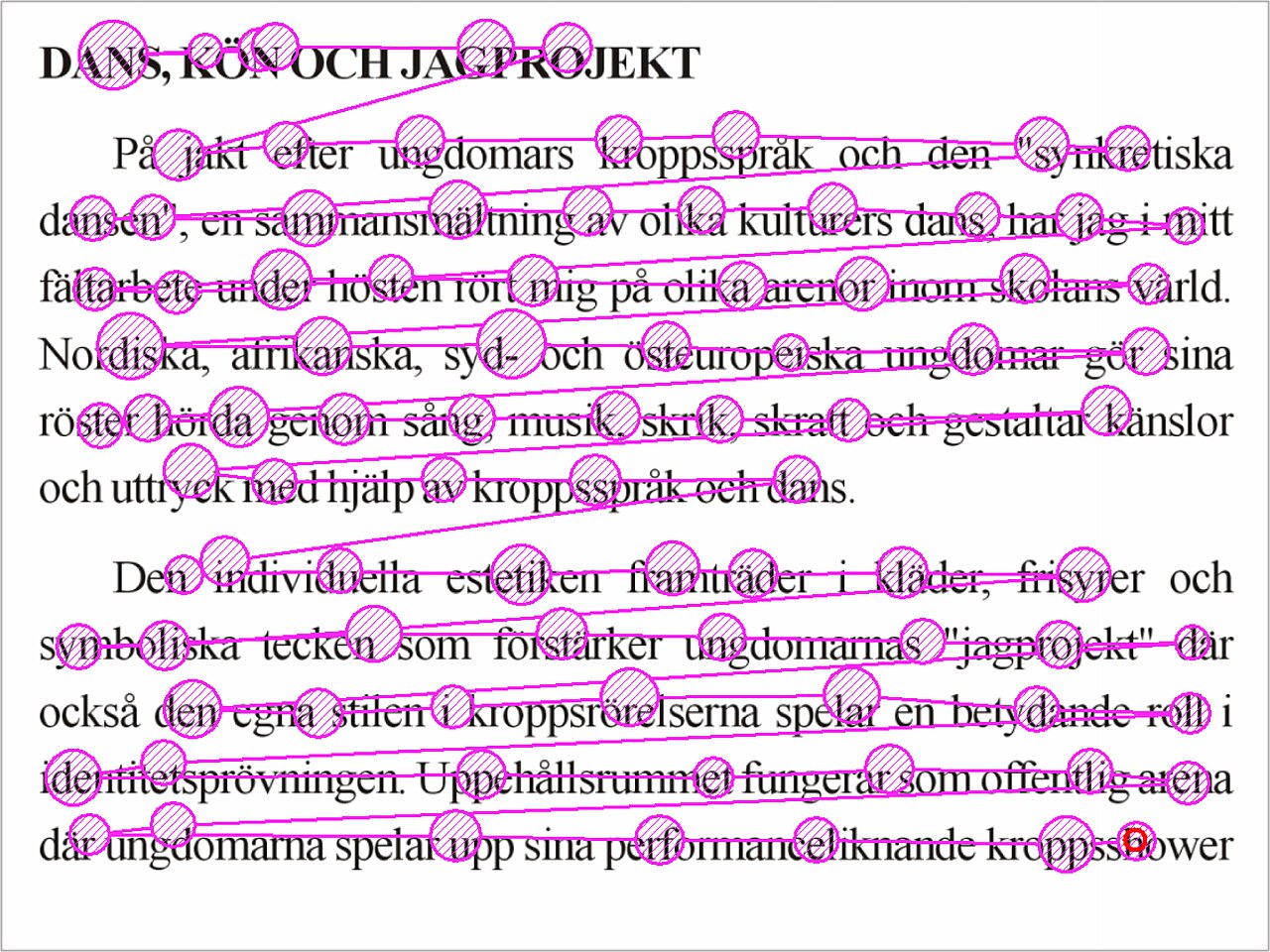

In eye-tracking recordings, reading does not look like a smooth stream. The eyes stop on one spot, then jump to the next. The studies on Davis's page suggest that words are not read letter by letter. Seeing a letter inside a word is easier than seeing it alone (Reicher, 1969). Alternating upper and lower case (“CaSe MiXiNg”) slows reading markedly (Mayall and colleagues, 1997). A prime like “uhser” speeds up recognition of USHER more than “ushre” does (Perea and Lupker, 2003). [1]
My reading of all this: the brain recognises a word as a unit, but that recognition depends on letter information, and the flexibility between letters has limits. Reading sits at neither extreme. We neither inspect every letter nor glance at the word's outline and move on.
A note
Why did this story catch on?
I think the text has a persuasive power that does not need it to be true: you try it while reading and it works. The result feels right, so nobody thinks to question the source, and Cambridge's name guarantees the trust. The real story is less flashy but, to me, more interesting. We predict far more than we realise while reading, and part of why scrambled text works is that we have already guessed the rest of the sentence.
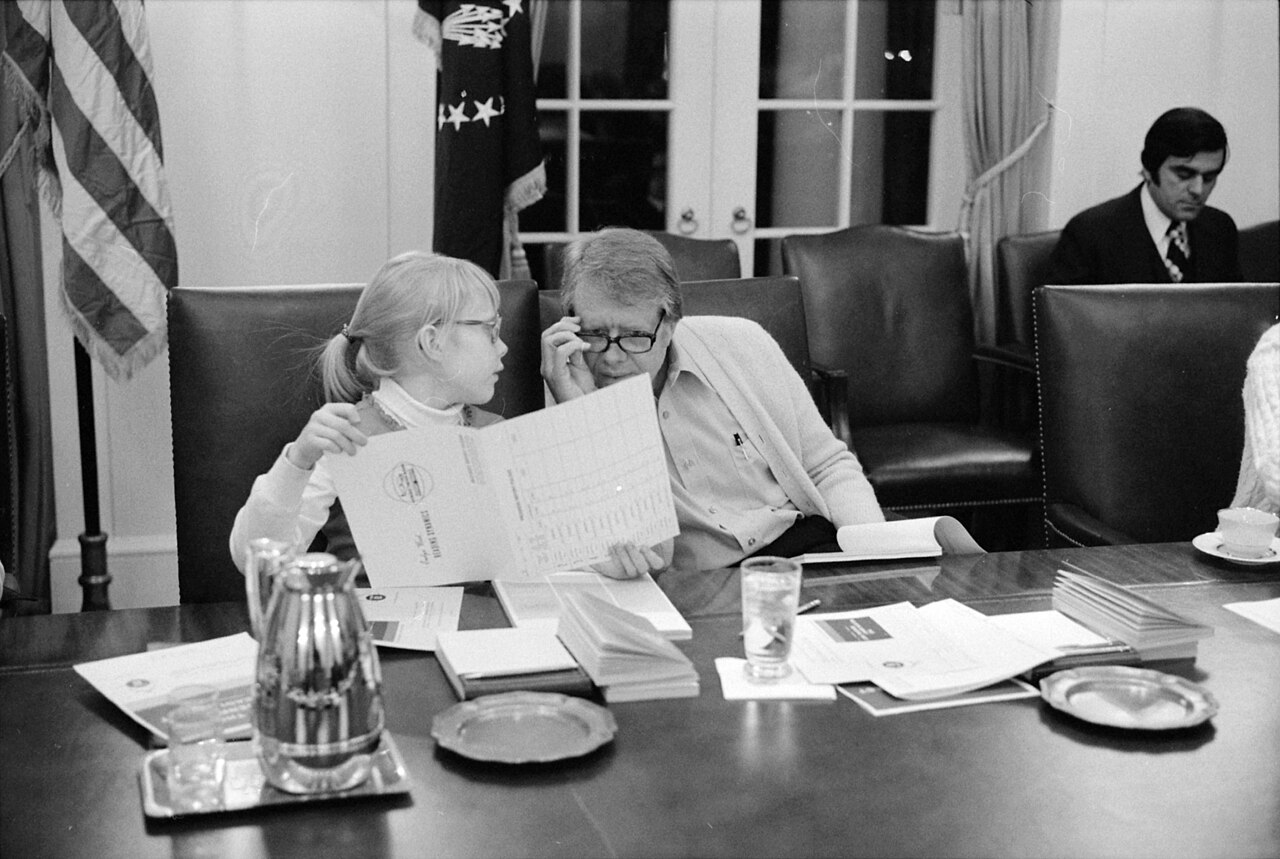
Cover image: A photo from a speed-reading course held in the White House Cabinet Room on 22 February 1977. White House Staff Photographers, U.S. National Archives · Wikimedia Commons · Public domain

Sources
- Davis, M. Aoccdrnig to a rscheearch at Cmabrigde Uinervtisy. MRC Cognition and Brain Sciences Unit, University of Cambridge (accessed: 2026-11-06)
- Rayner, K., White, S. J., Johnson, R. L. & Liversedge, S. P. (2006). Raeding wrods with jubmled lettres: there is a cost. Psychological Science (accessed: 2026-11-06)