The most important invention: mathematics, technology, or something else?
· Random
Ask people for the most important invention and the first answers are predictable. AI? The internet? Electricity? Then someone objects: “Electricity was already in nature. That’s not an invention, it’s a discovery.” Fair enough. But what about mathematics, the thing sitting under all the rest? Was it invented or discovered?
The easy part
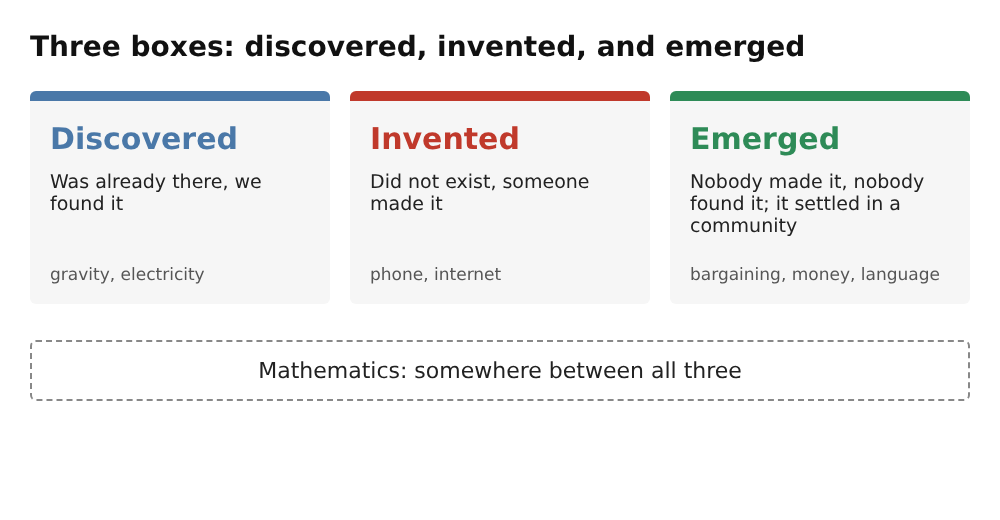
Gravity is clear. Apples fell before Newton. What he did was find a rule that explains why. The phone is clear too: it did not exist, and someone made it. Discovery is finding what was already there. Invention is making what was not.
The hard part starts now.
Which box does mathematics go in?
Two plus two is four. Did we make that up, or was it always so? Two communities that never met, each developing counting, end up with the same result. The angles of a triangle add up to 180 degrees on a flat surface, and nobody decided that one morning. Newton and Leibniz also reached calculus independently of each other, with different notation. [3] That suggests mathematics is “out there” somewhere.
On the other hand, “two” does not wander around in nature. There are two stones, two trees. The idea of “two,” the numerals and the way we write them are ours. Part of it looks like discovery, part like invention.
The odd thing is that mathematics that once looked like a mental game later describes how the universe works with startling accuracy. Physicist Eugene Wigner raised this in a 1960 paper. [1] There are two possible explanations. Either mathematics really touches the structure of the universe, or our brains were shaped to live in this world, so what they produce fits it. Nobody knows for sure which.

Things without a formula
Some things still have no formula. The motion of three bodies pulling on each other has no general closed-form solution. [2] Yet the planets keep moving. Failing to find a formula does not mean the thing does not exist. It does not mean it exists only in the way we understand it, either. Some things are probably independent of us. Others are things we made up to understand the world. Which is which is not always clear.
Sometimes the line runs through a single case: the object is discovered, but the box we put it in is invented. In 2006 the definition of a planet changed and Pluto became a dwarf planet. [4] Nothing changed about Pluto. Our box changed.
The third box
Think about bargaining. Who found it? Nobody. One person wanted to pay less, the other wanted to get more, and ways of meeting in the middle settled in over time. Bargaining has no inventor. Money is the same, and so is language. Nobody woke up one morning and said, “let’s invent English today.” A banknote is just paper, but we all give it value, so it is money.
These are neither discoveries nor inventions. They emerged, piled on top of one another, and a whole community agreed to them. Many of the things that shape us most belong to this group.
Why does it matter?
Saying “discovery” assumes the world exists apart from us. Saying “invention” assumes everything is up to us. In real life most things are a mix of the two, and many fit neither box.
Quick questions
What do you think the most important invention is? Mathematics, technology, or something else? Tell us in the comments.
Sources
- The Unreasonable Effectiveness of Mathematics in the Natural Sciences (Wigner, 1960), Wikipedia (accessed 2026-11-13)
- Three-body problem, Wikipedia (accessed 2026-11-13)
- Leibniz–Newton calculus controversy, Wikipedia (accessed 2026-11-13)
- Planet, Wikipedia (accessed 2026-11-13)
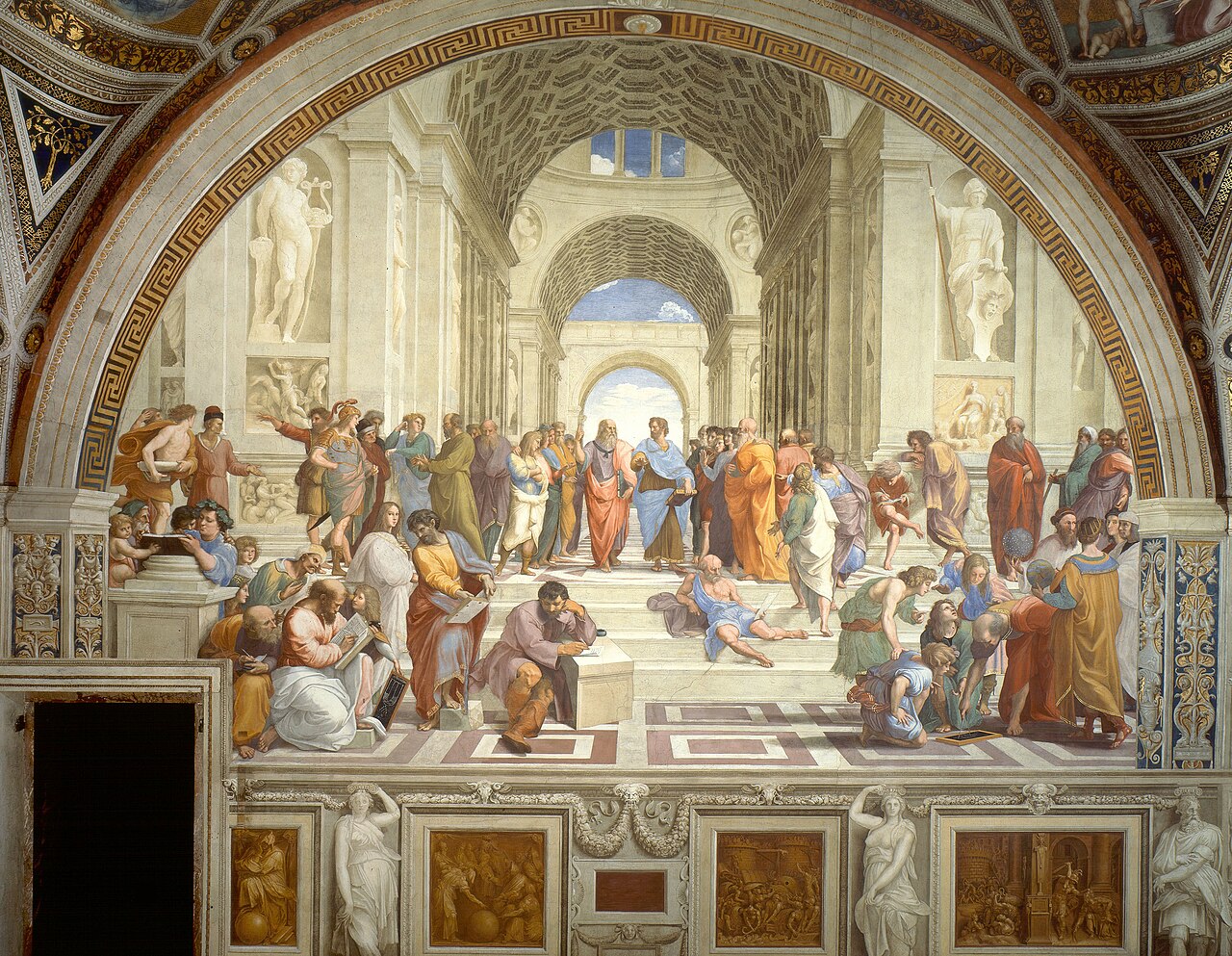
Cover image: Sanzio 01.jpg (The School of Athens), Wikimedia Commons · Raphael · Public domain.