Same date, same weekday: when does 31 December land on the same day again?
· Science
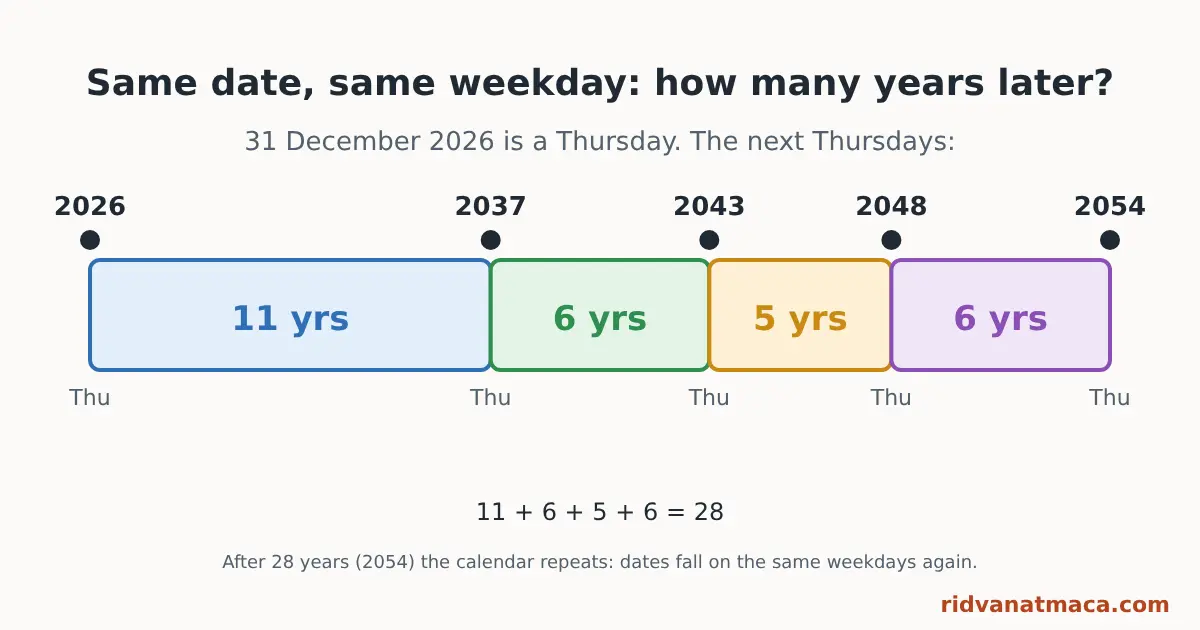
Look at a calendar: 31 December this year is a Thursday. When will 31 December fall on a Thursday again? You can ask the same about 15 April or 29 February. The answer is not random. There is a tidy cycle, and one division is enough to find it.
One simple fact first: a year is 52 weeks and 1 day
A year has 365 days. Divide by 7 and you get 52 with 1 left over: 365 = 52 × 7 + 1. So a year is exactly 52 weeks plus one extra day, and because of that extra day the same date next year lands one weekday later. If 31 December 2026 is a Thursday, 31 December 2027 is a Friday.
Leap years change this. When a 29 February falls in between, the span is 366 days: 366 = 52 × 7 + 2, so the date moves two weekdays. 31 December 2027 is a Friday and 31 December 2028 is a Sunday, because 29 February 2028 sits between them.
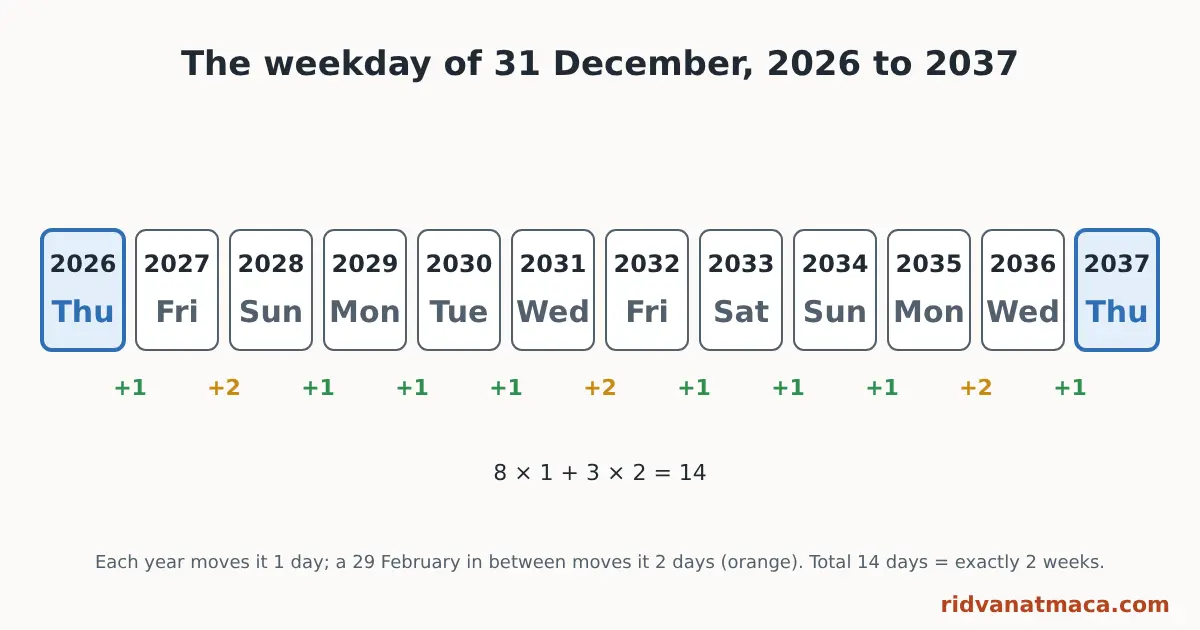
The diagram shows the sum. We start on Thursday, 31 December 2026, and move one or two weekdays each year. After 11 years, in 2037, the total shift is 8 × 1 + 3 × 2 = 14 days. Fourteen days is exactly two weeks, so the date is a Thursday again.
The rule: when the shift is a multiple of 7, the weekday matches
The weekday repeats only when the total shift is 7, 14, 21 and so on. You can work it out easily: the number of years that passed plus the number of 29 Februaries in between.
The same logic gives three kinds of gap:
- 6 years: one 29 February in between, 6 + 1 = 7.
- 5 years: two of them, 5 + 2 = 7.
- 11 years: three of them, 11 + 3 = 14.
Why not 1, 2, 3 or 4 years? In 4 years the shift reaches only 4 + 1 = 5, which is short of 7. No shorter gap can reach a multiple of 7. Five, six and eleven years are the first gaps where the total is exactly a multiple of 7.
The sequence never changes: 11, 6, 5, 6
Start from Thursday, 31 December 2026 and list the years that fall on a Thursday again: 2037, 2043, 2048, 2054. The gaps are 11, 6, 5, 6. Then at 2065 the same sequence starts over: 11, 6, 5, 6. It works for 15 April too: 15 April 2026 is a Wednesday, and it is a Wednesday again in 2037, then 2043, 2048 and 2054.
Add the four gaps: 11 + 6 + 5 + 6 = 28 years. Why exactly 28? There are 7 leap days in 28 years, so the number of days is 28 × 365 + 7 = 10,227. Divide by 7 and you get exactly 1,461. Twenty-eight years is a whole number of weeks.
How does this spread across 400 years?
I counted, for every year from 2000 to 2399, how many years pass before 31 December lands on the same weekday again. The result is below. Other ordinary dates give the same numbers.
Mostly it is 6 years. Five and 11 years are common too. Gaps of 7 and 12 years appear only around century years (9 years between 2000 and 2399, just before 2100, 2200 and 2300). Those century years are not leap years, so they have no 29 February, the count shifts and the 28-year pattern breaks.
29 February: always 28 years?
29 February exists only in leap years, so it shows up every 4 years. Its weekday steps backwards: 4 years is 1,461 days, which is 208 weeks and 5 days. Moving 5 days forward is the same as moving 2 days back, so each 29 February falls two weekdays earlier than the one before. 2024 is a Thursday, 2028 a Tuesday, 2032 a Sunday, 2036 a Friday, 2040 a Wednesday, 2044 a Monday, 2048 a Saturday, and 2052 is a Thursday again.
Two days back per step, seven steps to visit every weekday: 7 × 4 = 28 years. 29 February 2028 is a Tuesday. The next Tuesday 29 February is 2056, then 2084. The one after that does not take another 28 years: 2112 will be a Monday, not a Tuesday, because 2100 got in the way and has no 29 February. The next Tuesday 29 February is 2124, which is 40 years after 2084.
Which weekday is 29 February? (2024 to 2052)
| Year | 29 February |
|---|---|
| 2024 | Thursday |
| 2028 | Tuesday |
| 2032 | Sunday |
| 2036 | Friday |
| 2040 | Wednesday |
| 2044 | Monday |
| 2048 | Saturday |
| 2052 | Thursday |
The exact answer: 400 years
The 28-year cycle breaks at 2100 because the Gregorian leap rule is a bit more elaborate: years divisible by 4 are leap years, except years divisible by 100, which are not, except years divisible by 400, which are. So 1900 and 2100 are not leap years, but 2000 was.
With 97 leap days in 400 years, the total is 146,097 days, which divides into exactly 20,871 weeks. Every 400 years the calendar returns to exactly the same state, weekdays included. This one is exact: any date falls on the same weekday again 400 years later.
A few quick questions
Sources
- Gregorian calendar (Wikipedia): the leap year rule and the 400-year cycle
- Leap year (Wikipedia): leap years and 29 February
- Python datetime documentation: all day calculations here were checked with this library