How can we imitate a sound we have never heard before?
· Science, Psychology

You hear a bird's song for the first time, and within a few tries you can make something that sounds like it. The same goes for a cat's meow, a melody you just heard or a squeaking door. It feels so ordinary that we rarely stop on it, but it is a surprising feat: a sound entering your ear becomes a precise sequence of many muscles in the tongue, lips, jaw and vocal cords. And you may never have made that sound before.
Science has not worked out every detail of this. But what we know fits our own experience well.
Hearing and making are not the same thing
The first distinction: recognizing a sound is one thing, reproducing it with your own voice is another. Your dog can learn the word "sit" and respond to it, but it cannot say it. Researchers call the ability vocal learning: acquiring new sounds by imitation and producing them with the vocal organ. According to Wikipedia's summary, it has been found in only eight groups of animals. [1]
Those groups include songbirds, parrots and hummingbirds, some bats, whales and dolphins, some seals, and elephants. Among primates, only humans are classed as complex vocal learners. Chimpanzees and orangutans show only limited imitation. [1] So being able to imitate sound is anything but universal.
In infancy, babbling is practice
In humans the ability starts right after birth. Babies first cry and make pleasure sounds. Around two months you hear "goo"-like sounds. At four to five months they begin varying pitch and copying some adult sounds. Around six months they learn to open and close the vocal tract and produce repeated syllables like "baba." By nine to ten months babbling starts to resemble the rhythm and intonation of the language spoken at home. First words arrive around age one. [2] These are rough averages, and every baby moves at a different pace.
How babbling bends toward the home language is striking. French-exposed babies, for example, show more rising intonation than English-exposed ones. Vocal babbling also depends on hearing oneself: deaf babies babble much like hearing babies at first, but they usually stop vocal babbling earlier and make fewer sounds. [2]
We build a map between sound and muscle
Why does babbling matter? The DIVA model, developed in Frank Guenther's lab at Boston University, puts it like this: the baby makes random sounds, then hears its own voice. That feedback teaches which muscle movement produces which sound. After this "babbling phase," the model can combine sounds as it wishes. [3]
This part is my interpretation, but think of it like someone touching a keyboard in a dark room for the first time. At first they press keys at random and learn which key makes which sound. When they later hear a piece of music, they roughly know which keys to press. Our voice has far more "keys," and we cannot see them, which is why trying and hearing yourself matters so much.
Imitation is summarizing, not copying
We cannot actually copy a bird song or an engine sound exactly, because our vocal tract was not built to make it. Instead we capture the most salient features: where it rises, how often it repeats, how sharp or soft it is. A 2014 study by Lemaitre and Rocchesso shows that describing unfamiliar sounds in words is hard, so people turn to vocal imitation. Even when the source of a sound was hard to identify, listeners could pick the right sound from an imitation, and imitation matched the best verbal descriptions. [4] So "summarizing" a sound turns out to be a good way to communicate it.
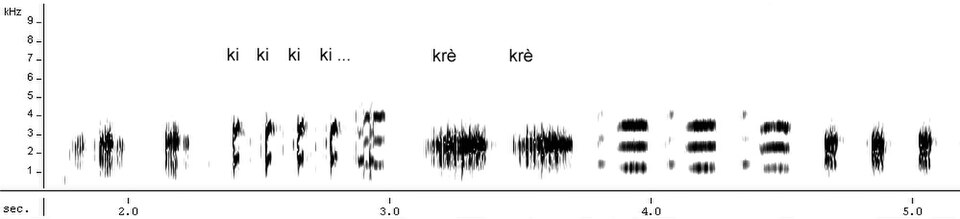

Among birds there are masters of this too. The northern mockingbird's repertoire ranges from 43 to 203 song types and keeps growing throughout life. It can imitate other birds, cats, dogs, frogs and crickets, even unoiled wheels and car alarms. The imitations often fool humans but not other birds. [5] The Mimus in its scientific name means "mimic." [5]
In music: matching what we hear
Repeating a melody you just heard is the best-known test of imitation. In a 2007 study by Pfordresher and Brown, about 10 to 15 percent of participants sang a note at least a semitone off (the difference between two neighboring keys on a piano). What was interesting is that these people were no worse than most at telling whether two sounds differed. The researchers interpreted the problem as lying not in hearing but in translating what is heard into movement of the vocal organ. [6]
More recent work makes it a bit more complicated: perception may play a role for some people, so "their ears are fine" is not true in every case. Still, listening to your own recording seems useful: in 2014 Pfordresher and Mantell reported that poor-pitch singers benefited more from imitating their own recordings than other examples did. [7]
| Step | What happens |
|---|---|
| 1. Listen | We pick out the sound's salient features (rise, repetition, sharpness) |
| 2. Try | We make a first approximation with the voice |
| 3. Hear yourself | We hear our own voice and compare it with the target |
| 4. Adjust | We change the muscle movement to shrink the gap |
The steps in the table are my own simplification, inspired by the "hear, compare, correct" loop in the DIVA model, and the real process is of course messier.
What changes in adulthood?
I will not give a firm verdict here, because the sources I read do not give a clear figure for how long this ability lasts in adult humans. Even among animals there are differences: canaries and many parrots keep learning throughout life, while zebra finches learn only during a certain period. [1] According to the sources I have, the groundwork for the map between sound and muscle is laid during babbling. In adulthood, trying, recording yourself and correcting the gap also looks like the most sensible approach. That is my interpretation, not a research result.
Short glossary
- Vocal learning: Acquiring new sounds by hearing and imitating them, and producing them with the vocal organ.
- Babbling: The stage when babies make repeated syllables and try out sounds.
- Sonogram: A picture of a sound drawn against time and pitch.
- Semitone: The pitch difference between two neighboring keys on a piano.
- Pitch: How high or low a sound is.
Sources
- Wikipedia. Vocal learning (accessed 2026-10-24)
- Wikipedia. Babbling (accessed 2026-10-24)
- Boston University Guenther Lab. The DIVA Model of Speech Motor Control (accessed 2026-10-24)
- Lemaitre, G. and Rocchesso, D. (2014). On the effectiveness of vocal imitations and verbal descriptions of sounds. Journal of the Acoustical Society of America, 135(2) (accessed 2026-10-24)
- Wikipedia. Northern mockingbird (accessed 2026-10-24)
- Pfordresher, P. Q. and Brown, S. (2007). Poor-pitch singing in the absence of tone deafness. Music Perception (accessed 2026-10-24)
- Pfordresher, P. Q. and Mantell, J. T. (2014). Singing with yourself. Cognitive Psychology (accessed 2026-10-24)
Cover image: a northern mockingbird singing. Ryanfmandelbaum · CC BY-SA 4.0
