Why is a computer mouse called a mouse? From a wooden box to your desk
· Technology
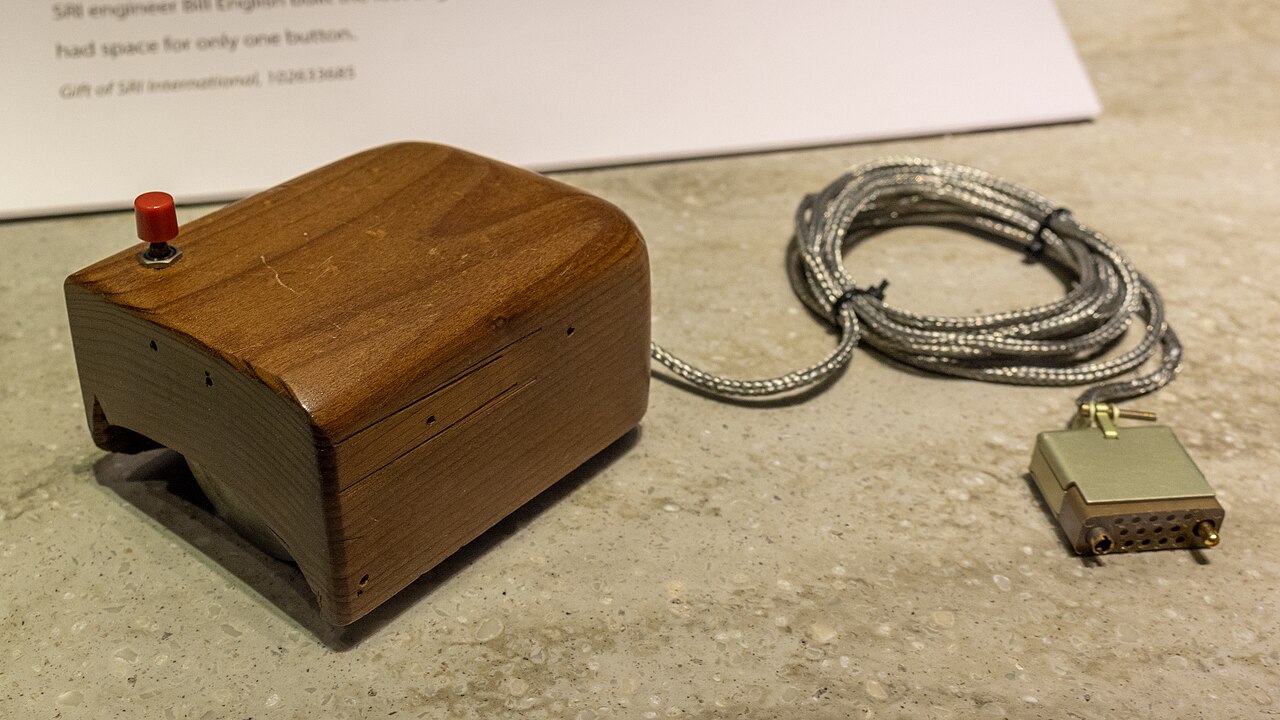
Look at the mouse on your desk. It may be wireless, or it may never have had a tail at all. It's still a mouse. Nobody voted on the name at a meeting, and the team that built the device can't say where it came from. [1]
A bug in a notebook
On 14 November 1963, Douglas Engelbart wrote an idea in his notebook: a "bug" with two orthogonal wheels and a drop point. According to Wikipedia, this is the earliest known note about the mouse. [5] The next year at the Stanford Research Institute (SRI), engineer Bill English turned the idea into an object: a wooden shell, knife-edge wheels and room for just one button. [1][2]
The two wheels were not arbitrary. One measures movement toward and away from you, the other left and right; together they move a cursor in two directions at once. The wheels were modeled on 19th-century planimeters, each rolling one way and sliding sideways. [1] The patent drawing also shows a small ball-bearing support as a third contact point and three buttons. [3]

Where does the name come from?
The most common explanation is a simple one: the cable came out from under the user's wrist, like a mouse's tail. The Computer History Museum summarizes Engelbart's own words this way: nobody remembers, it looked like a mouse with a tail, and everyone just called it that. [1] So there is no birth certificate, only everyday lab banter.
The earliest written use is often credited to English's July 1965 report "Computer-Aided Display Control". It was written under a NASA contract and is listed on NASA's technical reports server. [4][5] The patent speaks another language entirely. Its title is "X-Y position indicator for a display system", and the Computer History Museum notes that the word "mouse" never appears in it. [1][3]
I find that detail telling. When the official name is clumsy, people give the thing on their desk a nickname, and the nickname sticks. Plenty of product names live or die that way.
It had rivals
The mouse wasn't the only pointing device tried for Engelbart's NLS system. Wikipedia mentions several devices that used different body movements. One was a knee-operated device under the desk that kept both hands free for typing. In the end the mouse won out because of its speed and convenience. [5] One thing the sources don't say: I'm not quoting timing numbers for the era's devices, because nothing I read includes a measurement table.
My own reading is this: the mouse uses a movement the hand already makes on a desk. You don't have to lift your arm toward the screen or balance with a foot or knee. Its long life may owe more to that comfort than to any technical edge. That is an inference, not something the sources state outright.
Patent, demo and royalties
The patent application was filed on 21 June 1967 and granted on 17 November 1970, with SRI as the owner. [3] On 9 December 1968, Engelbart gave a 90-minute demonstration at the Fall Joint Computer Conference in San Francisco, showing the mouse together with linked text, live editing and multiple windows. [2] Because SRI held the patent, Engelbart reportedly received no royalties. [5]
From wood to every desk
A short timeline covers what followed. Dates come from Wikipedia's overview: [5]
- 1972: English builds a ball mouse, this time at Xerox PARC.
- 1973: The ball mouse ships with the Xerox Alto, regarded as the first modern computer to use a mouse.
- 1982: Logitech introduces its first mouse, the P4, at Comdex.
- 1983: Microsoft ships its own mouse.
- 1984: The Macintosh 128K arrives with a single-button mouse descended from the Lisa's.
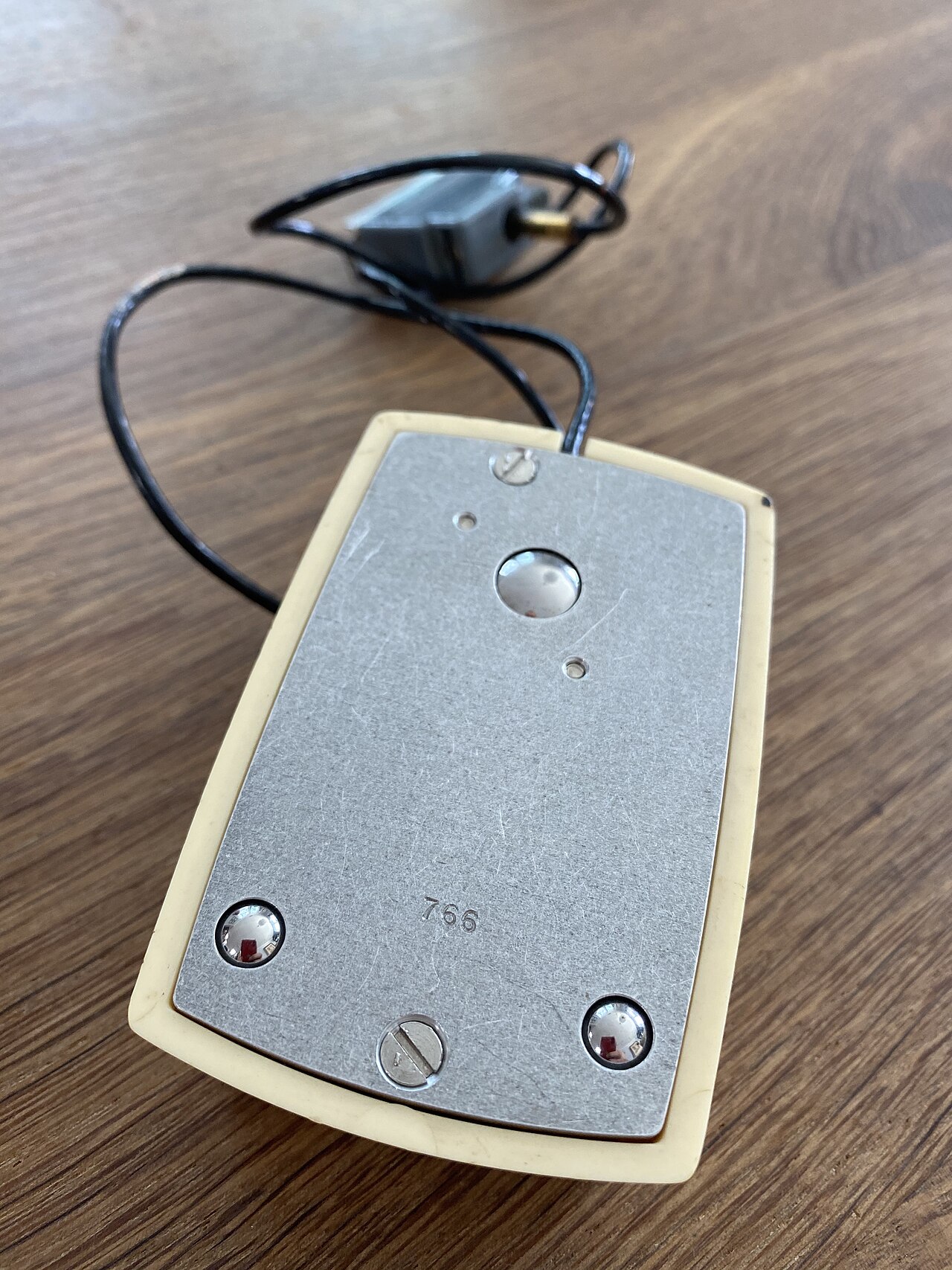
The underside of an Alto mouse, shown above, looks a long way from the wooden prototype. It has three round bearings, and movement now travels through a ball rather than a sliding wheel. The mechanism changed again and again, and optical sensors came later. What stayed is the pairing of hand, desk and cursor.
Mice or mouses?
Dictionaries accept both plurals, but "mice" is more common. J. C. R. Licklider used it as early as 1968 in "The Computer as a Communication Device". [5]
In short: who invented the mouse?
The idea was Douglas Engelbart's and the first prototype was built by SRI engineer Bill English. The patent was filed in Engelbart's name and assigned to SRI. [2][3]
Sources
- Computer History Museum. Engelbart's mouse (Revolution: Input and Output) (accessed: 2026-10-28)
- SRI International. Computer mouse (Hall of Innovation) (accessed: 2026-10-28)
- US Patent 3,541,541. X-Y position indicator for a display system (Engelbart, SRI) (accessed: 2026-10-28)
- NASA Technical Reports Server. Computer-aided display control: Final report (Engelbart, English, Huddart, 1965) (accessed: 2026-10-28)
- Wikipedia. Computer mouse (accessed: 2026-10-28)
Cover image: The wub · CC BY-SA 4.0.
