Weekly Security Bulletin #5: vCenter and Cisco Expressway join KEV, Apache Roller under active exploitation
· Security
This issue covers November 15 to 21. We checked the Red Hat CVE database and CVE.org. Exploitation data comes from the CISA KEV catalog (release of November 20, 17:48 UTC), scores from NVD and each vendor’s own record, and exploit probability from FIRST’s EPSS. We could not reach the GitHub Advisory Database this week and did not use OpenCVE. Vendor pages we could not read are marked in the text. The status of flaws from #4 is in “What happened to flaws from earlier issues?”.
In short
- CISA added nine flaws to KEV this week. Seven have a CVSS score of 9.8 or higher.
- The VMware vCenter authentication bypass CVE-2026-123890 (9.8) entered KEV on November 20. Broadcom shipped fixes on November 19 and lists no workaround. The deadline is November 23.
- CVE-2026-129448 in Apache Roller (9.8) allows unauthenticated code execution, and its record says it is being actively exploited. The fix is Roller 6.1.6.
- CVE-2026-76466 in Cisco Expressway (9.8) gives root command execution on clustered devices and entered KEV on November 20. Cisco’s advisory says it knows of no malicious use; the fix is X15.5.20.
- The Puppet flaw CVE-2026-115731 (9.4 / 9.9) from #3 entered KEV on November 17. Chrome 158, Firefox 160.0.1, nginx 1.30.7 / 1.31.9 and WordPress 7.1.5 shipped security fixes.
- 9 · New KEV entries · November 17 - 20, versus 12 last week
- 7 · KEV entries scoring 9.8 or higher · vCenter, Roller, Cisco, Puppet, REDCap, Axis, Synology
- 204 · Security fixes in Chrome 158 · 6 critical, 62 high
- 961 · New Red Hat CVE records · November 15 - 20, 14 of them critical
- 0.78 · EPSS of the LiteLLM flaw · 99.6th percentile
The urgent ones
VMware vCenter: CVE-2026-123890
Broadcom’s advisory VMSA-2026-0009 (November 19, updated November 20) describes an authentication bypass in the VMware Directory Service of vCenter: someone with network access to vCenter can gain unauthorized access without authenticating. Broadcom scores it 9.8 and credits Mandiant with the report. Fixed versions: 9.1.1.0200 for vCenter 9.1.x, 9.0.2.0200 for 9.0.x, 8.0 U3m for 8.0, and 5.2.5 for VMware Cloud Foundation 5.x. Telco Cloud Platform and Telco Cloud Infrastructure use KB463116, and vCenter 7.0 customers with an extended support contract should contact Broadcom Support. There is no workaround. The same advisory fixes three SDDC Manager flaws (CVE-2026-123891, -123892, -123893) and a SAML token signature bypass in VMware Tools (CVE-2026-123894); scores in the advisory range from 6.7 to 9.8. CISA added the flaw to KEV on November 20 with a deadline of November 23. Broadcom’s advisory does not mention exploitation, so the exploitation signal comes from CISA. EPSS is 0.03. Organizations running virtualization infrastructure are affected.
Apache Roller: CVE-2026-129448
In Roller 4.0.0 through 6.1.4, the XML-RPC endpoint deserializes vendor extension types before it authenticates the caller. The result is unauthenticated remote code execution, scored 9.8. The NVD record says the flaw is being actively exploited; CISA added it to KEV on November 20 with a deadline of November 23. The earlier CVE-2026-82384 for the same bug listed only 6.1.5, so 6.1.5 is affected too. The fix is Roller 6.1.6 or later. If you cannot upgrade right away, set “enabledForExtensions” to “false” in WEB-INF/web.xml, or remove the “/roller-services/xmlrpc” servlet mapping, and restart Roller. Turning XML-RPC off in the admin interface is not enough, because older versions process the request before checking that setting. Organizations and individuals who run their own Roller server are affected. EPSS is 0.05.
Cisco Expressway: CVE-2026-76466
On clustered Cisco Expressway-C and Expressway-E devices, an unauthenticated attacker can run commands as root through the database service (CVSS 9.8). The causes are persistent cookies and client certificates that are not validated when TLS Verify Mode is enabled for clustering. Cisco published the advisory on October 21. The fix is X15.5.20; X14 and earlier must migrate to a fixed release. There is no workaround. CISA added it to KEV on November 20 with a deadline of November 23. The version of the advisory we read (1.0, October) says Cisco PSIRT is not aware of malicious use, which conflicts with the KEV entry; check Cisco’s page for the current status. EPSS is 0.02. This affects organizations.
Puppet Server: CVE-2026-115731 (update from #3)
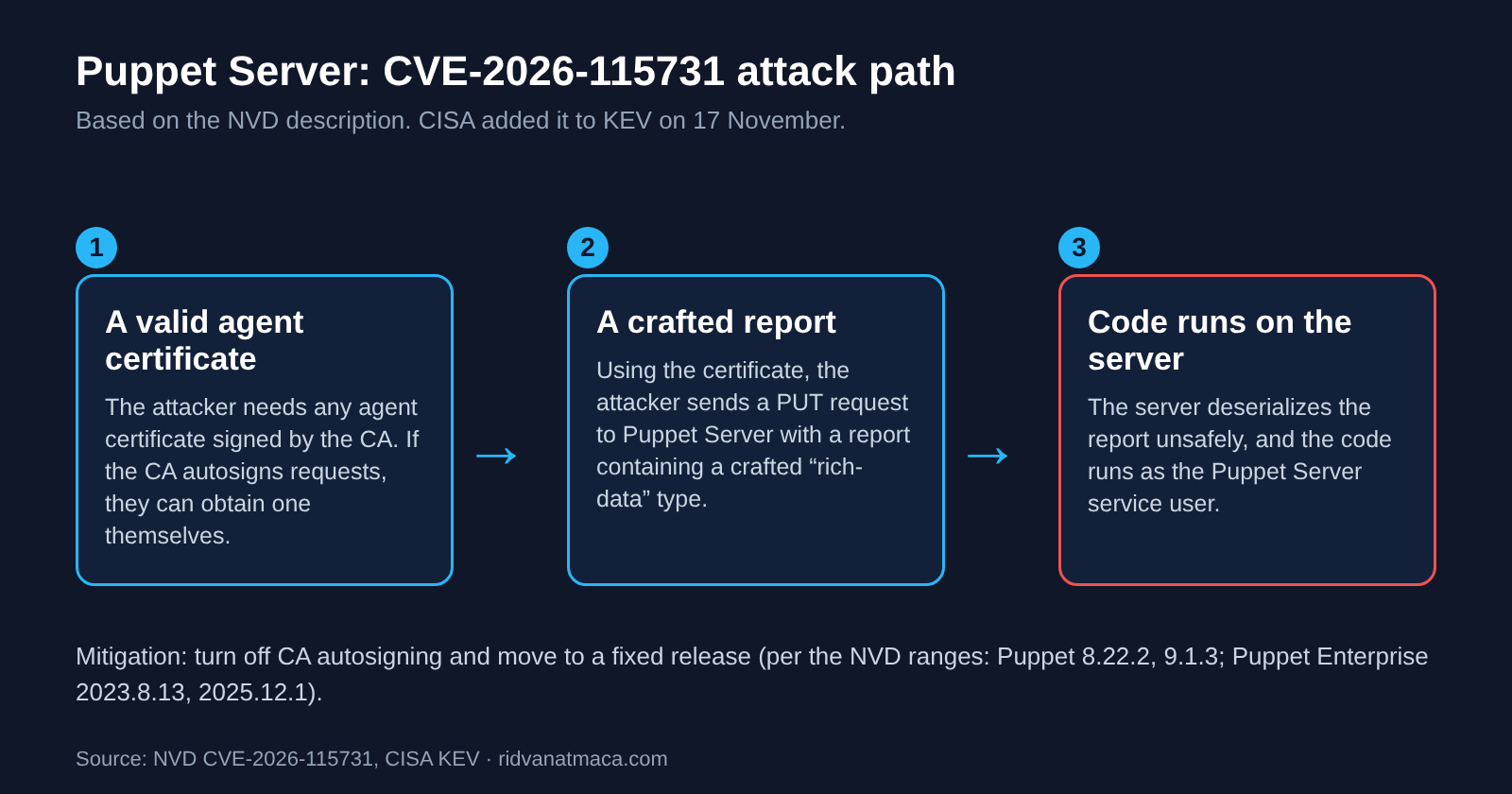
A client holding any CA-signed agent certificate can run code on Puppet Server as its service user by submitting a crafted report. If the CA autosigns requests, an unauthenticated attacker can obtain such a certificate. Perforce scores it 9.4 (CVSS 4.0) and NVD 9.9 (CVSS 3.1). We listed the Red Hat record as critical in #3. What is new: CISA added it to KEV on November 17 with a deadline of December 1. According to NVD, the affected ranges are Puppet 8.0.0 up to 8.22.2, 9.0.0 up to 9.1.3, and Puppet Enterprise 2023.8.0 up to 2023.8.13 and 2025.0.0 up to 2025.12.1. Perforce’s advisory page did not load, so we derived the fixed versions from the NVD ranges. EPSS is 0.01.
This week’s comparison table
| Flaw | Product | Issue | Score | Exploited? | Fix |
|---|---|---|---|---|---|
| CVE-2026-123890 | VMware vCenter 7.0, 8.0, 9.x and VCF / VVF | Authentication bypass in the VMware Directory Service | 9.8 | yes (KEV, Nov 20) | 9.1.1.0200, 9.0.2.0200, 8.0 U3m, VCF 5.2.5 |
| CVE-2026-129448 | Apache Roller 4.0.0 - 6.1.5 | Unsafe deserialization in XML-RPC, code execution | 9.8 (3.1) | yes (KEV, Nov 20) | 6.1.6 |
| CVE-2026-76466 | Cisco Expressway-C / -E (clustered) | Persistent cookies, root commands | 9.8 (3.1) | yes in KEV (Nov 20), not stated in Cisco’s advisory | X15.5.20 |
| CVE-2026-115731 | Puppet 8 and 9, Puppet Enterprise 2023.8 / 2025 | Unsafe deserialization in report processing, code execution | 9.4 (4.0), 9.9 (3.1) | yes (KEV, Nov 17) | Puppet 8.22.2, 9.1.3; PE 2023.8.13, 2025.12.1 (NVD range) |
| CVE-2026-90817 | REDCap 13.3.0 - 17.4.4 | Code execution via survey routing and data import, needs a valid survey hash | 9.8 (3.1) | yes (KEV, Nov 18) | not yet verified (vendor page needs a login) |
| CVE-2026-90436 | Apache Axis 1.x (through 1.4) | Class loading through a SOAP fault, code execution | 9.8 (3.1) | yes (KEV, Nov 18) | no patch, end of life |
| CVE-2024-10441 | Synology DSM and BeeStation OS | Code execution in the system plugin daemon | 9.8 (3.1) | yes (KEV, Nov 18) | DSM 7.2.2-72806-1, 7.2.1-69057-6, 7.2-64570-4, 7.1.1-42962-7; BSM 1.1-65374 |
| CVE-2026-40217 | LiteLLM 1.81.8 - 1.83.9 | Code execution via /guardrails/test_custom_code | 8.8 (3.1) | yes (KEV, Nov 18) | 1.83.10 (NVD range) |
| CVE-2025-42884 | SAP NetWeaver Enterprise Portal 7.50 | JNDI property injection, information disclosure and modification | 6.5 (3.1) | yes (KEV, Nov 20) | SAP Note 3660969 (login required, not read) |
| Chrome 158 | Chrome (Windows, Mac, Linux) | 204 security fixes, 6 critical | - | no exploitation in Google’s post | 158.0.8127.36 / .37 |
| nginx (10 flaws) | nginx 0.5.33 - 1.31.8 | HTTP/2 memory corruption (CVE-2026-123007), TLS 1.3 loop, mail proxy use-after-free and others | nginx: 3 rated “major” | not in KEV | 1.30.7, 1.31.9 |
Other updates
Chrome 158 reached the stable channel on November 17 (158.0.8127.36 on Linux, .36 / .37 on Windows and Mac; it rolls out over several days). Of its 204 security fixes, 6 are critical: WebView, GPU, Media, the garbage collector, ANGLE and WebAudio. There are also 62 high, 82 medium and 54 low fixes. Google’s post does not mention exploitation. ChromeOS updated to 158.0.8127.65 on November 18.
Firefox 160.0.1 (MFSA 2026-130, November 17) fixes two high-impact flaws: a privilege escalation in the Graphics: CanvasWebGL component on Android (CVE-2026-130020) and a use-after-free in audio/video playback (CVE-2026-130021).
nginx 1.30.7 and 1.31.9 fixed 10 vulnerabilities on November 18. nginx rates three as “major”: memory corruption in HTTP/2 flow control (CVE-2026-123007), an infinite loop while reading a request body over TLS 1.3 (CVE-2026-118899) and a use-after-free in the mail proxy module (CVE-2026-113425). Affected versions run up to 1.31.8. None is in KEV. Red Hat lists four nginx records among its critical ones.
PHP released 8.5.13, 8.4.28, 8.3.37 and 8.2.36 on November 19 (8.6.0 shipped the same day). Red Hat opened six PHP records that day and rated all of them critical (CVSS 8.1, for example CVE-2026-115560 and CVE-2026-129496). We could not match these CVEs to PHP releases from the release notes; check your distribution’s package update.
WordPress 7.1.5 shipped on November 18 as a security release, and the announcement recommends updating sites immediately. Sites with automatic background updates update on their own. WordPress 7.2 is planned for December 8.
Microsoft, Apple and Android: Microsoft had no monthly update this week; the next is on December 8. Apple’s release list shows no new security update after November 9 (HomeView 27.2.1 on November 18 has no published CVE entries). The December Android bulletin (2026-12-01) has not been published yet.
What happened to flaws from earlier issues?
- Puppet Server, CVE-2026-115731 (#3): entered KEV on November 17, deadline December 1. Details above.
- WordPress core, CVE-2026-119977 (#3): #4 reported no new security release. 7.1.5 is out now. We could not match the announcement to this CVE, but update your site anyway.
- SonicWall SonicOS, CVE-2026-19868 (#3): CISA’s deadline passed on November 20. SonicWall’s SNWLID-2026-0014 page returned a 403 again this week; confirm the fixed version directly in the advisory.
- Chrome, CVE-2026-125350 (#4): it was fixed in 157.0.8103.50, and Chrome 158’s security list does not include it. The KEV deadline is November 24.
- Android (#4): the December bulletin is still unpublished, so the November bulletin’s 2026-11-05 patch level applies.
- Other #4 entries (Barracuda, OpenSSH, Apache httpd, IBM Aspera and the rest): we did not re-scan vendor pages this week, and KEV has no new records for them.
The week in numbers
| Records | |
|---|---|
| Critical | 14 |
| Important | 174 |
| Moderate | 651 |
| Low | 122 |
| CVSS | |
|---|---|
| Puppet (115731) | 9.9 |
| vCenter (123890) | 9.8 |
| Apache Roller (129448) | 9.8 |
| Cisco Expressway (76466) | 9.8 |
| REDCap (90817) | 9.8 |
| Apache Axis (90436) | 9.8 |
| Synology DSM (10441) | 9.8 |
| LiteLLM (40217) | 8.8 |
| SAP NetWeaver (42884) | 6.5 |
| New entries | |
|---|---|
| H38 | 7 |
| H39 | 12 |
| H40 | 6 |
| H41 | 5 |
| H42 | 9 |
| H43 | 8 |
| H44 | 10 |
| H45 | 3 |
| H46 | 12 |
| H47 | 9 |
Full list of this week’s flaws
| Flaw | Product | KEV date | Deadline | EPSS | Note |
|---|---|---|---|---|---|
| CVE-2026-115731 | Puppet Server / Puppet Enterprise | Nov 17 | Dec 1 | 0.012 | mentioned in #3 |
| CVE-2024-10441 | Synology DSM, BeeStation OS | Nov 18 | Nov 21 | 0.031 | patched back in 2024 |
| CVE-2026-40217 | BerriAI LiteLLM | Nov 18 | Dec 2 | 0.780 | highest EPSS of the week |
| CVE-2026-90817 | REDCap | Nov 18 | Nov 21 | 0.334 | needs a valid survey hash |
| CVE-2026-90436 | Apache Axis 1.x | Nov 18 | Nov 21 | 0.038 | end of life |
| CVE-2026-129448 | Apache Roller | Nov 20 | Nov 23 | 0.055 | same bug as CVE-2026-82384 |
| CVE-2026-123890 | VMware vCenter | Nov 20 | Nov 23 | 0.030 | VMSA-2026-0009 |
| CVE-2025-42884 | SAP NetWeaver Enterprise Portal | Nov 20 | Nov 23 | 0.007 | November 2025 patch day flaw |
| CVE-2026-76466 | Cisco Expressway | Nov 20 | Nov 23 | 0.022 | advisory dates from October 21 |
| CVE-2026-123007 and 9 more | nginx | - | - | - | 1.30.7 / 1.31.9 |
| CVE-2026-130020, -130021 | Firefox 160.0.1 | - | - | - | high impact |
| CVE-2026-115560 and 5 records | PHP (Red Hat records) | - | - | - | release mapping not verified |
Patch and deadline calendar
- Nov 17 · Chrome 158 and Firefox 160.0.1 released · Puppet CVE-2026-115731 entered KEV
- Nov 18 · nginx 1.30.7 / 1.31.9 and WordPress 7.1.5 released · Synology, LiteLLM, REDCap and Apache Axis entered KEV
- Nov 19 · Broadcom VMSA-2026-0009, PHP 8.5.13 / 8.4.28 / 8.3.37 / 8.2.36 · vCenter fixes published
- Nov 20 · Apache Roller, vCenter, SAP NetWeaver and Cisco Expressway entered KEV · Broadcom updated its advisory
- Nov 21 · KEV deadline: Synology, REDCap, Apache Axis ·
- Nov 23 · KEV deadline: Apache Roller, vCenter, SAP NetWeaver, Cisco Expressway ·
- Nov 24 · KEV deadline: Chrome, Outlook, Cisco BroadWorks, Openwave (#4) ·
- Dec 1 · KEV deadline: Puppet. Android December bulletin expected ·
- Dec 2 · KEV deadline: LiteLLM ·
- Dec 8 · Microsoft December update, WordPress 7.2 (planned) ·
What to do this week
Priority order
- Patch vCenter · 9.1.1.0200, 9.0.2.0200, 8.0 U3m or VCF 5.2.5. Restrict network access to the vCenter management network. On 7.0, contact Broadcom about extended support.
- Move Apache Roller to 6.1.6 · If you cannot do it now, set enabledForExtensions to false in web.xml or remove the XML-RPC servlet mapping and restart.
- Cisco Expressway · X15.5.20 or later on clustered devices. X14 and earlier must move to a fixed release.
- Synology NAS · Update DSM from Control Panel. Use 7.2.2-72806-1 or later (69057-6 for 7.2.1, 64570-4 for 7.2). Do not expose the NAS directly to the internet.
- Puppet, LiteLLM and REDCap users · For Puppet, turn off CA autosigning and move to a fixed release. LiteLLM 1.83.10 or later. For REDCap, compare your version with the NVD ranges and ask the vendor.
- Apache Axis 1.x · There is no patch. Migrate to Axis2 or another SOAP engine, and keep the service off the internet until then.
- Browsers and WordPress · Chrome 158 (open About Chrome, update and restart), Firefox 160.0.1, WordPress 7.1.5. Check Edge and other Chromium browsers on their own update pages.
- Server software · nginx 1.30.7 / 1.31.9 and your distribution’s security update for PHP. On phones, iOS 27.2.1 / 26.7.3 and Android’s November patch level still apply; there is no new Apple or Android update this week.
- Is there a workaround for the vCenter flaw? · Broadcom says there is none. Limiting network access to vCenter to the management network reduces exposure until you patch, but it does not replace the fix.
- Which of these affect me as a home user? · If you own a Synology NAS, the DSM update. Otherwise, the Chrome and Firefox updates, and WordPress if you run a site. The other products are enterprise software.
- Why does Cisco say no exploitation while CISA put it in KEV? · The revision history of the Cisco advisory we read lists only the first release (1.0, October 21). A KEV entry means CISA has evidence of exploitation. Check Cisco’s page again.
- A fix says “not yet verified”. What should I do? · The vendor page needs a login or did not load (REDCap, SAP, Perforce). Confirm your version in the vendor’s own announcement.
- What is EPSS? · FIRST’s estimate of the chance that a flaw will be exploited in the next 30 days. 0.78 for the LiteLLM flaw means 78 percent.
Sources
- Red Hat CVE database
- CVE.org
- NIST National Vulnerability Database (NVD)
- CISA Known Exploited Vulnerabilities Catalog
- FIRST EPSS
- Broadcom: advisory VMSA-2026-0009
- Cisco: Expressway Series Remote Code Execution Vulnerability
- NVD record: CVE-2026-129448 (Apache Roller)
- NVD record: CVE-2026-115731 (Puppet)
- NVD record: CVE-2026-40217 (LiteLLM)
- NVD record: CVE-2026-90817 (REDCap)
- NVD record: CVE-2026-90436 (Apache Axis)
- Synology-SA-24:20 advisory
- NVD record: CVE-2025-42884 (SAP NetWeaver)
- Chrome Releases: Stable Channel Update for Desktop, November 17
- Mozilla: MFSA 2026-130
- nginx security advisories
- PHP 8 ChangeLog
- WordPress 7.1.5 release announcement
- Apple security releases
- Android Security Bulletin, November 2026