What is deja vu and why does it happen? The brain’s false sense of “I’ve been here”
· Psychology
- Déjà vu is a feeling that something happening for the first time is familiar. Reviews put the lifetime figure at roughly 60% of people.
- There is no single settled cause. One of the best-tested ideas is that a new place shares its layout with a scene you saw before and can’t recall.
- It is common in healthy people. In temporal lobe epilepsy it can also appear as part of a seizure.
You walk into a café for the first time and the table arrangement, the window and the sound from the kitchen all feel familiar. You are sure you have never been there. The feeling lasts a few seconds and usually leaves no explanation behind.
What déjà vu is
French for “already seen,” déjà vu is the sense that the present moment is familiar, combined with no idea where the familiarity comes from. The person knows the moment is new. Memory says “I know this,” and reasoning says “you can’t.”
It is common. In Alan Brown’s 2003 review of the literature, about 60% of people had experienced it at least once, and it became less frequent with age. The review also reports links with stress, fatigue and education level. The figure varies by study: in a survey of 386 Japanese adults, 76.2% said they had experienced it. How the question is worded can shift the answer too.
- ~60% People who report at least one déjà vu (Brown, 2003 review)
- 76.2% Of 386 Japanese adults reported it (Adachi et al., 2003)
- Falls with age More frequent in younger people (Brown, 2003)
The best-tested explanation: a similar layout
Anne Cleary at Colorado State University looked for a way to produce déjà vu in the lab. She built scenes in a virtual reality environment using The Sims. Some new scenes had the same spatial layout as an earlier scene while the objects and look were different. People were most likely to report déjà vu when they did not consciously notice that the layout matched an earlier scene. The work appeared in Consciousness and Cognition and was described as the first to model déjà vu with virtual reality.
The idea builds on a Gestalt psychology hypothesis that is nearly a century old: when the parts of a new scene are arranged like the parts of a scene you saw before, the brain produces a familiarity signal. If the earlier scene does not come to mind, the signal has no memory to point to. All that remains is the feeling of knowing.
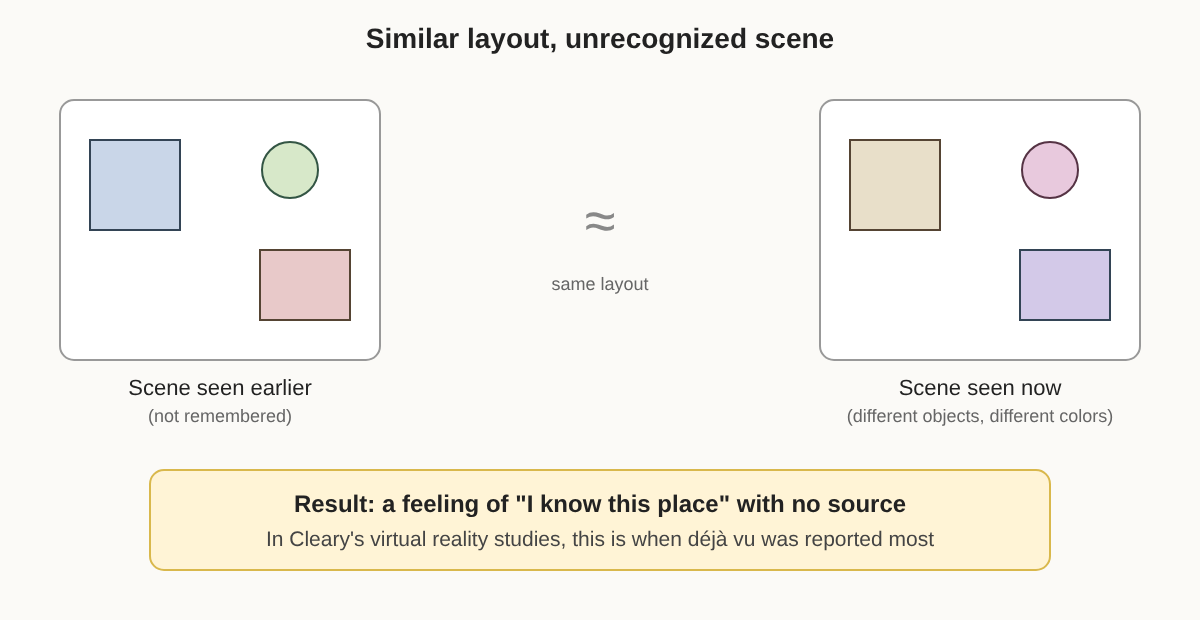
A shared layout can produce a familiarity feeling with no traceable source (original diagram).
Not the only explanation Cleary herself says layout similarity is not the only cause and that several mechanisms may be true at once. The literature also holds memory, attention, neurological and “dual processing” proposals.
What might be happening in the brain
Feeling that something is familiar and recalling the details are different things. One is “I’ve seen this face somewhere.” The other is “I saw them at a meeting last year.” One view of déjà vu is that the two come apart: the familiarity arrives, but it has nothing to do with what is happening now. A review calls this “decoupled familiarity” and links it to dysfunction in the parahippocampal region. It is a proposal, not an established mechanism.
The link with epilepsy
Medicine has a known connection. In temporal lobe epilepsy, especially some simple partial seizures, a person may experience déjà vu at the start of a seizure, and reports go back to the 19th century. The reverse does not follow. Déjà vu is common in healthy people and on its own is not treated as a sign of illness. In a seizure it usually comes with other features, such as altered awareness or repeated episodes.
Other ideas linked to déjà vu
Dual processing: two streams of perception processed milliseconds apart, so the second feels “old.”
Attention: a brief glance at a scene with divided attention, followed by full attention, can feel like a prior experience.
Memory: fragments of memories combining to fit a new situation.
Evidence for each is thin or disputed, and none has general acceptance.
Frequently asked questions
Is déjà vu the same as seeing the future?
No. Déjà vu is a feeling of familiarity. There is no evidence it shows that you know what will happen next.
Does everyone experience déjà vu?
No, but most people do. The rate varies by study, with about 60% in reviews and higher in some samples.
Why is it more common in younger people?
Brown’s review reports that frequency falls with age. There is no clear explanation for why.
Does déjà vu mean something is wrong?
No. It is a common experience in healthy people. In temporal lobe epilepsy it can also occur as part of a seizure.