Monthly Cyber Threat Report #1: Where ransomware stands worldwide
· Security
Each month this series puts the fraud and malware numbers from Kaspersky’s public statistics site next to other sources such as CISA, Sophos and Chainalysis. The first issue covers September 14 to October 13, 2026. Our previous post, Weekly Security Bulletin #1, looked at software flaws. This one looks at malware and ransomware, and updates what happened to the flaws from that bulletin.
In short
stats
First, what carries over from last week
Two flaws from the weekly bulletin were added to CISA’s Known Exploited Vulnerabilities list (KEV) on October 13. Their remediation deadline is October 16. CISA’s October 14 list adds four more entries, due October 17. The Palo Alto flaw requires an authenticated attacker with network access, so I put old and new flaws in one table.
compare
Ransomware link
timeline
| Flaws added | |
|---|---|
| Oct | 31 |
| Nov | 11 |
| Dec | 20 |
| Jan | 17 |
| Feb | 28 |
| Mar | 26 |
| Apr | 31 |
| May | 21 |
| Jun | 23 |
| Jul | 26 |
| Aug | 31 |
| Sep | 43 |
| Oct* | 15 |
The Chrome advice from last week stands: the browser should be on version 155.0.8059.79 or newer. A newer release may be out by now, so check Chrome’s About page.
What do these numbers measure?
Kaspersky publishes country by country the threats its antivirus catches on its users’ devices. A percentage here means the share of Kaspersky users in that country where a threat was seen. It does not measure the whole country, and results also depend on who installs Kaspersky.
features
Ransomware worldwide
| Share of users (%) | |
|---|---|
| Turkmenistan | 0.78 |
| Uruguay | 0.7 |
| Afghanistan | 0.66 |
| Yemen | 0.62 |
| China | 0.55 |
| Iran | 0.47 |
| South Korea | 0.41 |
| Pakistan | 0.36 |
| San Marino | 0.33 |
| Cameroon | 0.3 |
Turkmenistan is first (0.78%), followed by Uruguay (0.70%) and Afghanistan (0.66%). The top six, which also include Yemen, China and Iran, are all above 0.47%. Five countries from the top 10 of Securelist’s Q2 report also appear in this monthly list: Turkmenistan, China, Cameroon, Pakistan and South Korea. That may point to a lasting pattern, though a single month cannot prove it.
| Share of users (%) | |
|---|---|
| Turkmenistan | 21.65 |
| China | 17.07 |
| Burundi | 14.59 |
| Afghanistan | 12.93 |
| Mongolia | 12.43 |
| Chad | 12.24 |
| Congo | 11.45 |
| Cameroon | 11.42 |
| Central African Rep. | 11.38 |
| Uzbekistan | 11.18 |
Most common ransomware detections
The top entry (Trojan-Ransom.Win32.Gen.p, 30.72%) is not a specific family. It is a generic detection that says “this looks like ransomware”. Two WannaCry variants also made the top 10. WannaCry shook the world in 2017 and still turns up on unpatched Windows machines.
| Share (%) | |
|---|---|
| Qilin | 14.57 |
| Akira | 7.8 |
| DragonForce | 6.88 |
stats
quote
What else did ransomware do this quarter?
- Microsoft took down a malware-signing service (Fox Tempest) used by several ransomware groups.
- CISA confirmed active ransomware exploitation of CVE-2026-33825 (“BlueHammer”), a privilege escalation flaw in Microsoft Defender.
- Check Point linked zero-day exploitation of CVE-2026-50751 to the Qilin group.
- A group called PayoutsKing was reported to run hidden Linux virtual machines with QEMU to evade detection.
These items come from the summary of the Securelist report.
What the detection names mean
Kaspersky’s detection names look cryptic at first. The parts usually say this: the first part is the type (Trojan, Backdoor, Hoax), the second the platform (Win32, AndroidOS, Script), and the last the name of the family or version.
compare
Glossary of common names
- DangerousObject.Multi.Generic: a file Kaspersky’s cloud system judged malicious that has no classic signature yet.
- Trojan.Script.Generic: a generic script believed to be malicious. Common on web pages and email attachments.
- Backdoor.Win32.DarkKomet: a backdoor for controlling a computer remotely.
- Trojan-Ransom…Wanna: the WannaCry ransomware family.
- Trojan-Ransom…Blocker: usually ransomware that locks the screen or device.
- Trojan-Ransom…Crypren, Crypmod: ransomware detections that encrypt files.
- Hoax.Script.Scaremail: a fake email that tries to scare the reader.
- Trojan-Clicker.AndroidOS: an Android app that clicks ads in the background.
Ransomware and related threat types
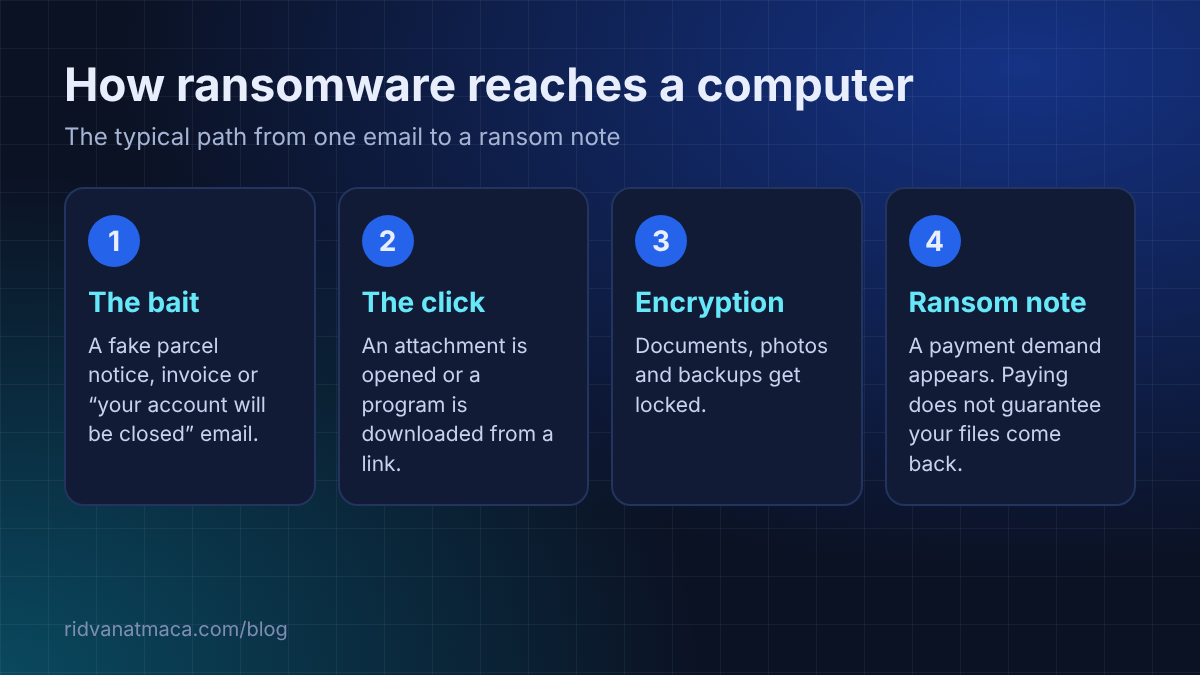
How ransomware starts and what it costs
Sophos’s 2026 study asked 2,158 IT and security leaders in 17 countries whose organizations had been hit by ransomware. It covers businesses, so it does not map one to one onto home users, but it shows which door attackers use.
Root cause of ransomware attacks (%)
stats
The top four causes are email, phishing, stolen passwords and unpatched flaws. Most attacks begin with one person’s click or one hijacked account. One more number stands out: Sophos says 97% of victims whose root cause was compromised credentials had some form of multi-factor authentication turned on. That does not show MFA is pointless. It means you should check that it is really on for every account and the most targeted places, such as VPNs and admin panels.
| Share who paid (%) | |
|---|---|
| 2022 | 78.9 |
| 2024 | 62.8 |
| 2025 | 28.0 |
According to Chainalysis, the share of victims who paid fell to 28% in 2025, a record low. At least $820 million in payments were tracked on-chain in 2025. The median payment rose from $12,738 to $59,556. In Sophos’s survey, 48% of victims whose data was encrypted say they paid. The two figures use different methods and samples, so do not compare them directly.
Do not pay the ransom
What you can do
Most ransomware and other malware gets in through the same few doors. The steps below need no special knowledge and are effective enough for a home user.
This week’s to-do list
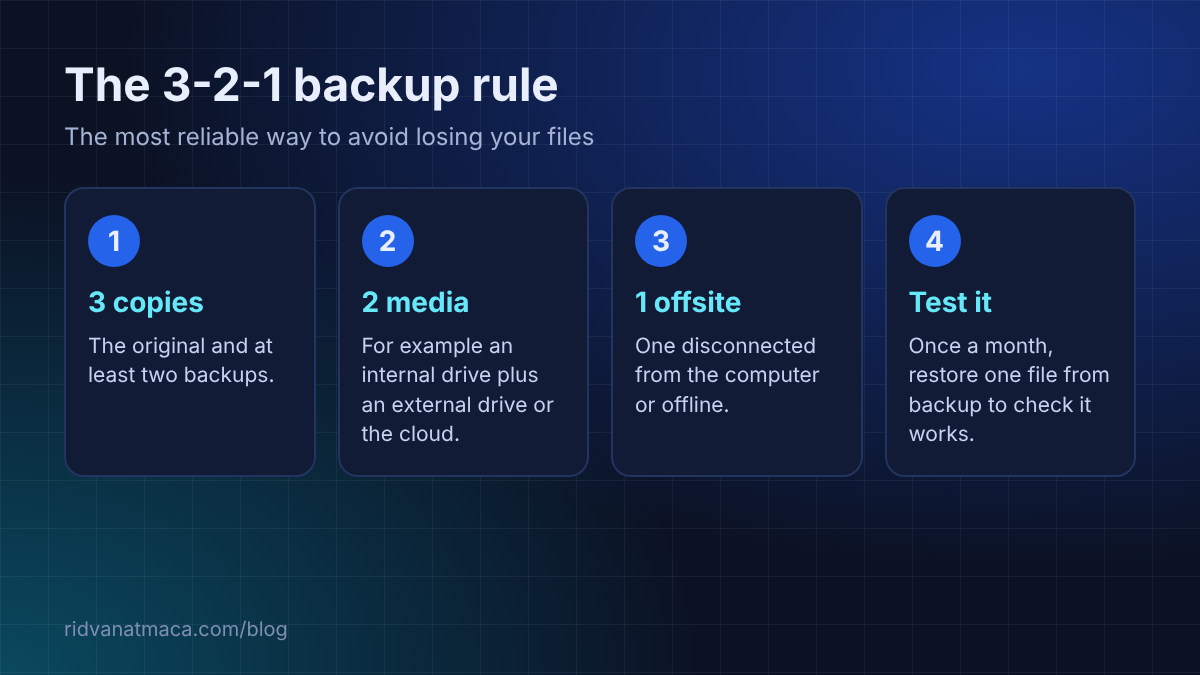
Where to keep a backup
features
Defense map
My computer was hit by ransomware. What now?
- Disconnect the computer from Wi-Fi and cables. It slows the spread.
- Do not plug in your backup drive. Clean the computer first.
- Take a photo of the note on the screen. Details in the ransom note help investigators.
- Do not pay or contact the people named in the note.
- At work, tell your IT team. At home, reinstall the system cleanly and restore your files from backup.
- You can check whether a free decryptor exists for your files at No More Ransom.
faq
Method and limits
How the data was compiled
- Period: the daily chart on Kaspersky’s site covers September 14, 2026 to October 13, 2026. The world pages use the monthly view.
- Country percentages and ranks come from the values behind the page’s country map. The page’s “top 10 countries” list shows different percentages; the order is the same, but because the rates differ I used the map values here.
- Detection-name percentages (for example 11.19%) come from Kaspersky’s top 10 list. Generic names (Generic, Gen) can cover many different malware samples.
- Percentages cover only Kaspersky users. They do not describe a whole country.
- KEV counts were tallied from CISA’s list as published on the evening of October 14, 2026. October is an incomplete month.
- The Sophos survey and Chainalysis on-chain data use different methods. They were not used in place of each other.
Sources
- Kaspersky Security Statistics: Ransomware (month)
- Kaspersky Security Statistics: Local infections (month)
- Securelist: IT threat evolution in Q2 2026, non-mobile statistics
- CISA Known Exploited Vulnerabilities Catalog
- Sophos: The State of Ransomware 2026
- BleepingComputer: Chainalysis ransomware payment figures (Feb 2026)
Weekly Security Bulletin #1
Open Kaspersky statistics
In the next issue I will compare the status of the Ivanti and Windows flaws, new KEV entries and the next period on Kaspersky’s site with this post.