The first barcode was scanned on a pack of gum: what happened in Troy, Ohio in 1974
· History
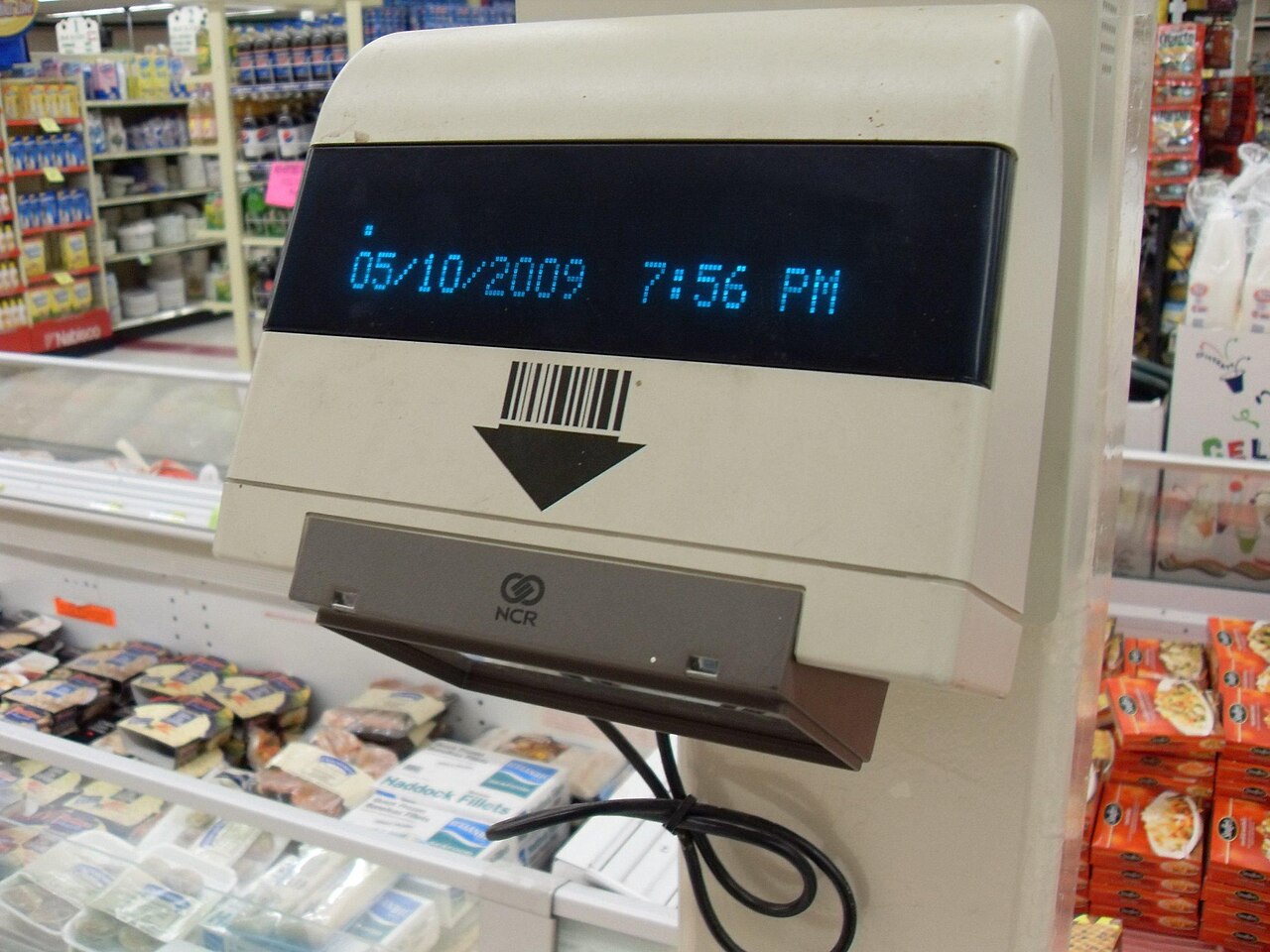
On the morning of 26 June 1974, at 8:01, a 10-pack of Wrigley's Juicy Fruit gum passed over a scanner at the Marsh supermarket in Troy, Ohio. The register showed 67 cents. The pack normally sold for 69, so the store had taken two cents off. The moment went into the record as the first time an item carrying a Universal Product Code (UPC) was read at a store checkout. [2]
The beep is so ordinary today that it is easy to forget it took about twenty-five years of work to get there.
Getting ready for that morning
None of it happened by itself. The night before, Marsh employees stuck temporary UPC labels on every prepackaged item in the store. At the checkout stood a newly installed NCR system. According to this account, Clyde Dawson, Marsh's head of research and development, picked the gum from a cart, and an employee named Sharon Buchannan did the scanning. Other accounts credit the scan to Dawson, so sources disagree on this small detail. [2]
The story has a nice footnote: a ten-pack from 1974 was scanned again at a Marsh checkout in 2009, and this time it rang up at 69 cents. [2]


The idea was on paper in 1949
The patent that Norman Woodland and Bernard Silver filed on 20 October 1949, granted on 7 October 1952 as US 2,612,994, is titled Classifying Apparatus and Method. It does not mention supermarket checkouts. It describes a system that reads codes printed on packages and sorts them automatically. Its worked example is sorting cans into price categories. [1]
The code works by whether a line is present at a given position. Present can be read as one, absent as zero, and the more positions there are, the more classes can be told apart. The first design used straight lines and needed the package to be presented in a particular orientation. The inventors changed it to a circular target of concentric rings, so the reader could decode it however the package sat. The reader was a photocell moving back and forth over a conveyor, and counters, gas-filled switching tubes and relays decoded the lines. [1]
What I find interesting is that the invention that later became the symbol of the supermarket checkout was born with a factory conveyor in mind. It looks nothing like a modern laser scanner, but the logic is the same: areas that reflect light differently turn into numbers.
Who decided on the bars and the digits?
An invention was not enough to get the idea to the checkout. The industry had to agree. The search for ways to speed up inventory and checkout in grocery retail had run for about 25 years. In 1973 grocery trade associations formed the Uniform Product Code Council and settled the numeric format with help from McKinsey consultants. Several firms proposed symbols, and the council chose the IBM design led by George Laurer. Woodland had helped Laurer as a planner at IBM. [2][4]
Murray Eden, technical consultant to the symbol subcommittee, describes the final meeting in an IEEE oral history. He had recommended the Pitney-Bowes design, but the committee voted for IBM. Eden says his own contribution was to suggest printing the digits under the bars. Asked which typeface to use, he picked OCRB over OCRA because it looked nicer. [3]
The digits were meant as a safeguard: if a scanner cannot read the bars, a person can read the number and key it in. [4]
The small piece of math behind the digits
A UPC-A has twelve digits: a number system digit, a five-digit manufacturer code, a five-digit product code and a check digit. To find the check digit, add the digits in odd positions and multiply by 3, add the digits in even positions, take the remainder of the total divided by 10 and subtract it from 10 (a remainder of 0 gives 0). For 03600029145 the odd positions add up to 14 and the even positions to 16. 14×3+16=58, the remainder is 8, and the check digit is 2. I worked it out by hand as well, and it holds. [4]
This simple check catches every single-digit error and about 89 percent of swaps between neighbouring digits. [4]
A short comment: a barcode is a number that identifies the product, and the store's system looks up the price. There are exceptions, such as store-assigned numbers for items sold by weight, but that is the general idea. Because the number carries no price, a discount can be set in the checkout records without touching the label. [4]
The 868 and 869 prefixes in Türkiye
Numbers issued to a company in Türkiye start with 868 or 869, prefixes allocated to GS1 Türkiye. According to GS1, a prefix does not show where a product was made. Prefixes are handed out so that numbers never collide anywhere in the world, and the code can be applied by a manufacturer, distributor, exporter or importer. So the first three digits you scan say less about where something was made than about which GS1 member organization issued the number. [5]
Sources
- Woodland, N. J. and Silver, B. US 2,612,994: Classifying Apparatus and Method (patent, 1952) (accessed: 2026-10-16)
- Deeter, J. First Item in the World Scanned by UPC (This Local Life) (accessed: 2026-10-16)
- Murray Eden oral history (IEEE Engineering and Technology History Wiki) (accessed: 2026-10-16)
- Wikipedia. Universal Product Code (accessed: 2026-10-16)
- GS1. GS1 Prefixes (accessed: 2026-10-16)
Cover image: an old NCR supermarket price scanner (illustrative image). Luke · Public domain.
