The cover of Voyager's Golden Record reads like an instruction manual
· Science
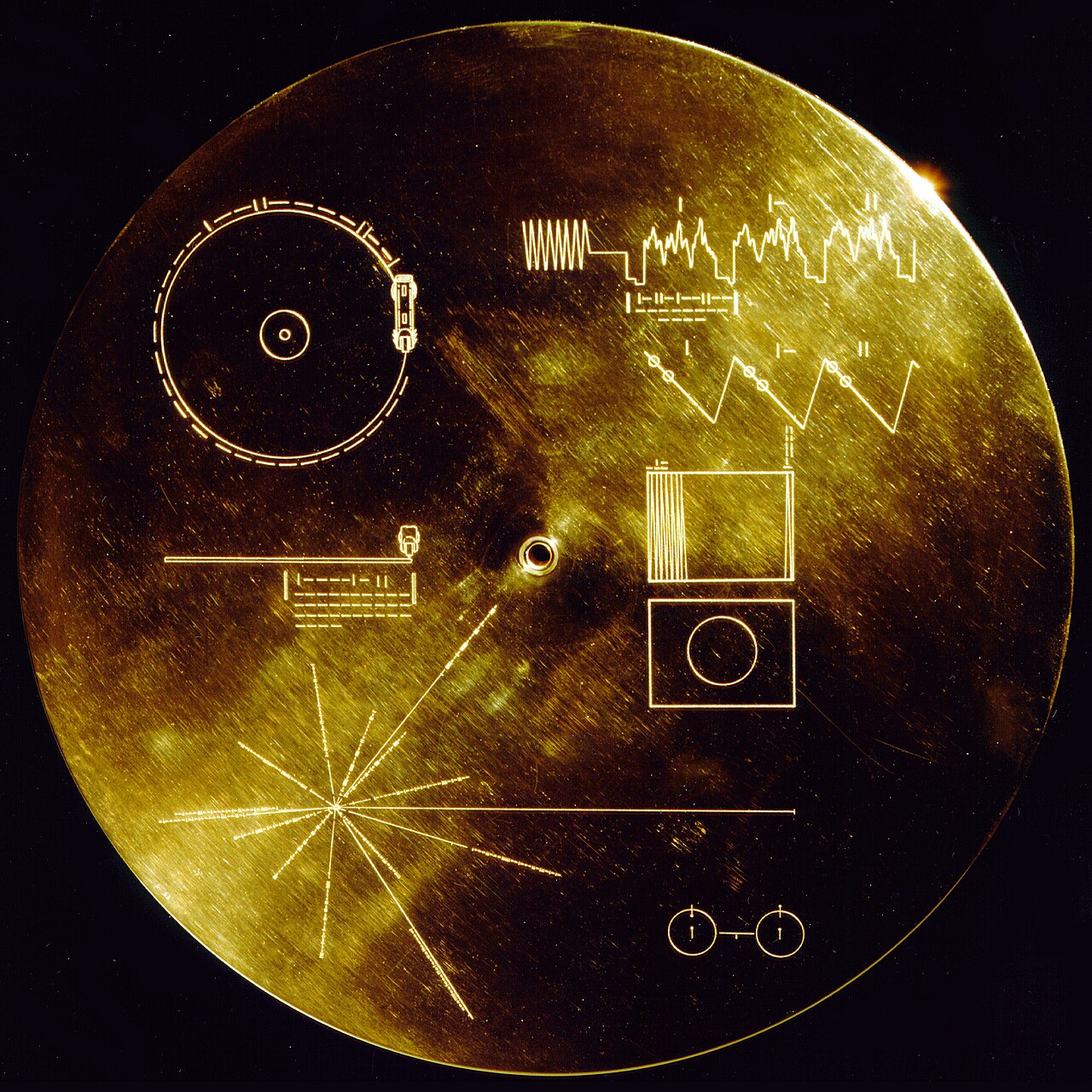
Voyager 1 and Voyager 2 each carry a record. Made of gold-plated copper, these records are 12 inches, or approximately 30 centimeters, in diameter and contain sounds, music, and images. But anyone who finds a record will first encounter its cover, rather than its contents. And on that cover is an instruction manual. [2] [6] [7]
The instructions are conveyed not through words, but through drawings and numbers. According to NASA, the symbols on the cover attempt to explain how to play the record, where Earth is located in space, and how long the record has been traveling. Since no one knows who might find it, the message relies on physics rather than any human language. [1] [6]
The Record Began in France and Was Gold-Plated in California
The production of the records took place across several countries and states. The blank discs came from Pyral S.A. in Créteil, France. CBS Records contracted the JVC Cutting Center in Boulder, Colorado, to cut the lacquer masters. The masters then went to James G. Lee Record Processing in Gardena, California. Eight Voyager records were cut and gold-plated there. [2]
The gold plating was completed on August 23, 1977. The records were then placed in aluminum containers and delivered to NASA's Jet Propulsion Laboratory. The cover is also made of aluminum. A sample of ultra-pure uranium-238 was electroplated onto it. An inscription on the record dedicates it to the makers of music across all worlds and all times. Each record is housed in an aluminum protective jacket, accompanied by a cartridge and stylus. [2] [6]
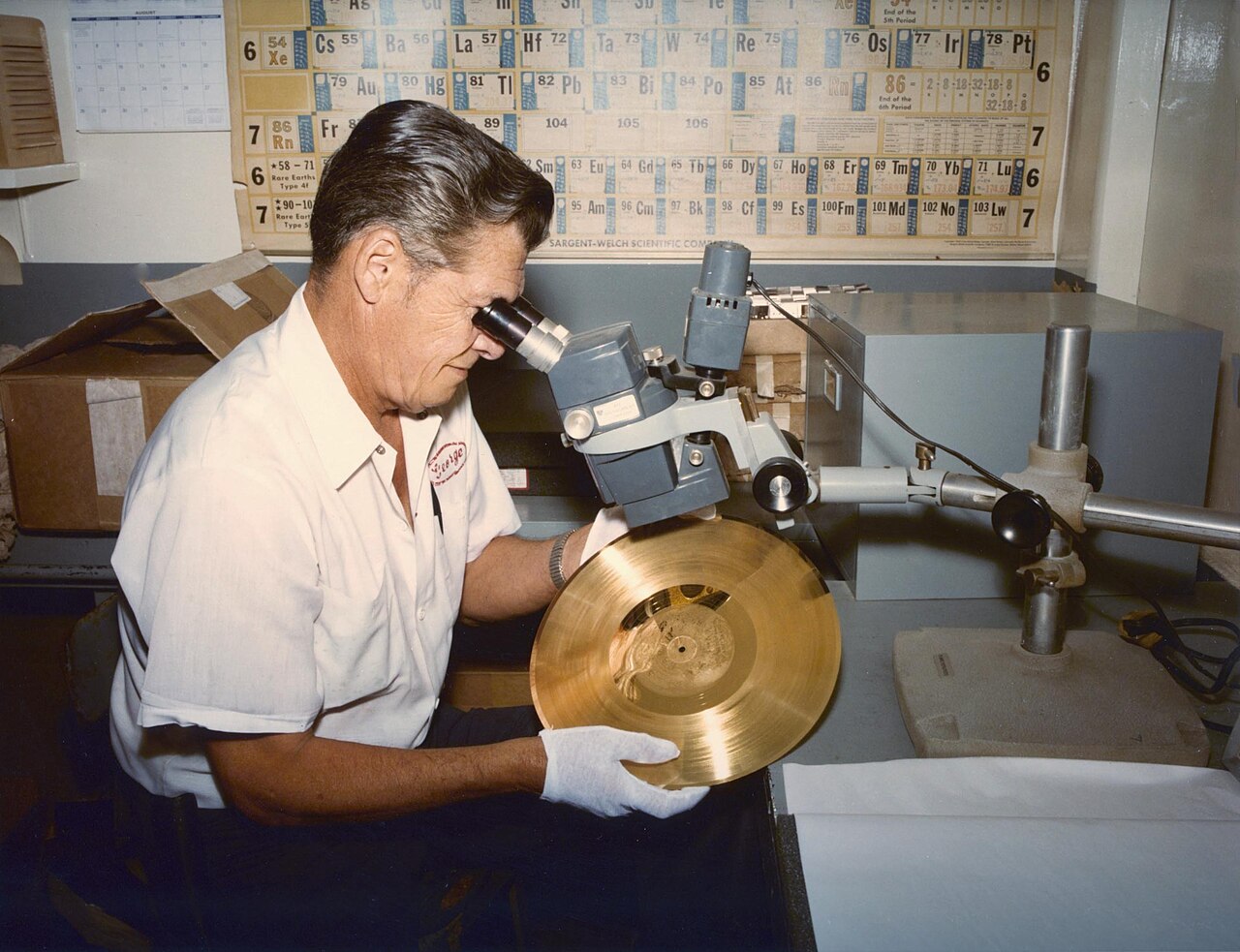
A worker examining a gold-plated Voyager record under a microscope. NASA/JPL · Public domain
It Takes Its Measure of Time from the Hydrogen Atom
The record plays at 16 2/3 revolutions per minute. The cover depicts the record and its stylus, with the duration of one complete revolution written nearby in binary: 3.6 seconds. Rather than expressing this duration in seconds, it uses units approximately 0.70 billionths of a second long. This unit corresponds to a time interval associated with a fundamental transition in the hydrogen atom. All time measurements on the cover are based on this unit. [1] [6]
The second is a unit of measurement invented by humans. The hydrogen atom, however, is not unique to Earth. The hydrogen diagram on the cover depicts the atom's two lowest states and a line connecting them. The number 1 beside the line indicates that this transition is to be used as the time scale. The same unit underlies not only the record's rotation period but also the time measurements used to decode the images. [1]
Each Image Is Constructed from 512 Lines
The record contains 115 images, all encoded in analog form. They include Earth's landscapes, wildlife, human activities, architecture, and scientific diagrams. The upper-right section of the cover explains how to reconstruct an image from the recorded signals. The diagrams show what the signal looks like at the beginning of an image and how the vertical lines should be drawn. A complete image consists of 512 vertical lines.[1] [3]
The cover also includes a sample image to help determine whether the decoding has been performed correctly. The first image on the record is a calibration circle. Anyone who reconstructs the image correctly should first see a circle. This is followed by images of structures such as the Taj Mahal, the Great Wall of China, the Sydney Opera House, and the Golden Gate Bridge; natural landscapes such as waterfalls and sand dunes; human activities such as cooking and construction; and animals including dolphins, eagles, and crocodiles.[1] [3]
Two Separate Clues for Location and Elapsed Time
The map in the lower-left section of the cover shows the position of the solar system relative to 14 pulsars. Their precise periods are also indicated on the map. Someone who finds the record could compare these periods with those of known pulsars to determine the location of the solar system. [1]
Uranium, meanwhile, measures elapsed time. NASA describes the sample as a kind of radioactive clock. The two-centimeter-diameter area plated onto the cover contains uranium-238, which takes 4.51 billion years for half of it to decay. Someone who finds the record could measure the ratio of remaining uranium to its decay products in this area and calculate how much time has passed since the uranium was placed aboard the spacecraft. [1] [7]
What's Beneath the Cover
The record's contents were selected by a committee chaired by Carl Sagan. The natural sounds include the seashore, wind, thunder, birds, and whales. Greetings are recorded in 55 languages. The oldest is Akkadian, spoken approximately 6,000 years ago, while the list also includes Wu, a modern Chinese dialect. The speakers were given only one instruction: keep the greeting short and address it to potential extraterrestrials. The English greeting comes from the children of planet Earth. Linda Salzman Sagan led the compilation of the greetings. According to NASA's account, the project aimed to present Earth not as a collection of separate nations, but as a shared community.[5] [6]
Music begins after the section featuring the sounds of Earth. The music section lasts approximately 90 minutes, and NASA's table lists 27 pieces. Among them are Bach's Brandenburg Concerto No. 2, the first movement of Beethoven's Fifth Symphony, Louis Armstrong's Melancholy Blues, Chuck Berry's Johnny B. Goode, and Tchakrulo, performed by a Georgian choir. The table also provides the duration of each piece: Johnny B. Goode lasts 2 minutes and 38 seconds, Melancholy Blues 3 minutes and 5 seconds, and Beethoven's movement 7 minutes and 20 seconds. The selection stretches from Germany to Java and from Senegal to Japan; Zaire, Australia, Mexico, New Guinea, Austria, Russia, Bulgaria, China, and India are also represented. [4] [6]
The Journey Will Be a Long One
On August 25, 2012, Voyager 1 crossed the boundary beyond which the Sun's plasma influence ends, becoming the first human-made object to reach interstellar space. NASA estimates that it will take the spacecraft approximately 300 years to reach the inner edge of the Oort Cloud and approximately 30,000 years to emerge from the cloud's outer boundary. Whether anyone will ever find the record remains unknown. [1] [7]
Sources
NASA Science: Golden Record Cover (accessed: 2026-10-06)
NASA Science: Making of the Golden Record (accessed: 2026-10-06)
NASA Science: Golden Record Images (accessed: 2026-10-06)
NASA Science: Golden Record Sounds and Music (accessed: 2026-10-06)
NASA Science: Golden Record Greetings (accessed: 2026-10-06)
NASA Science: Golden Record Contents (accessed: 2026-10-06)
NASA Science: Voyager Frequently Asked Questions (accessed: 2026-10-06)
Cover image: NASA/JPL · Public domain.