On the tip of my tongue: what happens in your head when you know the word but can't say it
· Psychology, Science
The name of a film, an actor's surname, a song you heard years ago. You know what kind of word it is, you may even remember the first letter, but the word itself won't come. Psychologists call this the tip-of-the-tongue state (TOT for short), and it has been studied for the better part of a century.
Below I look at three questions: how researchers describe the state, what it looks like in sign language, and why it happens more often in a group. The sources are at the end.
- In a TOT state the meaning of the word is in place and its sound form is missing. The first letter or the number of syllables often comes to mind.
- One review found that nearly everyone has it, it happens about once a week, and about half of the cases resolve on their own while you are in them.
- People who use sign language report the same thing, in their fingers.
- Trying to remember with a group increases the feeling, but not the number of correct answers.
Knowing a word and producing it are separate steps
Roger Brown and David McNeill ran the first systematic study in 1966. They read participants the definitions of rare words and asked them to name the word. When people failed, they told them the answer and asked whether the word had been on the tip of their tongue. Even people who could not produce the word guessed its first letter, its number of syllables and similar-sounding or similar-meaning words better than chance. [2]
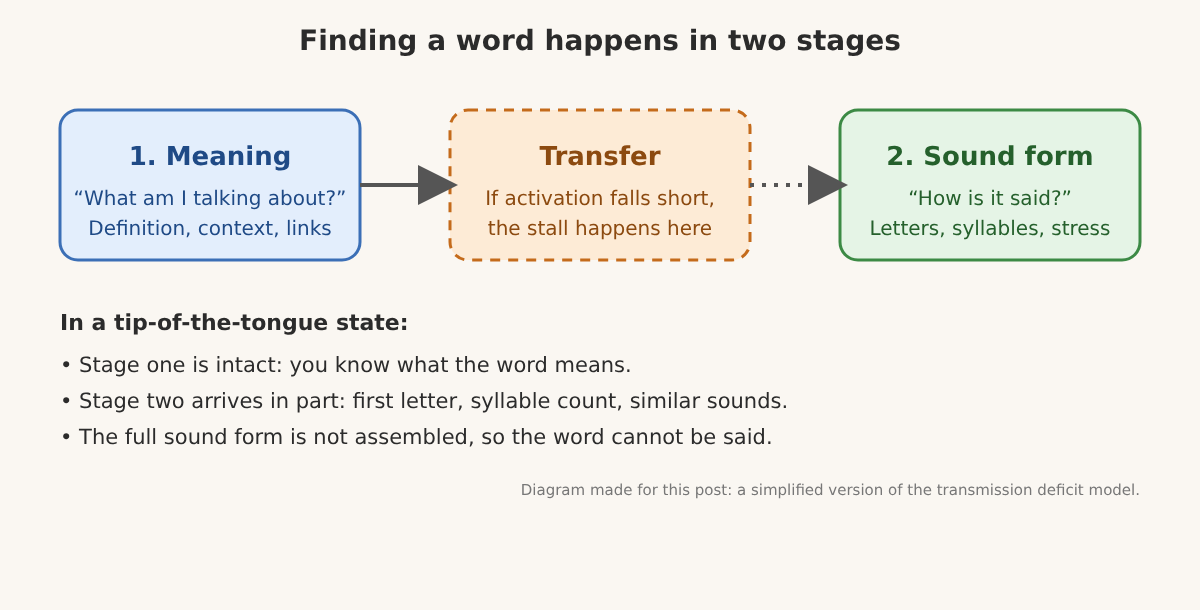
I find this the most interesting part. Finding a word feels like a single move, but the results suggest it runs in stages: meaning comes first, then the sound shape is assembled. The transmission deficit model says the stall happens when activation passes only partway from meaning to sound. Other explanations exist and the topic is still debated. [2]
How common is it?
- 97.5% People who reported having had a TOT (Campus survey of 197)
- ≈ once a week Frequency reported in reviews (Brown, 1991)
- ≈ half Resolved while in the state (Brown, 1991)
Brown's 1991 review lists what earlier studies had in common: the state is nearly universal, grows with age, is frequent for proper names, and people often reach the first letter of the target. [1]
In a 2021 campus survey by Rousseau and Kashur, 97.5% of 197 people said they had experienced it. [4]
It does not surprise me that proper names get stuck so often. A name usually has no meaning to hold on to, only a string of sounds. That is my reading and is not stated in the sources. The language detail is more concrete: in Bennett Schwartz's survey of 51 languages, 45 had an idiom for the experience, most pointing to the tongue, mouth or throat. American Sign Language was among those without one. [2]
On the tip of the fingers
No idiom does not mean no experience. Thompson, Emmorey and Gollan (2005) worked with 33 deaf ASL signers in California. The participants tried to name 20 pictures of famous faces and to translate fairly obscure English words, including city and country names, into ASL. [3]
For famous names, 21 people had 55 episodes. Because many such names are fingerspelled letter by letter in ASL, people typically recalled the first letter's handshape but not the rest. For obscure words, 13 people had 24 episodes. In those cases some of the four components of a sign (handshape, location, orientation and movement) came back and others did not. [3]
The researchers conclude that meaning and form are stored separately in signers too. That cuts against the idea that sign language is mostly pantomime: as I read it, if form carried meaning directly, one could not stay intact while the other went missing. [3]
Why does it happen more in groups?
Rousseau and Kashur asked 48 participants general knowledge questions. People answered either alone or in groups of four. Those alone reported a TOT on 3% of the questions, those in groups on 8%. The share of correct answers stayed nearly the same (65% against 62%). [4]
The authors take this as a sign that a TOT is not the same thing as retrieving something. On the view advanced by Schwartz and Metcalfe, the feeling is a premonition of future recall that appears when clues pass a threshold. The authors suggest that the group itself may count as one such clue. [4]
The participants were young (mean age about 25) and the sample was small, so the result should not be stretched. Still, think of a conversation at a table that starts with “that one, in that film” and never quite gets there. It is a familiar scene. That part is my inference and the study did not measure it. [4]
When you get stuck Reviews report that being given the first letter helps resolve a TOT and that scanning the alphabet is a known strategy. According to Brown, about half of these states resolve on their own while they last.
- 1966 Brown and McNeill publish the first systematic study — Definitions of rare words are read aloud
- 1991 Brown's review — Nearly universal, about once a week
- 2005 Tip of the fingers — Study with 33 deaf ASL signers
- 2021 Group study — 3% alone, 8% in groups
Sources
- Brown, A. S. (1991). A review of the tip-of-the-tongue experience. Psychological Bulletin, 109, 204–223 (accessed: 2026-10-14)
- Tip of the tongue (Wikipedia) (accessed: 2026-10-14)
- Thompson, Emmorey & Gollan (2005). “Tip of the fingers” experiences by deaf signers (özet: BPS Research Digest) (accessed: 2026-10-14)
- Rousseau & Kashur (2021). Socially Shared Feelings of Imminent Recall: More Tip-of-the-Tongue States Are Experienced in Small Groups. Frontiers in Psychology, 12 (accessed: 2026-10-14)
Cover: Cullen328 · CC BY-SA 4.0.
