The Antikythera mechanism: a bronze sky calculator from a shipwreck
· History
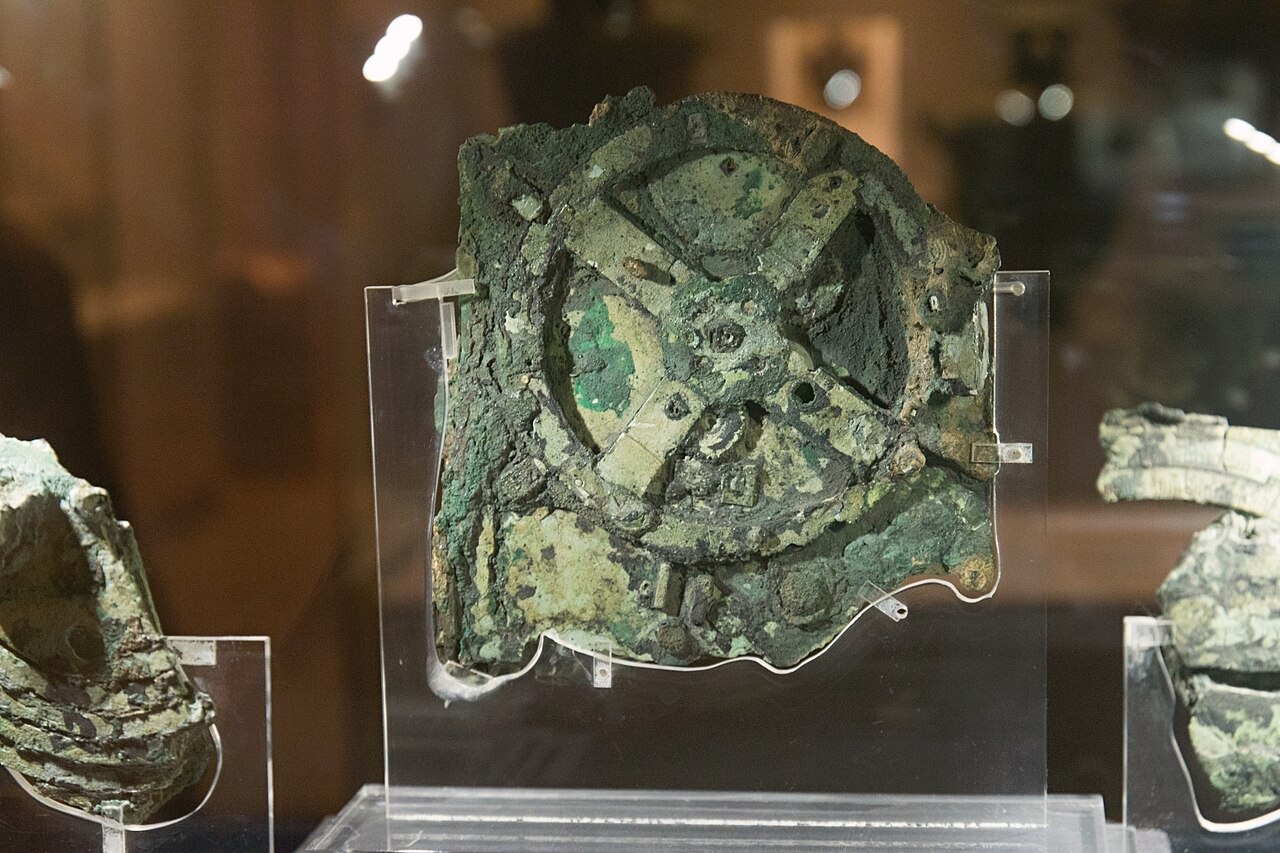
A Roman trading ship lies 45 metres deep off the Greek island of Antikythera. Captain Dimitrios Kontos and sponge divers from Symi found the wreck in early 1900. Their dives brought up bronze and marble statues, pottery, glassware, jewellery and coins [2]. Among the finds was a lump that looked like rock. It sat unnoticed in the National Archaeological Museum in Athens for about two years. On 17 May 1902, Valerios Stais and his cousin Spyridon Stais noticed a gear wheel embedded in one of the pieces [2].
A shoebox-sized bronze case
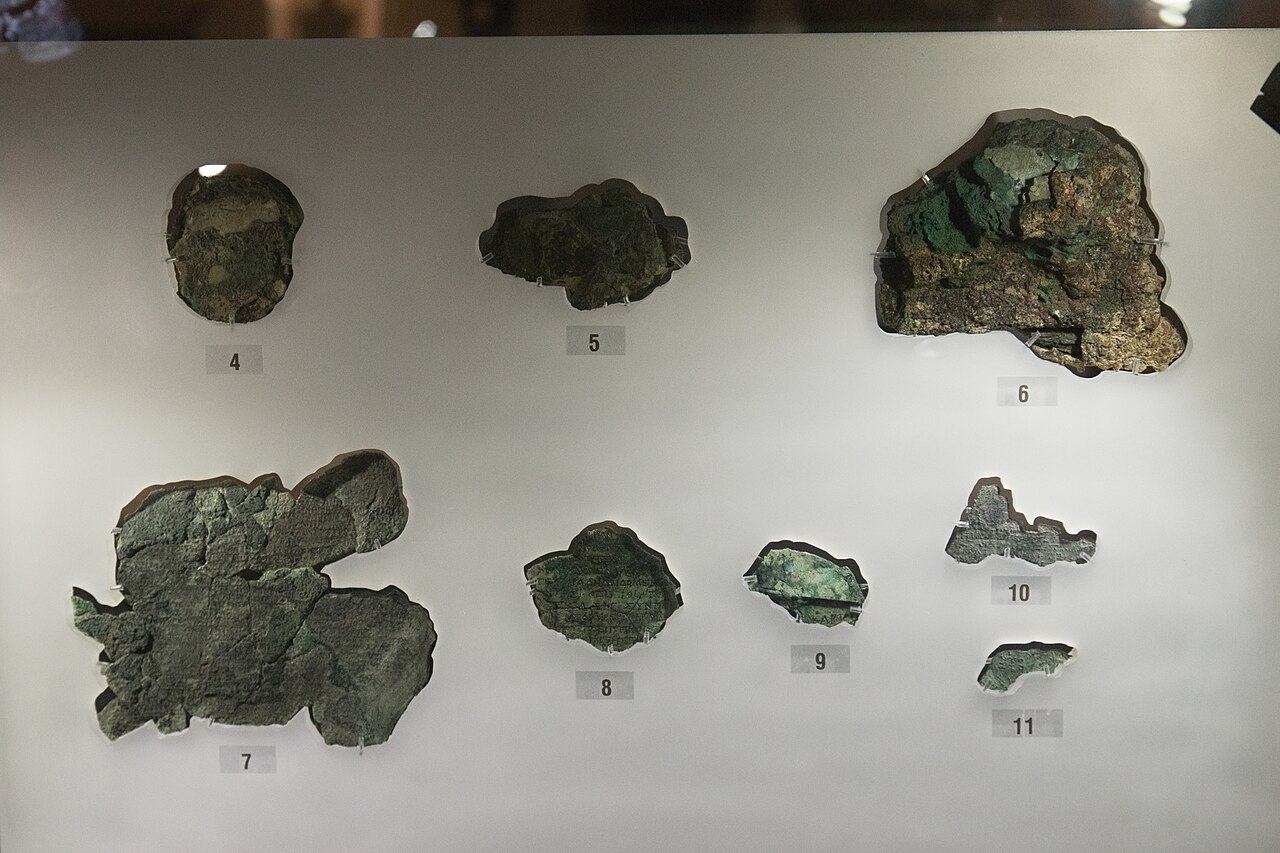
According to Britannica, the device was built from bronze sheets inside a case about the size of a shoebox, and dates to roughly 100 BCE, give or take 30 years [1]. Wikipedia gives the case as 34 × 18 × 9 cm. The largest gear is about 13 cm across and originally had 223 teeth [2]. Of the 82 surviving fragments, seven matter mechanically. Thirty gears are visible, and the original total is estimated at about 35 [2].
A hand-turned shaft drove a main gear, and one turn of that gear stood for one solar year. The front showed zodiac positions, and the back carried spiral dials for the Moon and for eclipse cycles [1]. Britannica notes that gearing this complex did not show up again for about a thousand years, in medieval cathedral clocks [1].
The cycles on the dials
One of the back dials follows the Metonic cycle. 235 synodic months, about 19 years, bring the solar and lunar calendars back into step [1][2]. Another dial is for eclipse prediction. It uses the 223-month Saros cycle, which lasts about 18 years and 11⅓ days [2]. A further dial covers the 54-year Exeligmos, three Saros cycles [2]. A lower dial tracks the four-year calendar of the Panhellenic Games, including the Olympics [1].

Looking inside the corrosion
The surfaces are corroded, so the interior cannot be seen without imaging. Derek J. de Solla Price began the work in 1951. Between 1971 and 1974 he and Charalampos Karakalos took X-ray and gamma-ray images and published the results in 1974 [2]. In 2005 Mike Edmunds' team at Cardiff University used X-ray tomography and high-resolution scanning, and the findings appeared in Nature in 2006 [2]. A 2016 tomography read the numbers 462 for Venus and 442 for Saturn, which relate to the two planets' synodic cycles [2][3].
Planets on the front
In March 2021, Tony Freeth and colleagues at UCL published a new model of the front in Scientific Reports. The inscriptions read by tomography describe the motions of the Sun, the Moon and the five planets known in antiquity. The team rebuilt these as a display of the Greek Cosmos on the front [4]. Planet positions were shown with marker beads on rings [3]. The team derived the cycles of the missing planets using Greek mathematical principles attributed to Parmenides [3]. According to the team, ratios with small prime factors such as 7 and 17 were used, so some gears could serve more than one planet [2].
What is still open
For now the model exists as a three-dimensional computer model. The team's next task is to show that the system of nested tubes could be made with ancient workmanship [2][3]. Britannica adds that the device's exact purpose is still speculative, and that nobody knows whether similar bronze gear technology was used elsewhere in the Greco-Roman world [1].
Work at the wreck also continued. Jacques Cousteau's expedition visited in the 1970s, and dives in 2012 and 2015 turned up more objects and possibly a second ship [2]. All 82 fragments of the mechanism are now in the National Archaeological Museum in Athens [2].
Sources
- Britannica: Antikythera mechanism (accessed: 2026-10-07)
- Wikipedia: Antikythera mechanism (accessed: 2026-10-07)
- Popular Archaeology: Experts recreate a mechanical Cosmos from the world's first computer (UCL press release) (accessed: 2026-10-07)
- Freeth et al. (2021), A Model of the Cosmos in the ancient Greek Antikythera Mechanism, Scientific Reports (accessed: 2026-10-07)
Cover image: Zde, CC BY-SA 4.0.
