Gemini 4 Argon: Google Is Back in the AI Race
· Technology
On September 30, 2026, Google announced Gemini 4 Argon, its new frontier model, and returned to the top three of the AI race after a long stretch behind. The model is built for software engineering, enterprise knowledge work and cybersecurity defense.
Over the past year the spotlight had largely gone to OpenAI's GPT-6 Astra and Anthropic's Fable 5. Argon is Google's answer: intelligence scores on par with its rivals, aggressive pricing and strong performance on long-running tasks.
What is Gemini 4 Argon?
Argon is the first model in Google DeepMind's Gemini 4 family and the company's most advanced AI to date. Its core promise is sustained deep reasoning across complex, multi-step work.
The model is also the result of a change of course. Google had planned to ship Gemini 3.5 Pro this year, but cancelled it to focus on the lighter 3.8 Flash and go straight to Gemini 4. As a result, Argon is Google's first proprietary model above the Flash class in roughly seven months.
Google's long-term plan is clear: as with Gemini 3, Argon will gradually power most of the company's services, from Search to YouTube.
Key capabilities
What sets Argon apart is its ability to run long, multi-stage tasks end to end, rather than one-off questions and answers.
1 million token output limit: The previous 64K-token cap has been raised to 1 million, making it possible to generate very long code, reports or documents in a single pass.
Real-world coding: Google engineers use Argon for everything from everyday debugging to large-scale codebase migrations and algorithm design.
Agentic performance: In an area where Gemini models have historically been weak, there is a clear jump. On Terminal Bench 4, the score rose 53 points over Gemini 3.1 Pro Preview to 57%.
Multimodality: It posts the best result on LVBench, which measures long video understanding, at 91.7%.
Enterprise knowledge work: Trained to be strong in professional workflows such as legal and finance; creative writing is also a focus area.
A concrete example from real use: Google says it used Argon to optimize memory across its data centers, freeing up about 300 TiB of memory without buying new hardware. Quantum computing researchers are also using the model in their work.
Cybersecurity: Argon's most striking side
Google trained Argon specifically to be highly capable at cyber defense. The model can autonomously find, validate and patch critical software vulnerabilities.
Fairwind Program: Argon was first released to trusted security teams in this program, so they can find and fix flaws in their own software before the model is widely available.
Access without guardrails: Trusted defenders and Google's internal teams get a version with cyber safeguards removed, so they can use the model's full defensive capability.
Prompt injection resistance: The model is designed to withstand attacks that try to hijack its behavior with malicious instructions. According to Google, it ranks first on Gray Swan's indirect prompt injection benchmark.
Extra monitoring layers: Argon ships with chain-of-thought and action monitors that can halt execution when needed.
For developers and small teams who run their own infrastructure, this focus matters: once access opens up, Argon could be a strong assistant for code and configuration audits.
Benchmark results: where does it stand?

Independent evaluations put Argon at the top on some tests and behind Claude Opus 5.5 and GPT-6 Astra on others. On Artificial Analysis's composite Intelligence Index, Argon matches GPT-6 Astra at about 60% of the cost per task.
Benchmark | What it measures | Gemini 4 Argon | Note |
|---|---|---|---|
Terminal Bench 4 | Agentic tasks in a terminal | 57% | Behind Claude Sonnet 5.5 (64%), Claude Opus 5.5 (60%) and GPT-6 Astra (59%) |
CWE-bench v1 | Vulnerability remediation | 68% | Tied for first |
AutomationBench (Zapier) | End-to-end business process automation | 51.3% | Ranked #1 |
LVBench | Long video understanding | 91.7% | Best result |
Factual accuracy (Artificial Analysis) | Knowledge accuracy | 50% | 13 points behind GPT-6 Astra (63%) |
CWE-bench, AutomationBench and LVBench scores come from Google's own announcement; Terminal Bench and accuracy scores come from the independent firm Artificial Analysis.
Comparison with other current models
Short answer: Argon is at the same intelligence level as GPT-6 Astra and slightly behind Claude Opus 5.5, but at its introductory price it is one of the cheapest frontier models. September 2026 was a very busy month: Anthropic released Fable 5.1, Opus 5.5 and Sonnet 5.5; OpenAI released GPT-6 Astra, GPT-6 Luna and GPT-6.1 Sol; and Google released Argon.
Current models and pricing
Model | Company | Released | Price (input / output, $ per 1M tokens) | Cached input ($ per 1M tokens) | Positioning |
|---|---|---|---|---|---|
Anthropic | Sep 1, 2026 | $10 / $50 | $0.25 | Most capable Claude, long autonomous agent work | |
GPT-6 Astra | OpenAI | Sep 3, 2026 | $10 / $50 | $1 | OpenAI's most intelligent model |
Claude Opus 5.5 | Anthropic | Sep 22, 2026 | $4 / $20 | $0.20 | Complex, open-ended work |
Gemini 4 Argon | Sep 30, 2026 | $2 / $10 (intro), then $4 / $20 | $0.10 | Google's new frontier model | |
Anthropic | Sep 28, 2026 | $2 / $10 | $0.20 | Fast, well-scoped everyday work | |
GPT-6.1 Sol | OpenAI | Sep 29, 2026 | $2 / $10 | $0.10 | Near-Astra intelligence at one fifth of the price |
Claude Haiku 4.5 | Anthropic | Oct 2025 | $1 / $5 | $0.10 | Light, fast tasks |
GPT-6 Luna | OpenAI | Sep 22, 2026 | $0.10 / $0.50 | $0.01 | Fast everyday work at scale |
Intelligence or cost?
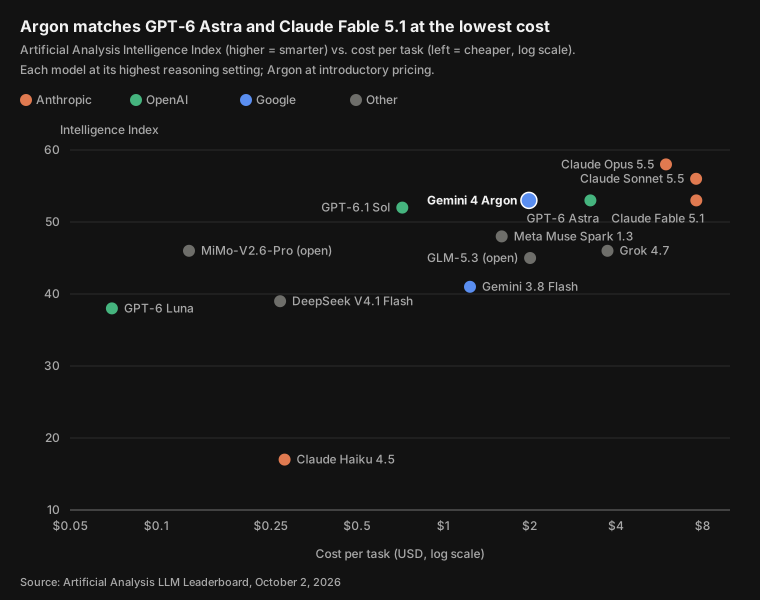
The chart shows Artificial Analysis's composite Intelligence Index against the real cost of running an average task in that index. Claude Opus 5.5 leads (58), followed by Claude Sonnet 5.5 (56). Argon, GPT-6 Astra and Claude Fable 5.1 share the same score (53), but Argon gets there at the lowest cost. On price-performance, GPT-6.1 Sol stands out: it scores 52 at $0.72 per task.
Argon's edge depends on its introductory price: once the discount ends, its cost per task rises to $3.98, above Astra's. Outside the big three, the strongest models are Meta Muse Spark 1.3 (48), Grok 4.7 (46) and the open-weights MiMo-V2.6-Pro (46). Claude Haiku 4.5, a previous-generation model, sits far down the list.
Four models on Google's reported benchmarks
Benchmark (vendor-reported) | Gemini 4 Argon | Claude Opus 5.5 | GPT-6 Astra | Claude Fable 5.1 |
|---|---|---|---|---|
DeepSWE v1.1 (long software tasks) | 77.9% | 74.2% | 74.1% | 67.4% |
Vals Index (general professional work) | 68.9% | 67.0% | 63.1% | 65.8% |
Harvey Legal Agent (legal agent) | 19.6% | 3.8% | 5.4% | 6.7% |
GraphWalks 256K–1M (long context) | 84.2% | 66.8% | 71.8% | 65.0% |
FrontierSWE v2 (large codebases) | 55.0% | 62.3% | 65.5% | 56.3% |
These scores were compiled from Google's own table and had not been independently reproduced at launch. On Terminal Bench 4, the top score goes to Claude Sonnet 5.5 (64%); Argon is fourth at 57%, behind Opus 5.5 and GPT-6 Astra.
Details that make a difference
Output limit: Argon can generate 1 million tokens in a single response; Opus 5.5, Sonnet 5.5, Fable 5.1 and GPT-6 Astra cap out at 128K tokens.
Hallucination: Argon's hallucination rate is 15%, versus 51% for GPT-6 Astra and 54% for GPT-6.1 Sol. On factual accuracy, however, Astra leads (63% vs. 50%).
GPT-6.1 Sol's claim: According to OpenAI, Sol matches Astra on DeepSWE v1.1 at roughly one fifth of the cost. On the scientific research test Terminal-Bench Science, its cost per task is $5.47, versus $23.21 for Opus 5.5 and $23.80 for Astra. These are OpenAI's own tests.
Speed: OpenAI launched GPT-6 Astra Ultrafast and GPT-6.1 Sol Ultrafast in the API, running up to 8 times faster than Astra.
Access: Claude Fable 5.1, Opus 5.5 and Sonnet 5.5 are generally available. GPT-6.1 Sol is available to ChatGPT Plus, Pro, Business, Enterprise and Edu users (in Work and Codex) and in the API as
gpt-6.1-sol. Argon, for now, is limited to Fairwind Program members.
Which one should you choose?
Your need | Model to consider | Why |
|---|---|---|
Hardest tasks, budget secondary | Claude Fable 5.1 / GPT-6 Astra | Each company's most capable model |
Production use today | Claude Opus 5.5 | Generally available, highest independent index score |
Terminal-based coding agents | Claude Sonnet 5.5 / Opus 5.5 | Top two on Terminal Bench 4 |
Legal, finance and research agents | Gemini 4 Argon (once available) | First on Harvey and Vals benchmarks |
Very large code migrations, long output | Gemini 4 Argon | 1M-token output limit |
Low-cost, high-volume work | GPT-6.1 Sol / Claude Sonnet 5.5 | High intelligence at $2 / $10 |
Simple, very high-volume tasks | GPT-6 Luna / Claude Haiku 4.5 | Lowest token prices |
Pricing and availability
During the introductory period, Argon will cost $2 per million input tokens and $10 per million output tokens, the same as OpenAI's newly discounted GPT-6.1 Sol.
Price (per 1M tokens) | Input | Output | Cached input |
|---|---|---|---|
Introductory price | $2 | $10 | $0.10 |
Standard price | $4 | $20 | $0.20 |
The discount on cached input tokens has been raised to 95%. One caveat: Argon averages 62K output tokens per task, versus 27K for GPT-6 Astra. In other words, its cost advantage comes from a lower unit price, not from using fewer tokens.
Availability: The model is currently open only to Fairwind Program members and selected users and has not yet launched publicly. Next in line are Google AI Ultra subscribers and paid API customers. As of launch day, no API model ID had been published.
Weaknesses and criticism
Argon is a strong model, but it does not lead everywhere and has not yet been tested independently in depth.
Limited access, limited verification: Because the model is not widely available, independent testing remains limited.
Internal doubts: According to a pre-launch Bloomberg report, some Google employees worry that Argon is not as powerful as Anthropic's and OpenAI's models. Google disputes this and says employees have been testing Gemini 4 versions for weeks.
Accuracy drop: Its factual accuracy score fell 5 points compared with Gemini 3.1 Pro Preview. On the other hand, the model is more likely to admit when it doesn't know an answer rather than guess.
Token appetite: It produces more than twice as many tokens per task as its rivals; once the discount period ends, its cost advantage may shrink.
Shifting focus: Market attention is moving from raw model power to personal agents. Google is still evaluating how Argon will be used in products such as Spark.
Conclusion: what it means for developers
Gemini 4 Argon puts Google back in the frontier-model league, and it does so mainly on price. Offering the same intelligence as its rivals at a lower cost makes it attractive for teams that want to automate long, multi-step work.
Its strongest areas are cybersecurity, business process automation and long video understanding. In pure agentic coding and factual accuracy, the Claude and GPT-6 families are still ahead. Once the model opens up more broadly, the most sensible path is to start with a small pilot on your own workload and keep a close eye on token consumption.