OM SYSTEM OM-3
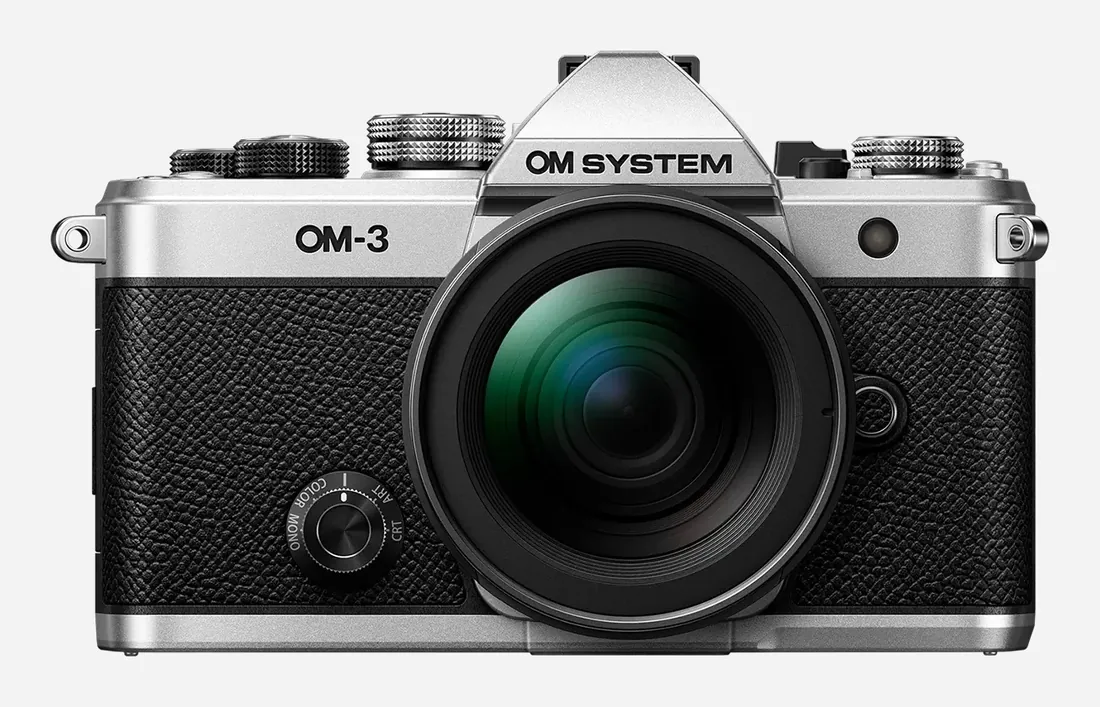
OM-3 is a mirrorless camera with a Micro Four Thirds mount and interchangeable lenses. Its metal body, inspired by old film SLRs, weighs 413 g. The stacked sensor and in-body stabilization stand out. It has one SD slot and no pronounced grip on the front.
OM-3 · body only
Specifications
| Specification | Value |
|---|---|
| Announcement / availability | 6 February 2025 / late February 2025 |
| Sensor | 4/3-inch stacked BSI Live MOS; approx. 20.4 MP effective, 22.9 MP total |
| Processor | TruePic X |
| Mount / format | Micro Four Thirds; 35 mm equivalent focal length approx. 2× |
| Photo size and format | 5184 × 3888 maximum; 12-bit RAW and JPEG |
| ISO | LOW (approx. 80) – 102400; default auto upper limit 25600 |
| Stabilization | Five-axis sensor shift |
| Stabilization rating | 6.5 stops at centre and 5.5 at the corner in the body; 7.5 and 6.5 stops with a compatible Sync IS lens |
| Autofocus | 1053-point cross-type on-chip phase detection; subject detection: people, birds, cats, dogs, car and motorcycle racing, aircraft, helicopters, trains |
| Viewfinder | 2.36-million-dot OLED electronic viewfinder; up to 1.37× magnification; 27 mm eye point |
| Rear display | 3-inch, 3:2; approx. 1.62 million dots; touch, vari-angle |
| Shutter | Focal plane; 1/8000–60 s; down to 1/32000 s in silent mode; approx. 100,000 shot durability |
| Burst | Approx. 6 fps; with Pro Capture 20 fps, 50 fps with compatible lenses and 120 fps with focus and exposure fixed at the first frame |
| Pro Capture | Pro Capture: starts capturing at half-press; a full press saves up to 70 frames from before it |
| Computational modes | High Res Shot (10368 × 7776 on a tripod, 8160 × 6120 handheld); Live ND (ND2–ND64) and Live GND; HDR; focus stacking; multiple exposure; CP button |
| Colour control | Creative dial on the front: COLOR, MONO, ART, CRT; Color and Monochrome Profile Control |
| Video resolution | 4K 3840 × 2160 and C4K 4096 × 2160: 60/50/30/25/24p; Full HD 60/50/30/25/24p |
| Video codec | H.264 8-bit and H.265 10-bit; Flat, OM-Log400, HLG, OM-Cinema1 and OM-Cinema2 profiles |
| High-speed video | Full HD at 240, 120 and 100 fps; no sound recorded; slow and quick motion mode |
| Continuous video recording | At 4K 30p 10-bit: up to 30 minutes at 40 °C; unlimited at 25 °C |
| External recording | HDMI Type D; 4K/C4K 12-bit RAW output to a compatible recorder |
| Audio | Built-in stereo microphones; 3.5 mm microphone and headphone jacks; 96 kHz / 24-bit linear PCM |
| Card slot | One SD slot; SDHC/SDXC, UHS-I and UHS-II |
| Ports and wireless | USB-C (USB 3); HDMI Type D; microphone and headphone; hot shoe; sync socket; Bluetooth Low Energy and Wi-Fi |
| Battery | BLX-1 lithium-ion battery; 7.2 V / 2280 mAh; approx. 500 charge cycles |
| Battery life | Approx. 590 shots in standard mode, approx. 1040 in quick sleep mode; 120 min video (CIPA) |
| USB charging and power | The battery charges in the camera over USB-C; USB PD can power the camera externally |
| Dimensions | 139.3 × 88.9 × 45.8 mm (excluding protrusions) |
| Weight | 413 g body only; 496 g with battery and card |
| Durability | Magnesium alloy body; IP53 splash and dust resistance; freezeproof to −10 °C |
| Dust reduction | Supersonic Wave Filter |
| Software | OM Image Share (OI.Share) app; OM Workspace RAW processing software |
From the manufacturer
OM SYSTEM describes the OM-3 as a camera that brings the OM-1 Mark II’s stacked sensor and focus system into a smaller, film-SLR-inspired body, with computational photography modes and OM-Cinema video profiles. OM Digital Solutions
Strengths and limitations
The Cotswold Photographer’s Fleet, after several months, singles out continuous-AF tracking and stabilization; he finds the viewfinder the weakest of his cameras, notes the single card slot and adds an L-grip for the 25 mm f/1.2 because there is no front grip.
The Cotswold Photographer: OM System OM-3 Review (long-term update)Westlake reports sharp handheld frames at 2 seconds with the 12–45 mm f/4 PRO and usable frames at exposures up to 10 seconds with primes. He used a single battery and never wanted a spare, and says bursts approached a thousand frames per charge; he finds the physical controls sparse and the body without a real grip.
Amateur Photographer: OM System OM-3 reviewEisl lists the small number of buttons and the lack of a screw-in protective sleeve for the HDMI port as limits for video use, saying the HDMI port is more exposed than on the OM-1 series.
Thomas Eisl: OM System OM-3 ReviewDPReview finds the autofocus good but not best in class: standard tracking follows subjects but sometimes misjudges lens drive distance, producing a few soft frames, and subject recognition cannot be combined with AF tracking. In video, rolling shutter was measured at 5.8 ms in the main 4K and FHD modes.
DPReview: OM System OM-3 reviewDPReview finds the battery, rated at 590 shots by CIPA, impressive for the size, and lists IP53 protection and the computational modes behind the CP button (Live ND, high resolution, focus stacking) as positives. The small, low-resolution viewfinder, no AF joystick and 50 fps working only with certain lenses are listed as negatives.
DPReview: OM System OM-3 review
Owner experiences and issues
Joel B. writes that water got into the camera while it was used with a professional lens and that the warranty did not cover it; he says not to rely on the IP53 rating.
Adorama: OM System OM-3 customer reviewsPatricia H. is happy with it for birding because it is light; she reports film-like grain in low-light RAW files, recommends a spare battery for a full day and says the viewfinder is hard to see through polarized sunglasses.
Adorama: OM System OM-3 customer reviews
Tags
Compare
- Canon EOS R8 Mark II / OM SYSTEM OM-3
- Canon EOS R6 V / OM SYSTEM OM-3
- Panasonic LUMIX DC-L10 / OM SYSTEM OM-3
- Sony α7R VI / OM SYSTEM OM-3
- Fujifilm X-T30 III / OM SYSTEM OM-3
- Canon EOS R50 V / OM SYSTEM OM-3
- DJI Osmo Action 6 / OM SYSTEM OM-3
- FUJIFILM X-E5 / OM SYSTEM OM-3
- Nikon Z5II / OM SYSTEM OM-3
- OM SYSTEM OM-3 / Panasonic LUMIX S1II
- OM SYSTEM OM-3 / Sony α7 V
- OM SYSTEM OM-3 / Nikon Z6III
- OM SYSTEM OM-3 / Sony ZV-E10 II
- OM SYSTEM OM-3 / Sony α6700 (ILCE-6700)
- OM SYSTEM OM-3 / Sony α7C II (ILCE-7CM2)
Sources
- OM SYSTEM OM-3 Instruction Manual (IM036): Specifications
- OM SYSTEM: OM-3 technical specifications
- OM Digital Solutions: OM-3 press release and technology detail
- The Cotswold Photographer: OM System OM-3 Review (long-term update)
- Amateur Photographer: OM System OM-3 review
- Thomas Eisl: OM System OM-3 Review
- Adorama: OM System OM-3 customer reviews
- DPReview: OM System OM-3 review