Fujifilm X100VI
The Fujifilm X100VI is a fixed-lens compact camera released in 2024. It offers a 40.2 MP APS-C sensor, a 23 mm f/2 lens, in-body image stabilisation and a hybrid viewfinder that switches between optical and electronic views. Testing liked the stabilisation for handheld long exposures and the sharpness of 40 MP at base ISO, and criticised battery life, the UHS-I-only card slot and the need for extra parts for weather sealing. No verifiable owner reviews were found.
X100VI, silver or black body; compact camera with a fixed 23 mm lens. The X100V and special editions based on the X100VI are separate.
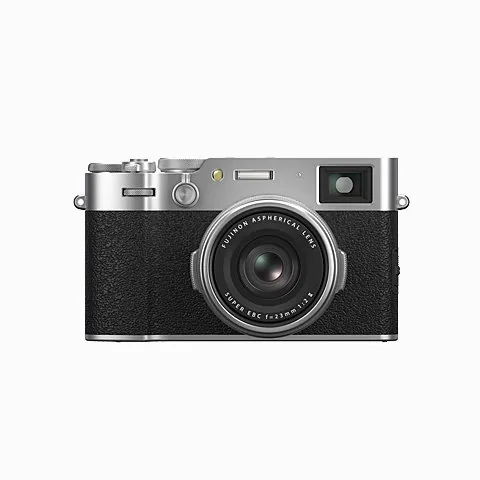
Specifications
| Specification | Value |
|---|---|
| Sensor | 23.5 × 15.7 mm APS-C X-Trans CMOS 5 HR; 40.2 MP; X-Processor 5 |
| Lens | Fixed 23 mm f/2 (35 mm equivalent); 8 elements in 6 groups, 2 aspherical; f/2–16; focusing down to about 10 cm |
| ND filter | Built-in 4-stop ND filter |
| Image stabilisation | In-body 5-axis; up to 6.0 stops |
| ISO | 125–12,800; extended 64–51,200 |
| Shutter and burst | Mechanical up to 1/4000 s, electronic up to 1/180,000 s; about 20 fps with electronic shutter (1.29× crop), 6 fps with mechanical shutter |
| Autofocus | Intelligent Hybrid AF; subject detection for animals, birds, cars, motorcycles, airplanes and trains |
| Viewfinder | Hybrid viewfinder: optical 0.52×, about 95% coverage; electronic 0.5-inch OLED, 3.69 million dots, 0.66× |
| Screen | 3.0-inch tilting touch LCD; 1.62 million dots |
| Video | 6.2K up to 29.97p; 4K/DCI 4K up to 59.94p; Full HD 240p high speed; 10-bit 4:2:2 H.265 |
| Film simulation | 20 film simulation modes |
| Card and connectivity | Single SD card slot (UHS-I); USB-C 10 Gb/s; micro HDMI; Wi-Fi 802.11ac; Bluetooth 4.2 LE |
| Battery | NP-W126S; about 310 frames (EVF) or 450 frames (OVF) in normal mode per CIPA |
| Size and weight | 128.0 × 74.8 × 55.3 mm; about 521 g with battery and card |
| Operating temperature | 0–40 °C |
From the manufacturer
Fujifilm presents the X100VI as the first model in the series with in-body stabilisation and a 40.2 MP sensor. Fujifilm X
Strengths and limitations
In Cameralabs’ testing the in-body stabilisation was effective by about 5 to 6 stops; 1/2 s was easily sharp handheld, and 1 to 2 s with care. With mostly the electronic viewfinder and stabilisation on, the battery gave a low warning after about 150 photos and a few minutes of video. Autofocus was found similar to the X100V. The 40 MP sensor gave crisper results at base ISO; from ISO 3200 the image matched the X100V. 4K 25p recording ran for 1 hour 19 minutes until the battery ran out; in 4K HQ mode it stopped after about 32 minutes due to heat. Weather sealing needs a separate adapter ring and filter. Cons included no front-facing screen, a UHS-I-only card slot, a 2.5 mm microphone jack and an exposure compensation dial that turns by accident.
Cameralabs — Gordon Laing: Fujifilm X100VI review
Tags
Compare
- Canon EOS R8 Mark II / Fujifilm X100VI
- Canon EOS R6 V / Fujifilm X100VI
- Panasonic LUMIX DC-L10 / Fujifilm X100VI
- Sony α7R VI / Fujifilm X100VI
- Fujifilm X-T30 III / Fujifilm X100VI
- Canon EOS R50 V / Fujifilm X100VI
- Canon EOS R6 Mark III / Fujifilm X100VI
- DJI Osmo Action 6 / Fujifilm X100VI
- Fujifilm GFX100RF / Fujifilm X100VI
- FUJIFILM X-E5 / Fujifilm X100VI
- Nikon Z5II / Fujifilm X100VI
- OM SYSTEM OM-3 / Fujifilm X100VI
- Panasonic LUMIX S1II / Fujifilm X100VI
- Sony α7 V / Fujifilm X100VI
- Nikon Z6III / Fujifilm X100VI
- Fujifilm X100VI / Fujifilm X-M5
- Fujifilm X100VI / FUJIFILM X-T50
- Fujifilm X100VI / Sony ZV-E10 II
- Fujifilm X100VI / Sony α1 II (ILCE-1M2)
- Fujifilm X100VI / Fujifilm X-S20
- Fujifilm X100VI / Canon EOS R50 with RF-S18-45mm IS STM kit
- Fujifilm X100VI / Canon EOS R8 Body 5803C003
- Fujifilm X100VI / Sony ZV-E1
- Fujifilm X100VI / Sony α6700 (ILCE-6700)
- Fujifilm X100VI / Sony α7C II (ILCE-7CM2)
- Fujifilm X100VI / Sony α9 III (ILCE-9M3)
- Fujifilm X100VI / Fujifilm X-T5
- Fujifilm X100VI / Fujifilm X-H2
- Fujifilm X100VI / Canon EOS R7 (Body)
- Fujifilm X100VI / Canon EOS R10 (body)
- Fujifilm X100VI / Fujifilm X-H2S
- Fujifilm X100VI / Sony α7R V (ILCE-7RM5)
- Fujifilm X100VI / Sony α7 IV (ILCE-7M4)