vivo X500
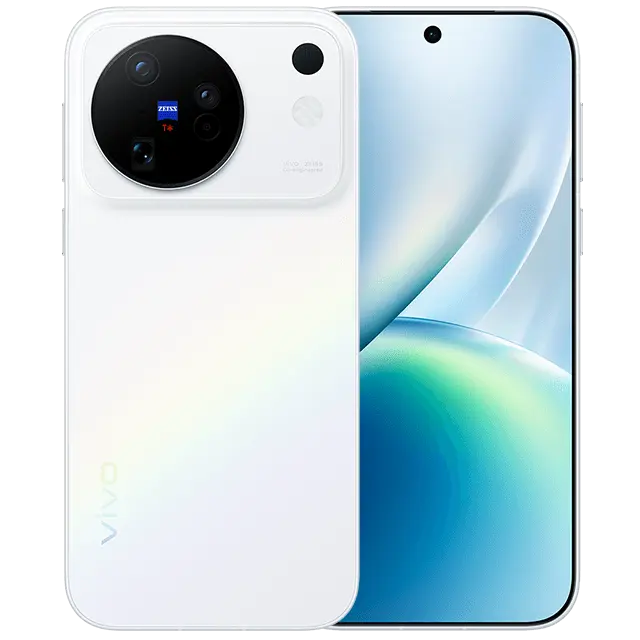
An Android phone with a flat 6.59-inch AMOLED display and a 7500 mAh battery. The rear has 50 MP main, 64 MP telephoto and 50 MP ultra-wide cameras. This record is the V2609A sold in China; the X500 Pro and X500 Pro Max are separate models.
V2609A; 12 GB / 256 GB; Sunny (晴天), white
Specifications
| Specification | Value |
|---|---|
| Model code | V2609A |
| Release | September 2026, China |
| Processor | MediaTek Dimensity 9600M; 8 cores; 3 nm; 1 × 4.21 GHz + 3 × 3.5 GHz + 4 × 2.7 GHz |
| GPU | Arm G1-Ultra |
| Memory | 12 GB LPDDR5X Ultra, quad-channel; 16 GB option |
| Storage | 256 GB UFS 4.1; 512 GB and 1 TB options |
| Display | 6.59-inch AMOLED; 2750 × 1260; 459 PPI; 30/60/90/120/144 Hz |
| Brightness | 4000 nits peak (20% APL); 2000 nits full-screen peak; 1 nit minimum |
| Colour and HDR | 100% P3; 1.07 billion colours; HDR support; TÜV Rheinland flicker-free certification |
| Body materials | Cold-carved glass back with an integrated "floating island" camera section; aerospace aluminium frame |
| Main camera | 50 MP Sony LYT-828; 1/1.28-inch; f/1.68; OIS; 23 mm equivalent |
| Telephoto | 64 MP Sony LYT-610; 1/2-inch; f/2.55; OIS; 72 mm equivalent; 3.1× optical; 15 cm macro |
| Ultra-wide | 50 MP; 1/2.76-inch; f/2.0; 15 mm equivalent; autofocus |
| Front camera | 50 MP; 1/2.76-inch; f/2.0; 92° field of view; autofocus |
| Video | Up to 8K recording; 4K slow motion |
| Battery | Lithium-ion; single cell; 7500 mAh typical (28.20 Wh); 7270 mAh rated (27.34 Wh) |
| Charging | 90 W wired; up to 40 W wireless with the vivo 50 W Stand Wireless Charger 2 |
| Reverse charging | OTG reverse charging supported |
| Wi-Fi | Wi-Fi 6 and Wi-Fi 7; 2 × 2 MIMO; MU-MIMO; simultaneous 2.4 + 5 GHz |
| Bluetooth | Bluetooth 6.0 (hardware) |
| Bluetooth audio | SBC, AAC, aptX, aptX HD, LDAC, LHDC 5.0 |
| USB | USB Type-C; USB 3.2; DisplayPort video output |
| Positioning | GPS L1+L5; BeiDou B1C+B1I+B2a+B2b; GLONASS G1; Galileo E1+E5a+E5b; QZSS L1+L5; NavIC L1+L5 |
| NFC | Card reader mode; card emulation (HCE, NFC-SIM, eSE payments) |
| SIM and network | Dual nano SIM; 5G dual-SIM dual-standby |
| Network bands | 2G GSM: 850/900/1800/1900 MHz; 3G WCDMA: B1/B2/B4/B5/B6/B8/B19; 4G TD-LTE: B34/B38/B39/B40/B41/B42/B43/B48; 4G FDD-LTE: B1/B2/B3/B4/B5/B7/B8/B18/B19/B20/B25/B26/B28A/B66; 5G: n1/n2/n3/n5/n7/n8/n18/n20/n25/n26/n28A/n34/n38/n39/n40/n41/n48/n66/n77/n78/n79 |
| Audio | Symmetric dual speakers (1511) |
| Biometrics | 3D ultrasonic single-point fingerprint; face recognition |
| Cooling | Ice-vein fluid VC (vapour chamber) cooling |
| Durability | IP68 + IP69 dust and water protection |
| Sensors | Dual ambient light; front/rear colour temperature; ultra-sensitive flicker sensor; camera laser focus; Hall; infrared remote control; X-axis linear motor |
| Size and weight | 157.01 × 74.49 × 8.15 mm; 211 g (Sunny, Dawn, Earth Echo); 213 g (Night Shot) |
| Colours | 晴天 (Sunny), 晨曦 (Dawn), 大地回声 (Earth Echo), 摄夜 (Night Shot) |
| Software | OriginOS 7 based on Android 17 |
From the manufacturer
vivo stresses its ZEISS-partnered camera and CIPA 5.5-class stabilisation. The 4000-nit peak brightness and 100× digital zoom are also manufacturer claims; the 100× zoom is digital, not optical. vivo
Strengths and limitations
GSMArena says the standard X500 may be the most sensible of the three, carrying most of the Pro models' high-end features. It does not judge battery life or camera quality yet.
GSMArena: vivo X500, X500 Pro and X500 Pro Max hands-on review
Tags
Compare
- OPPO Find X10 Pro Max / vivo X500
- Apple iPhone 18 Pro / vivo X500
- Samsung Galaxy S26 FE / vivo X500
- Google Pixel 11 Pro / vivo X500
- Apple iPhone 17e / vivo X500
- Samsung Galaxy S26 / vivo X500
- Google Pixel 11 / vivo X500
- Motorola razr 70 ultra / vivo X500
- Samsung Galaxy S26 Ultra / vivo X500
- Samsung Galaxy Z Flip8 / vivo X500
- Samsung Galaxy Z Fold8 / vivo X500
- Sony Xperia 1 VIII / vivo X500
- vivo X500 / Xiaomi 17T
- vivo X500 / Google Pixel 10 Pro
- vivo X500 / Samsung Galaxy Z Flip7
- vivo X500 / Samsung Galaxy Z Fold7
- vivo X500 / Samsung Galaxy S25 Edge
- vivo X500 / Samsung Galaxy S25 Ultra
- vivo X500 / Apple iPhone 17
- vivo X500 / Apple iPhone 17 Pro Max
- vivo X500 / Apple iPhone Air
- vivo X500 / Google Pixel 10
- vivo X500 / Apple iPhone 16 Pro
- vivo X500 / Samsung Galaxy A54 5G